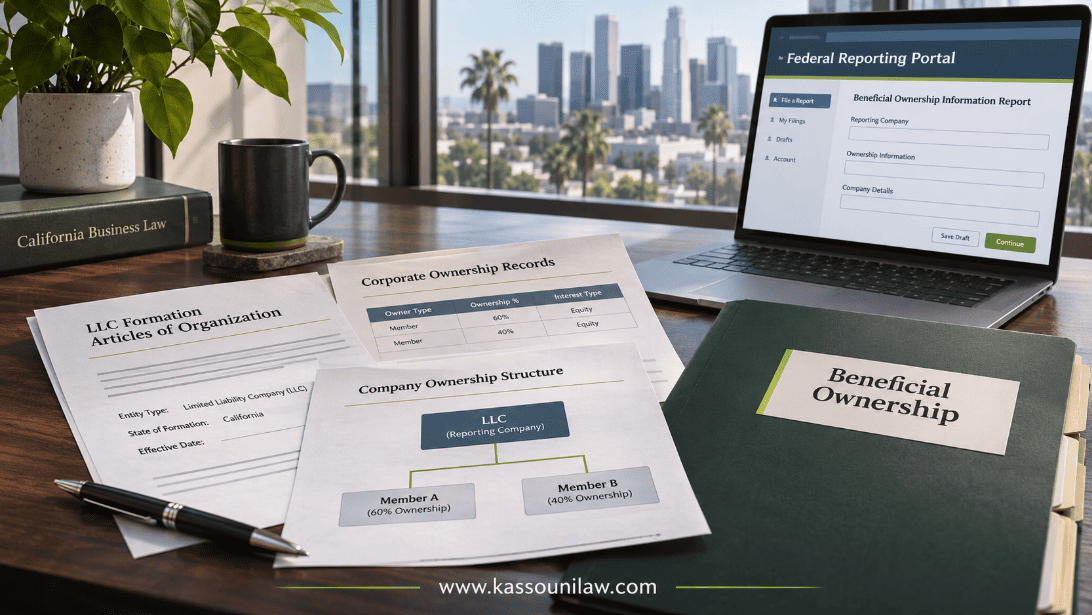
 Most California businesses no longer have to file beneficial ownership information (BOI) reports with the Financial Crimes Enforcement Network (FinCEN). Under a final rule announced on August 11, 2026 and effective August 14, 2026, entities created under U.S. law are exempt from federal BOI reporting. That includes California LLCs and corporations.
Some foreign entities may still have to report. An entity formed under the law of a foreign country that has registered to do business in a U.S. state or tribal jurisdiction can still be a reporting company, subject to exemptions. It reports only non-U.S. individuals.
The federal rules changed significantly in 2025 and 2026, so older guidance on BOI reporting requirements and filing deadlines is often wrong. Federal BOI reporting is also separate from California filings, such as Statements of Information, which continue to apply. This article reflects the BOI reporting requirements for 2026 as they stand in November.
Does California Still Require Businesses to File BOI Reports With FinCEN?
Is BOI still required? For most businesses, no. The BOI requirement comes from federal law, not from a California statute. Under the current FinCEN BOI reporting requirements, entities created under U.S. law are exempt, so they do not file an initial BOI report, and filing one is unnecessary.
Several common situations raise questions. For background on how these entity types differ and where each is formed, see the firm’s guide to LLCs and corporations in California.
- California LLCs. California LLC BOI reporting is not required. A California LLC is created under U.S. law, so it is exempt.
- California corporations. Exempt for the same reason.
- Other state-filed entities. Limited partnerships and similar entities created by a state filing are also U.S.-created and exempt. Disputes among partners are a different issue, discussed in the firm’s article on breach of partnership agreements.
- U.S.-created companies with foreign owners. Foreign ownership alone does not make a domestic entity a reporting company.
- U.S. businesses with international customers or operations. Overseas sales, suppliers, or offices do not create a federal BOI reporting obligation by themselves.
An entity formed in another U.S. state and registered to do business in California is also created under U.S. law. It is not a foreign entity for these purposes.
FinCEN’s own BOI reporting page now states that U.S. companies are exempt and no longer file BOI reports.
Why Did FinCEN Change the BOI Reporting Rules?
Congress passed the Corporate Transparency Act (CTA) in 2021, and it is codified at 31 U.S.C. section 5336. Its purpose is to help law enforcement identify the real people behind companies, especially shell companies used to hide ownership. The Treasury Department’s FinCEN administers it. FinCEN’s original reporting rule took effect January 1, 2024, and required many small domestic companies, as well as foreign companies registered in the United States, to report their beneficial owners.
Three federal developments produced the current framework:
- March 26, 2025. FinCEN issued an interim final rule, which took effect on publication. It limited the term “reporting company” to foreign entities registered to do business in a U.S. state or tribal jurisdiction and exempted domestic entities and U.S. persons.
- August 2026. FinCEN adopted the narrowing as a permanent rule in a final rule published in the Federal Register, effective August 14, 2026. The final rule also exempts reporting companies from reporting U.S. person company applicants and removes the update and correction duty for U.S. persons with FinCEN identifiers.
- Today. Domestic entities and U.S. persons are exempt. Certain foreign reporting companies still report information about foreign individuals.
FinCEN concluded that requiring domestic entities to report was not in the public interest and placed burdens on small businesses that the reports’ usefulness did not justify. The rule does not repeal the CTA. It narrows who must report under it, which is why Corporate Transparency Act questions in California now turn mostly on where an entity was formed.
Which Foreign Entities Still Need to Report Beneficial Ownership Information?
The remaining category is narrow. An entity may be a reporting company if it meets both of these conditions:
- It was formed under the law of a foreign country.
- It registered to do business in a U.S. state or tribal jurisdiction by filing a document with a secretary of state or similar office.
Even then, one of the FinCEN reporting exemptions may apply. The rule lists exemptions for categories such as securities reporting issuers, banks, large operating companies, and inactive entities. Each exemption has detailed conditions, so the statute and the rule control.
A short comparison shows why the place of formation matters more than the owners’ nationality:
- Example 1. A California LLC is owned entirely by residents of another country. It was created under U.S. law, so it is exempt from federal BOI reporting.
- Example 2. A company formed in a foreign country registers with the California Secretary of State to do business here. It was formed under foreign law and registered in a U.S. state, so it may be a foreign reporting company unless an exemption applies.
Not every foreign company that operates internationally must file. The company must first meet the registration and reporting company definitions.
A foreign reporting company reports its non-U.S. beneficial owners and, where company applicant reporting applies, its non-U.S. company applicants. It does not report U.S. person beneficial owners or U.S. person company applicants. According to the final rule, a foreign reporting company whose beneficial owners are all U.S. persons still files a report, but that report does not have to include beneficial owner information.
Timing is specific. A foreign entity registered after March 26, 2025 files within 30 days of actual notice that its registration is effective, or of the first public notice of it, whichever is earlier. Later updates and corrections are due within 30 days of a change.
What Information Must a Foreign Reporting Company Submit to FinCEN?
Beneficial ownership information reporting by a foreign reporting company has two parts: information about the company and information about reportable individuals.
The company. The report lists the company’s legal name, any trade or “doing business as” names, its current address, the foreign jurisdiction where it was formed, the state or tribal jurisdiction where it first registered, and a taxpayer identification number. A company without a U.S. taxpayer number can give a foreign tax identification number and the issuing jurisdiction.
Foreign beneficial owners. The report lists each individual’s name, date of birth, address, and an identifying number from an acceptable document, such as a passport, with an image of that document.
A beneficial owner is an individual who either owns or controls at least 25 percent of the company’s ownership interests or exercises substantial control over the company. Substantial control can include senior officers, people with authority to appoint or remove senior officers or most of the board, and people who direct or heavily influence important decisions.
Company applicant information applies only to foreign companies first registered to do business in the United States on or after January 1, 2024. Whether someone has substantial control often turns on the person’s actual role, not only a job title, so the company’s structure matters.
Requirements from earlier guidance no longer apply. Under the current rule, a foreign reporting company does not list U.S. persons among its beneficial owners or company applicants.
What Happened to BOI Reports Filed Before the Rule Changes?
FinCEN’s BOI frequently asked questions and final rule answer most of the practical questions.
- U.S.-created entities. They do not have to update or correct earlier reports. They are no longer reporting companies, so no ongoing duty applies.
- U.S. persons with FinCEN identifiers. They no longer have to update or correct the information they submitted to obtain the identifier. Foreign FinCEN identifier holders keep that duty.
- Information U.S. persons already submitted. FinCEN has announced that it will delete previously reported information about U.S. persons. It plans to do so in a single sweep of the database, using the identifying documents it reasonably believes a U.S. person provided. FinCEN says it will post a public notice on its website when the process is finished, and it does not plan to confirm deletion to individual filers.
- Foreign reporting companies. They still have filing responsibilities, including updating or correcting a report within 30 days of a change.
The deletion should not be treated as finished until FinCEN says so. FinCEN also does not anticipate deleting U.S. person information included in filings made after February 10, 2027, which is another reason to avoid unnecessary reports.
Does California Have Separate Beneficial Ownership Reporting Requirements?
California has its own business filing rules, but they are separate from federal BOI reporting. The federal exemption does not change them.
- Formation filings. Domestic LLCs and corporations are created by filing articles of organization or articles of incorporation with the Secretary of State.
Statements of Information. Entities file a Statement of Information annually or biennially, and the Secretary of State says failure to file may result in penalties assessed by the Franchise Tax Board and in suspension or forfeiture.
- Foreign entity registration. The Secretary of State handles registration of out-of-state and out-of-country corporations and LLCs.
- Licenses and permits. State, county, and city licensing rules vary by business type and location.
- Tax reporting. State and federal tax obligations continue independently of BOI reporting.
Contracts, operating agreements, and similar documents are also separate. The firm’s article on key terms in California business contracts explains why those documents matter.
California does not have a general state-level BOI system equivalent to the CTA based on the official sources reviewed for this article. Proposals for one have been introduced in the Legislature, so owners should check current California requirements rather than assume nothing has changed.
One more caution applies. Banks and other financial institutions follow a separate FinCEN customer due diligence rule. FinCEN has said it did not revise that rule and plans to address it separately, so a bank may still ask who owns a business when it opens an account.
What Should California Business Owners Do Now?
This checklist helps determine where a business stands. It does not assume that every business has a federal filing.
- Identify where the business entity was legally formed. The formation documents show the state or country.
- Determine whether it is a U.S.-created entity or a foreign-country entity.
- If it was formed in a foreign country, check whether it registered to do business in a U.S. state or tribal jurisdiction, and when.
- Review the current FinCEN reporting company definition and exemptions instead of guidance from 2024 or early 2025.
- Determine whether any federal BOI reporting obligation remains, including the 30-day timing for initial and updated reports.
- Keep up with separate California registration, filing, and tax obligations.
- Consult an attorney if the entity’s status or reporting obligations are unclear.
Most domestic California businesses do not need to submit a BOI report under the current federal rule.
When Should a Business Owner Seek Legal Advice?
Many owners can answer the basic question from their formation documents. Legal guidance is more useful in situations like these:
- A foreign-formed entity is registering to do business in California
- It is unclear whether an entity meets the reporting company definition or an exemption
- The owners need to decide who has substantial control or meets the 25 percent ownership threshold
- There are questions about previous BOI filings or FinCEN identifiers
- The business has concerns about California registration or disclosure requirements
A review of the formation documents, registrations, and ownership structure is often enough to settle which rules apply.
The Bottom Line on California BOI Reporting
Most U.S.-created businesses, including California LLCs and corporations, are exempt from federal BOI reporting under the current rule, while certain foreign entities registered to do business in the United States may still have obligations. Before deciding whether a filing is necessary, a business owner should identify where the entity was formed and review both the federal and California requirements.
Kassouni Law represents private parties in business law matters, and owners with questions about their entity, its registrations, or its obligations can call (877) 770-7379 or schedule a consultation to discuss their situation. Submitting a contact form does not create an attorney-client relationship.
Frequently Asked Questions
Do California LLCs still need to file BOI reports in 2026?
No. Under FinCEN’s final rule, effective August 14, 2026, entities created under U.S. law, including California LLCs, are exempt from federal BOI reporting.
Are California corporations exempt from FinCEN reporting?
Yes. A California corporation is created under U.S. law, so it is exempt from BOI reporting under the current rule. California Secretary of State filings still apply.
Does a U.S. company owned by foreign nationals need to report BOI?
No. The test turns on where the entity was formed, not who owns it. A company created under U.S. law is exempt even with foreign owners.
Do foreign companies registered in California still have BOI reporting obligations?
They may. An entity formed under foreign-country law that registered to do business in a U.S. state may be a reporting company unless an exemption applies. It reports its non-U.S. beneficial owners, not U.S. persons.
Do California businesses need to update BOI reports filed before the 2026 rule?
No. U.S.-created entities and U.S. persons with FinCEN identifiers do not have to update or correct earlier information. Foreign reporting companies must still update or correct reports within 30 days of a change.
The information provided here is for general informational purposes only and is not legal advice. Federal and California requirements change, and how they apply depends on the specific entity. Consult a qualified attorney about your circumstances.