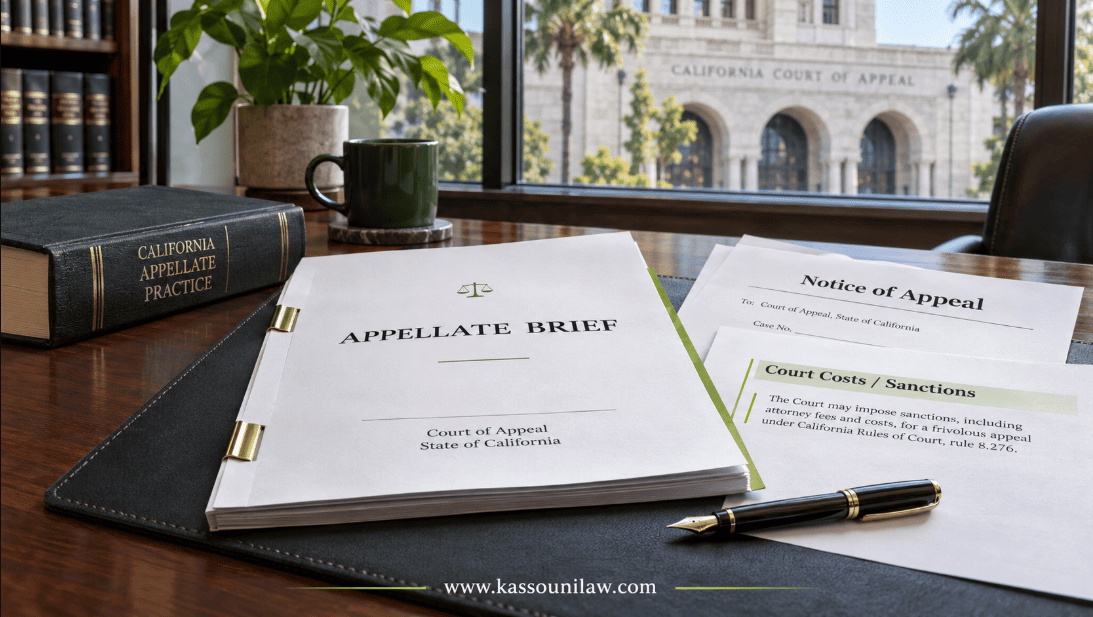
California appellate courts can impose sanctions when an appeal is frivolous or filed solely to cause delay. Their authority comes from Code of Civil Procedure section 907 and California Rules of Court, rule 8.276. However, courts do not treat every weak or unsuccessful appeal as frivolous. Sanctions apply only when an appeal meets the legal standard for frivolousness or improper delay.
Losing an appeal does not automatically make it frivolous. Courts reserve sanctions for cases that meet specific legal criteria. They also apply these standards cautiously to avoid discouraging parties from pursuing legitimate appeals.
California state appellate court rules differ from federal appellate rules, including those followed by the Ninth Circuit. For a basic explanation of the parties involved in an appeal, see the firm’s article on appellant versus appellee.
What Is a Frivolous Appeal in California?
A frivolous appeal is one that has no reasonable legal or factual basis, or one pursued for harassment or delay. Examples include arguments that the law or the appellate record clearly does not support. The test is demanding, and a weak appeal does not meet it.
Consider two hypothetical appeals. In the first, a business owner argues that the trial court misapplied a contract interpretation rule. The argument is reasonable, but the Court of Appeal disagrees and affirms. That appeal lost, but it was not frivolous.
In the second, a party appeals a judgment by arguing a statute that was repealed, ignoring controlling Supreme Court authority, and citing no support in the record. Any reasonable attorney would see that the appeal has no arguable basis. That appeal faces a real risk of sanctions.
When Can a California Court Impose Sanctions for a Frivolous Appeal?
California frivolous appeal sanctions rest on two sources. Section 907 provides that when it appears to the reviewing court that “the appeal was frivolous or taken solely for delay,” the court may add to the costs on appeal such damages as may be just. Rule 8.276 adds that the Court of Appeal may impose sanctions on a party or attorney for taking a frivolous appeal or appealing solely to cause delay.
The leading case is In re Marriage of Flaherty (1982) 31 Cal.3d 637, 650. The Supreme Court said an appeal should be held frivolous only in two situations. One is when it is prosecuted for an improper motive, such as to harass the respondent or delay the effect of an adverse judgment. The other is when any reasonable attorney would agree it is totally and completely without merit.
Flaherty states these two standards as alternatives joined by “or.” Courts treat them as separate routes, though they are often used together because a complete lack of merit can be evidence of improper motive. A finding does not require proof of both.
Appeals Pursued for an Improper Purpose
The subjective standard looks at motive. An appeal pursued primarily to harass the other side or to delay enforcement of a judgment can raise sanctions concerns. An example would be an appeal with no realistic chance of success filed only to postpone a payment or a sale.
A court cannot infer improper motive merely because an appeal takes time or causes inconvenience. An appeal can do both without being improper. The question is whether the appeal was pursued for that purpose, which is why courts look at the appeal’s merits and the surrounding circumstances.
Appeals That Are Indisputably Without Merit
The objective standard looks at the appeal itself, not the appellant’s state of mind. It asks whether any reasonable attorney would agree the appeal is totally and completely without merit. An argument that is unlikely to succeed is not enough. The argument must be one that no reasonable attorney would consider arguable.
The appeal in Singh v. Lipworth (2014) 227 Cal.App.4th 813 shows how a court applies the standard. The appellants’ briefs lacked citations to the record, and the court found the appeal frivolous. One weak argument does not make an entire appeal frivolous, but an appeal that ignores controlling authority or the record throughout can cross the line.
Is Losing an Appeal Enough to Trigger Sanctions?
No. Flaherty states that an appeal that is simply without merit is not by definition frivolous and should not incur sanctions. The Supreme Court added that sanctions should be used most sparingly, to deter only the most egregious conduct.
In Flaherty itself, the Court of Appeal had fined the appellant’s attorney $500. The Supreme Court held the appeal was not frivolous and nullified the penalty.
Courts distinguish an unsuccessful appeal from a frivolous one in several ways:
- A reasonable argument that ultimately fails is not frivolous.
- A good-faith argument seeking clarification or development of the law is not frivolous.
- A disagreement about how the trial court applied the law is a normal basis for appeal.
This approach protects legitimate appellate review. Sanctions require more than an adverse result.
What Sanctions Can an Appellant Face in California?
California appellate court sanctions depend on the court’s authority and the circumstances. Code of Civil Procedure 907 permits additional damages that are just. Attorney fees for a frivolous appeal can form part of a sanctions award when the court finds them reasonable and supported. Rule 8.276 permits sanctions against a party or attorney, including awarding or denying costs under rule 8.278.
Published decisions show two components. One is compensation to the respondent for fees and costs incurred defending the appeal. The other is a payment to the court reflecting the public cost of processing the appeal.
In In re Marriage of Gong & Kwong (2008) 163 Cal.App.4th 510, the court dismissed an appeal as a frivolous bad faith appeal. It imposed $15,000 payable to the respondent and $6,000 payable to the clerk, with the attorneys jointly and severally liable. In Singh, the court awarded $7,478.75 to the respondent and $7,500 to the clerk. Those outcomes reflect their facts, and they are not standard amounts.
Sanctions also differ from ordinary appellate costs. Under rule 8.278, the prevailing party generally recovers listed costs, such as filing fees and record preparation, and attorney fees are not part of those costs unless the court orders otherwise. A party may seek fees separately under rule 3.1702 where a contract or statute allows them. A failed appeal therefore does not automatically mean the appellant pays the respondent’s attorney fees.
Who Can Request Sanctions for a Frivolous Appeal?
A respondent may file a motion for sanctions, and the court may also consider sanctions on its own motion. Rule 8.276 covers both routes.
A party’s motion must include a declaration supporting the amount of any monetary sanction sought. The rule requires the motion to be served and filed before any order dismissing the appeal and no later than 10 days after the appellant’s reply brief is due.
Filings must also comply with the service and filing rules in rule 8.25, including proof of service. A request should identify the specific conduct and the legal basis for sanctions. Courts do not award sanctions automatically because someone asks, and the respondent must still show that the standard is met.
Limited civil appeals decided by the appellate division follow a parallel provision in rule 8.891.
What Happens When a Respondent Requests Appellate Sanctions?
If the court is considering sanctions, rule 8.276 requires written notice. The party or attorney may then serve and file an opposition within 10 days after the court sends the notice. Failing to oppose is not treated as consent. Unless the court orders otherwise, oral argument on sanctions is combined with argument on the merits.
Flaherty also emphasizes fair warning and a chance to respond before penalties are imposed. The court then examines the appeal’s legal and factual basis, including whether the arguments are supported by authority and by citations to the appellate record.
The procedure can depend on how the request is raised and which rule applies, so each notice and order should be read closely.
How Can Appellants Reduce the Risk of Frivolous Appeal Sanctions?
Before appealing a court decision in California, an appellant should weigh the strength of the legal issues, the cost, and whether the record supports each argument. These practical steps help:
- Identify a genuine legal or procedural error that an appellate court can review. The firm’s guide to filing an appeal in California covers the basics, and the article on motions for reconsideration versus appeals helps with choosing the right procedure.
- Research controlling California law before developing arguments.
- Review the trial court record and confirm that each argument has evidentiary support. The firm’s article on the California appellate record explains what the record contains.
- Follow appellate filing, briefing, and procedural requirements.
- Avoid unsupported factual allegations.
- Do not use an appeal merely to delay enforcement of a judgment.
- Get advice from an appellate attorney when the legal basis for an appeal is uncertain.
These steps can help an appellant assess and present a legitimate appeal. They cannot guarantee that sanctions will never be requested or imposed.
What Should You Do If Someone Requests Sanctions Against Your Appeal?
Start by reading the specific allegations. Identify the legal and factual basis for each argument, and check every citation and record reference. Address the Flaherty standards directly, explaining why the appeal has an arguable basis and was brought in good faith.
Follow the court’s instructions and deadlines. The 10-day opposition period under rule 8.276 applies when the court sends notice that it is considering sanctions, and other situations may involve different timing, so the notice or order controls. Seek legal advice before submitting a response, because the response can affect the outcome.
When Should You Speak With a California Appellate Attorney?
California appellate law is technical, and appellate counsel can be useful in several situations:
- Before filing, when the legal basis for an appeal is uncertain
- When a respondent alleges that an appeal is frivolous
- When a sanctions request has been filed
- When an appellant faces potential financial consequences
- When an appeal involves complicated procedural or legal questions
- When a party needs an independent assessment of the record and available arguments
An attorney can evaluate the record and the law. No attorney can promise that sanctions will be avoided or that an appeal will succeed.
A Failed Appeal Is Not Automatically a Frivolous One
California courts can impose sanctions for frivolous appeals or appeals pursued solely for delay. An appeal does not become frivolous simply because it fails.
Kassouni Law handles appellate matters for private parties. Individuals involved in an appeal or facing allegations of frivolous appellate conduct can contact the firm to discuss their circumstances and potential legal options.
Call Kassouni Law at (877) 770-7379 or schedule a consultation to discuss your situation. Submitting a contact form does not create an attorney-client relationship.
Frequently Asked Questions
Can you be sanctioned for losing an appeal in California?
Not for losing alone. An unsuccessful appeal is not automatically frivolous. Sanctions require that the appeal be frivolous or taken solely for delay under the legal standards.
What makes an appeal frivolous under California law?
Under Flaherty, an appeal is frivolous when it is prosecuted for an improper motive, such as harassment or delay, or when any reasonable attorney would agree it is totally and completely without merit.
Can a California appellate court impose sanctions without a request?
Yes. Rule 8.276 allows the Court of Appeal to consider sanctions on its own motion, but it must first give written notice and an opportunity to oppose.
What financial sanctions can result from a frivolous appeal?
Depending on the case, a court may order payment to the respondent for fees and costs, a payment to the court, or additional damages under section 907. Attorneys can also be liable. Amounts vary with the facts.
Can an appellant challenge a request for frivolous appeal sanctions?
Yes. An appellant can file an opposition explaining the legal and factual basis for the appeal, following the notice and deadlines the court sets.
The information provided here is for general informational purposes only and is not legal advice. Appellate sanctions depend on the specific appeal, the record, and the rules in effect. Consult a qualified attorney about your circumstances.