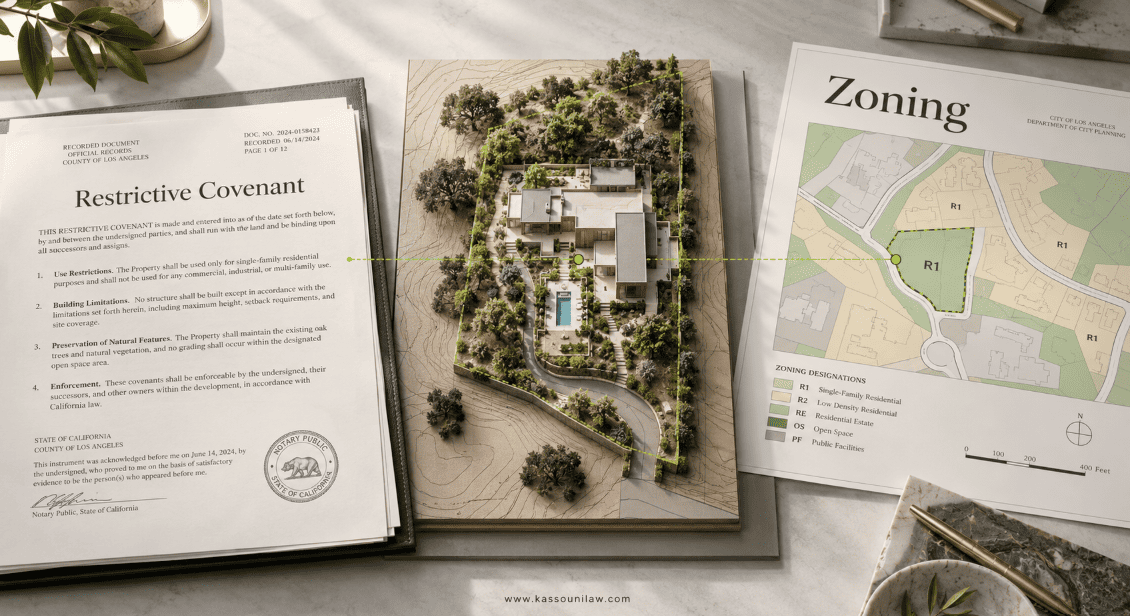
 One California parcel can answer to two separate sets of rules. Local zoning, adopted by a city or county, regulates how land may be used and built. A recorded restrictive covenant, created by private parties, can limit the same land in different ways.
That creates a common question in restrictive covenants vs zoning California disputes: which one controls? In most cases, both apply. Neither automatically cancels the other.
A project can comply with local zoning and still violate a recorded covenant. A covenant can also permit a use that local zoning does not allow. The outcome depends on the covenant’s language, its enforceability, the zoning code, and the facts.
Identifying both kinds of restrictions before buying, building, or changing a property’s use can prevent costly surprises.
What Is a Restrictive Covenant in California Real Estate?
A restrictive covenant is a private limit on how land may be used. It usually appears in a recorded deed, a declaration of covenants, conditions, and restrictions (CC&Rs), or another recorded instrument. Typical examples limit a lot to residential use, cap building height, require design approval, or bar certain businesses.
Some covenants run with the land, which means they bind later owners. Under Civil Code section 1468, a covenant binds successive owners only if it meets statutory requirements, including recording. The instrument can also provide otherwise, so the exact wording matters.
In a common interest development, Civil Code section 5975 makes the covenants and restrictions in a declaration enforceable equitable servitudes, unless unreasonable. The California Supreme Court applied that standard under the predecessor statute in Nahrstedt v. Lakeside Village Condominium Assn. (1994) 8 Cal.4th 361. In Citizens for Covenant Compliance v. Anderson (1995) 12 Cal.4th 345, the Court held that restrictions in a properly recorded declaration can bind later buyers even when their deeds do not repeat them.
Not every covenant is enforceable. A restriction may be unreasonable, contrary to public policy, or limited by statute. For example, Civil Code section 4751 declares void certain covenants that effectively prohibit or unreasonably restrict accessory dwelling units. Each CC&R provision must be evaluated on its own terms.
What Is Zoning in California?
Zoning is public land-use regulation. Its authority comes from government power, not from a private agreement. The California Constitution lets a city or county adopt local ordinances that do not conflict with general laws, as Article XI, section 7 provides.
Under Government Code section 65850, local zoning ordinances can regulate matters such as:
- Permitted uses, including residential, commercial, and industrial uses
- Density and the number of units allowed
- Building height and bulk
- Setbacks from property lines
- Lot coverage and open space
- Other development characteristics, such as parking and landscaping
Zoning rules vary substantially between cities and counties. A use allowed in one jurisdiction may require a permit in another. Property owners should consult the local zoning code and the zoning law provisions that apply to their parcel.
How Are Restrictive Covenants Different From Zoning?
The two differ in source, enforcement, and how they change. The table below summarizes the main distinctions.
| Factor | Restrictive Covenant | Zoning |
|---|---|---|
| Source | Private agreement or recorded restriction | Government regulation |
| Enforced by | Private parties or other authorized parties | Public agency |
| Scope | Depends on the recorded covenant | Depends on the applicable zoning code |
| Typical purpose | Restrict private property use | Regulate land use and development |
| Changes | May require a private legal process or statutory remedy | May require a zoning amendment, variance, use permit, or other public process |
| Disputes | Often involve property owners or private parties | Often involve property owners and local government |
The effect of a restrictive covenant or zoning rule depends on the specific documents, applicable law, and circumstances of the property.
Does Zoning Override a Restrictive Covenant?
Not automatically. Zoning and restrictive covenants generally operate independently because they come from different sources of authority. A city can regulate land use through its police power. It does not, by that power alone, rewrite private rights that owners created by recorded agreement.
Courts have recognized this separation. In Seaton v. Clifford (1972) 24 Cal.App.3d 46, neighbors enforced residential deed restrictions against a licensed care home. The defendant argued that state statutes treating such homes as residential for zoning purposes defeated the restrictions. The court held that those statutes did not impair the private restrictions. Later legislation addresses some care facilities directly, so the case illustrates the general principle, not current law on any particular use.
Two points follow from that principle:
- If zoning permits a use but a valid covenant prohibits it, zoning compliance does not necessarily eliminate the covenant.
- If zoning prohibits a use, a private covenant generally cannot authorize the owner to violate that zoning law.
Neither statement is a universal rule. The outcome depends on the covenant’s language, its enforceability, applicable statutes, local zoning rules, and the facts. The Legislature can also limit specific covenants by statute, as it has done for accessory dwelling units. That limit comes from a statute, not from zoning itself.
What Happens When Zoning Allows a Use but a Restrictive Covenant Prohibits It?
This is the most common problem. An owner confirms that a use is permitted under the zoning code, or even receives a city approval, and then learns that a recorded restriction bars the same plan.
Government approval does not necessarily resolve a private covenant dispute. A city permit generally confirms compliance with public rules. It does not decide whether private parties have enforceable rights, and permit review does not usually test a project against recorded covenants. The covenant issues can arise in several forms:
- Residential development: a covenant may limit a lot to single-family use even where zoning allows more units.
- Commercial uses: a deed restriction may bar a business that the zoning code permits.
- Building restrictions: a covenant may require design review or set a stricter height limit.
- Density: a recorded restriction may allow fewer units than zoning does.
- Redevelopment: a covenant may block demolition, subdivision, or a change of use.
- Alterations: a covenant may require approval for additions or exterior changes.
Where legally applicable, a party with enforcement rights under the covenant may seek relief in court. That party could be a neighboring owner within the same tract or an association. Who holds those rights depends on the recorded instrument and the property’s title history.
What Happens When a Restrictive Covenant Allows a Use but Zoning Prohibits It?
The reverse situation turns on a different principle. A private restriction generally cannot grant permission to use property in a way that violates applicable public zoning requirements. A deed that says a lot may host a business does not make the business lawful if the zoning code prohibits it.
The distinction is between private authorization and government authorization. A covenant reflects an agreement among private parties. Zoning permission can only come from the public agency that administers the code.
Depending on the circumstances, an owner may need a conditional or use permit, a variance, a zoning amendment, or another public approval. Under Government Code section 65901, a zoning administrator or board hears applications for conditional uses and variances when the local ordinance provides for them. A variance has limits. Under Government Code section 65906, it cannot authorize a use that the zone does not otherwise expressly authorize.
No approval is available in every case, because local criteria and the specific property affect the result.
Can a Restrictive Covenant Be More Restrictive Than Zoning?
Yes. Private restrictions can impose limits beyond the minimum requirements of zoning, assuming the restriction is otherwise valid and enforceable. A covenant can narrow zoning’s range for a particular property or subdivision. Practical examples include:
- Building height: zoning allows 35 feet, but a recorded restriction sets a lower limit.
- Property use: zoning allows home-based businesses, but the covenant restricts the lot to residential use only.
- Development intensity: zoning allows a second unit or a lot split, but the covenant allows one dwelling per lot.
- Architectural requirements: the covenant requires design committee approval, materials, or colors that zoning does not address.
- Commercial activity: the covenant bars certain businesses, signs, or operating hours that zoning permits.
- Lot use: the covenant limits fencing, parking, or outbuildings beyond local setbacks.
Enforceability still depends on the covenant and applicable law. A restriction can fail if it is unreasonable, contradicts public policy, or conflicts with a statute that overrides it.
How Do Restrictive Covenants Affect California Property Development?
Developers and investors face risk when they review only one side. Zoning research alone may not reveal private restrictions. Reviewing title documents alone does not show whether a proposed project complies with local zoning. A sound review covers both.
Private-side documents include:
- Preliminary title reports
- Recorded deeds
- CC&Rs and any amendments
- Recorded covenants and restrictions
- Easements
Public-side documents include:
- Zoning classifications
- General plan designations
- Development standards
- Existing permits and approvals
A conflict found early can change the design, the price, or the decision to proceed. Developers often involve counsel experienced in land use law at the due diligence stage, when options remain open.
What If a Restrictive Covenant Is Outdated or Unenforceable?
A recorded restriction does not remain enforceable in every circumstance. At a high level, owners sometimes raise questions about:
- Restrictions that have expired under their own terms
- Restrictions that are invalid, vague, or unreasonable
- Restrictions affected by later changes in the law
- Restrictions that may be subject to a statutory procedure
- Challenges based on the covenant’s language or surrounding circumstances
Discriminatory restrictions are one example. California provides a modification procedure for them under Government Code section 12956.2. For certain other outdated restrictions, newer legislation created a structured judicial process, which Kassouni Law explains in its article on how to remove restrictive covenants in California under AB 1050.
An owner should not assume a restriction is unenforceable simply because it is old or unused.
What Should Property Owners Check Before Buying or Developing Property?
Review both private and public restrictions before committing to a significant project. A practical review includes:
- Title report: identifies recorded covenants, easements, and other exceptions to title.
- Recorded documents: obtain the full text of each covenant, CC&R, and deed, not just the summary in the report.
- Zoning map and code: confirm the parcel’s zone and the uses and standards it allows.
- General plan: check the land-use designation, which can affect rezoning and approvals.
- Development standards: compare the proposed height, density, setbacks, and lot coverage.
- Existing permits: confirm what has been approved and whether the work matches the approvals.
- Local regulations: check overlays, design review rules, and other local requirements.
Evaluate the property-use plan against both sets of restrictions. No checklist catches every legal issue, and documents can be missing, ambiguous, or amended. Legal review of the actual documents is part of sound due diligence.
For broader questions about restrictions on how owners use their land, see Kassouni Law’s resources on California property rights.
What Legal Remedies May Be Available When Restrictions Conflict?
The available remedy depends on whether the dispute concerns a private restriction, a government regulation, or both. Depending on the circumstances, options may include:
- Negotiation: discussions with the parties who can enforce the covenant, sometimes leading to a written agreement.
- Modification or release: a recorded amendment or release of a private restriction, where the instrument and the parties allow it.
- Declaratory relief: a court action to determine rights and duties. Code of Civil Procedure section 1060 allows a person interested under a written instrument to seek a declaration, including on its validity or construction.
- Quiet title: an action to establish title or resolve adverse claims, where appropriate under Code of Civil Procedure section 760.010 and related provisions.
- Zoning administrative remedies: variances, conditional or use permits, and appeals of a local agency’s decision.
- Zoning amendments: a legislative request to change the zoning or general plan designation.
- Litigation: a lawsuit over a covenant’s enforceability or interpretation, or over a government decision.
Some disputes require more than one path. An owner may need a public approval for zoning and a private resolution for a covenant. The right sequence is a legal and strategic question for each case.
When Should a California Property Owner Talk to a Lawyer?
Legal advice is worth considering in situations such as these:
- Zoning permits a proposed use, but a title report reveals a restrictive covenant.
- A neighboring owner threatens to enforce a deed restriction.
- A development project may conflict with recorded CC&Rs.
- A property owner believes a restrictive covenant is no longer enforceable.
- A local agency denies a use that appears permitted by zoning.
- A buyer discovers a private restriction after entering a transaction.
- A developer needs to determine whether both public and private restrictions affect a project.
- A dispute involves both a recorded covenant and a government land-use decision.
Reviewing Both Public and Private Property Restrictions
Zoning and restrictive covenants are separate sources of property-use restrictions. A property owner may need to comply with both. Zoning approval does not necessarily eliminate a private covenant, and a private covenant does not authorize a use prohibited by public regulation.
Owners and developers should review title restrictions and applicable zoning before purchasing property or committing to development plans.
Kassouni Law is a California real estate, land use, and property rights firm. If you are facing a conflict between a restrictive covenant and zoning rule, call (877) 770-7379 or schedule a consultation through our contact page. Submitting a contact form does not create an attorney-client relationship.
Frequently Asked Questions
Can a restrictive covenant override California zoning laws?
Generally, no. A private covenant cannot authorize a use that applicable zoning prohibits. An owner may need a public approval, such as a use permit or zoning amendment, depending on the circumstances.
What happens when zoning allows a use but a deed restriction prohibits it?
Zoning compliance does not necessarily eliminate the deed restriction. If the restriction is valid and enforceable, a party with enforcement rights may seek to stop the use. The result depends on the covenant’s language and the facts.
Can a private covenant restrict property more than zoning does?
Yes, if the covenant is valid and enforceable. A covenant can set lower height limits, narrower uses, or design requirements beyond what zoning requires.
Can zoning allow something that a restrictive covenant prohibits?
Yes. Zoning and covenants come from different sources. A use can be permitted by the zoning code and still be barred by a recorded covenant.
Do restrictive covenants apply to future property owners?
Some do. A covenant that meets the requirements of Civil Code section 1468, or a recorded declaration in a common interest development, can bind later owners. Not every covenant runs with the land, so the recorded language matters.
This article is provided for general informational purposes only and does not constitute legal advice. Laws and individual circumstances vary, so readers should consult a qualified California attorney about their specific situation.