Appellate Lawyer in Santa Rosa, CA
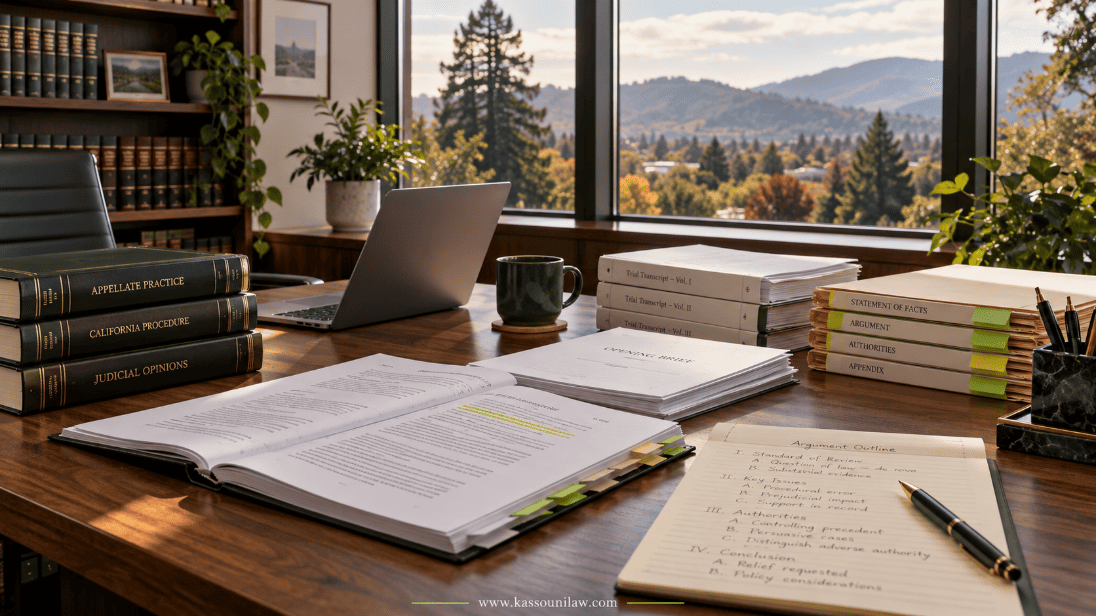 After months of litigation, the trial court rules against a business owner on a contract claim. The owner believes the judge applied the wrong legal rule. In another case, a property owner wins at trial and then learns the other side plans to appeal. Both parties now face a new stage with its own rules and a short clock.
An appellate lawyer in Santa Rosa, CA helps private parties assess that stage. Kassouni Law represents individuals and businesses in civil appeals, whether they are challenging a ruling or defending one. The firm does not represent government agencies.
An appeal is generally not a second trial. The reviewing court ordinarily works from the existing record, without new witnesses or new evidence.
What Does an Appellate Lawyer Do?
Appellate lawyers handle proceedings in which a reviewing court examines a lower court’s judgment or appealable order for legal error. The main tasks are:
- Reviewing judgments, court orders, motions, transcripts, and trial court filings
- Identifying potential legal or procedural errors
- Determining whether a judgment or order is appealable
- Evaluating the record and the standard of review
- Preparing briefs and supporting legal arguments
- Representing clients at oral argument when appropriate
- Defending a favorable judgment when another party appeals
When May a Civil Appeal Be Appropriate?
Appellate review may deserve a close look when:
- A court may have misinterpreted a statute or applied the wrong legal rule
- A ruling may rest on an incorrect reading of a contract or other legal instrument
- The court may have made a significant procedural or evidentiary error
- A party wishes to challenge factual findings under the applicable standard of review
- An appealable order affects property, contractual rights, or other legal interests
- A party needs to defend a favorable judgment against the opponent’s appeal
Not every unfavorable ruling can be appealed right away. Some orders are reviewable only after a final judgment. Others are independently appealable under California law, such as certain post-judgment orders and orders granting or denying injunctions (Code of Civil Procedure section 904.1). For some rulings made before judgment, a writ petition may be the available route.
Dissatisfaction with the outcome does not establish grounds for reversal.
Santa Rosa, Sonoma County, and the Court of Appeal
Civil litigation involving Santa Rosa parties may be heard in the Sonoma County Superior Court, depending on jurisdiction and venue. The court lists its Civil and Family Law Courthouse on Cleveland Avenue in Santa Rosa.
For many appeals from that court, the reviewing court is the California Court of Appeal, First Appellate District. The district serves twelve Northern California counties, including Sonoma, and sits in San Francisco.
The route depends on the case. According to California Courts, limited civil cases, generally those of about $35,000 or less, are appealed to the superior court’s appellate division. Unlimited civil cases are generally appealed to a Court of Appeal (which court hears an appeal). Other proceedings can follow different rules, so not every case that starts in Santa Rosa follows the same path.
The Appellate Process
Reviewing the Judgment and Potential Grounds for Appeal
Counsel starts with the judgment, the relevant orders, the procedural history, and the record. That review shows which issues, if any, can support appellate relief.
Filing the Notice of Appeal
A party starts the appeal by filing a notice of appeal in the appropriate trial court within the applicable deadline. The deadline depends on the case type and the order.
Preparing the Record on Appeal
The record usually includes the clerk’s transcript, the reporter’s transcript, exhibits, and other authorized materials. The reviewing court generally relies on that record to assess the claimed errors. Missing materials can limit what the court can consider.
Preparing the Appellate Briefs
The appellant’s opening brief identifies the issues, cites the record, explains the law, and argues why the judgment should be reversed or modified. The respondent’s brief answers those arguments. A reply brief may respond to the opposing position. The briefs carry most of the persuasive weight.
Oral Argument and the Court’s Decision
The court may hear oral argument and issue a written decision. Depending on the case, it may affirm, reverse, modify, or remand the matter (Code of Civil Procedure section 43). Not every appeal includes oral argument, and a reversal does not always lead to a new trial. See the firm’s overview of the stages of an appeal.
Standards of Review and Reversible Error
The standard of review affects how an appellate court evaluates an alleged error:
- Legal questions are often reviewed independently, depending on the issue.
- Factual findings are commonly reviewed under a deferential standard, such as substantial evidence, where it applies.
- Discretionary decisions are generally reviewed for abuse of discretion when that standard governs.
An appellant generally must establish more than a possible mistake. The error must meet the requirements for relief, including prejudice where required. Under Article VI, Section 13 of the California Constitution, errors such as improper instructions, evidence rulings, or procedural mistakes lead to reversal only if a review of the whole case shows a miscarriage of justice. Not every error requires reversal, and no single standard governs every issue.
Appellate Deadlines and Procedural Risks
Deadlines are strict and should be checked right after a judgment or appealable order. For many unlimited civil cases, California Rules of Court, rule 8.104 sets the filing deadline at the earliest of two triggers. One is 60 days after service of a notice of entry or a file-endorsed copy of the judgment. The other is 180 days after entry of judgment. Other case types and certain appealable orders may follow different rules.
Some timely posttrial motions can affect the deadline under rule 8.108. Parties should not assume an extension applies.
A late notice of appeal may result in dismissal. A reviewing court cannot extend the deadline because a party missed it. Only emergency orders under rule 8.66, such as those issued after a disaster, can toll or extend appellate deadlines. Some orders must be challenged promptly or the chance for review may be lost.
How Appellate Counsel Can Help
Focused appellate review can clarify what an appeal can and cannot accomplish. Counsel may:
- Identify legally reviewable issues
- Distinguish potentially reversible errors from arguments unlikely to succeed
- Assess the standard of review
- Determine whether issues were properly preserved
- Review the record and confirm that citations support the arguments
- Develop a clear, persuasive written brief
- Evaluate potential outcomes, costs, and procedural risks
- Help a prevailing party respond to an appeal
Appellate counsel cannot ordinarily introduce new evidence because a party believes it would strengthen the case.
How Kassouni Law Can Assist
Kassouni Law’s appellate services are for private individuals and businesses seeking to challenge or defend civil court decisions. Counsel can review the judgment and record, assess potential issues and deadlines, develop legal arguments, prepare briefs, and advise on strategy. Where a ruling needs review before final judgment, the firm’s writs and injunctions practice may also be relevant.
Talk With an Appellate Lawyer in Santa Rosa
Anyone considering an appeal, or responding to one, can contact Kassouni Law to discuss the ruling, the applicable deadlines, and possible options.
Call (877) 770-7379 or use the firm’s contact page. Submitting a contact form does not create an attorney-client relationship.
Frequently Asked Questions
How long do I have to appeal a Sonoma County Superior Court judgment?
It depends on the case and the order. For many unlimited civil cases, the deadline is the earlier of 60 days after service of a notice of entry or file-endorsed copy of the judgment, or 180 days after entry. Check it immediately.
Can I present new evidence on appeal?
Ordinarily no. The reviewing court generally examines the existing record rather than hearing new witnesses or receiving new evidence.
What is the difference between an appeal and a writ petition?
An appeal usually challenges a final judgment or an appealable order. A writ petition can ask a higher court to review certain rulings before final judgment. Each has its own requirements and deadlines.
Which court hears appeals from Santa Rosa civil cases?
For many unlimited civil appeals from Sonoma County Superior Court, it is the First Appellate District. Limited civil cases go to the superior court’s appellate division, and other proceedings may differ.
What if the other side appeals a judgment I won?
You may need to respond with a respondent’s brief defending the judgment. Deadlines apply, so consult counsel promptly after receiving notice of the appeal.
The information provided here is for general informational purposes and does not constitute legal advice. Outcomes depend on the facts and the applicable law. Readers should consult a qualified California attorney about their specific situation.