Inverse Condemnation Lawyer in Santa Rosa, CA
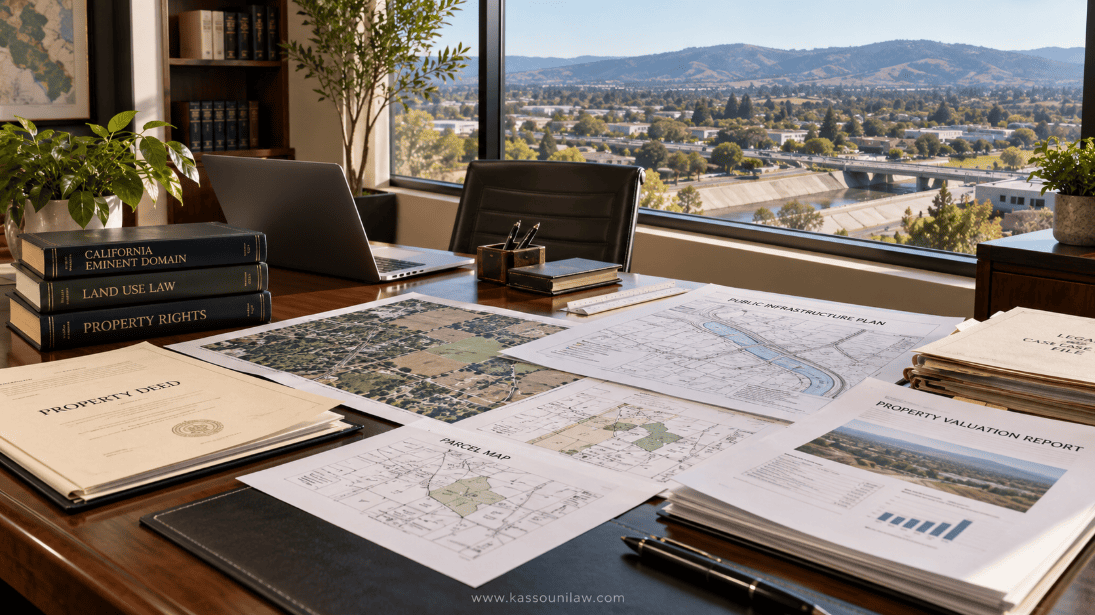 A culvert is replaced near a creek, and the next winter water reaches a yard it never touched before. A street project changes how stormwater leaves the road. A public sewer line fails and sewage backs up into a building. In each case, the owner may wonder whether a public improvement is responsible and whether the government owes compensation.
An inverse condemnation lawyer in Santa Rosa, CA can help evaluate those questions. Kassouni Law represents private owners and businesses in constitutional property claims, including inverse condemnation matters. The firm does not represent government agencies.
Not every flood or construction injury is compensable. Government involvement alone does not establish liability.
What Is Inverse Condemnation?
Inverse condemnation is a claim an owner brings when government action or a public improvement has taken or damaged private property for public use. The government has not completed formal condemnation or paid the compensation required. Article I, Section 19 of the California Constitution is the foundation. It allows private property to be taken or damaged for public use only when just compensation has first been paid.
It helps to separate three kinds of cases:
- Eminent domain. A public entity formally acquires property for public use, following required procedures and paying compensation.
- Inverse condemnation. The owner sues, alleging that government action or an improvement took or damaged property in a way that requires compensation.
- Negligence and similar claims. Other theories may apply when government conduct causes harm, but they carry different elements and defenses. Private-neighbor drainage disputes and challenges to permitting decisions are also separate matters.
The nature of the improvement, the damage, causation, and the governing standard all matter. The firm’s eminent domain page covers the formal process.
Situations That May Lead to a Claim
These examples may warrant legal review. None is an automatic basis for recovery.
Flooding and Drainage Damage
A public drainage or flood-control improvement may allegedly change water flows or cause physical damage to nearby land. Proof that flooding occurred is not enough. The evidence must connect the damage to the public action and satisfy the legal standard.
Public Construction and Infrastructure
Road work, grading, drainage improvements, and sewer infrastructure can affect neighboring property. The analysis turns on what the entity built, operated, or changed, and how that affected the parcel.
Physical Occupation or Acquisition of Property Interests
A claim may arise when a public entity physically occupies or takes a property interest, such as an easement, without completing the acquisition and compensation process.
Repeated Property Damage
Recurring damage allegedly tied to a public improvement raises questions about causation, the character of the project, the liability standard, and the timing of the claim.
Not every flood, erosion problem, construction defect, or property loss qualifies.
Santa Rosa and Sonoma County Public Infrastructure
Public works shape how water moves through and around private land. The City of Santa Rosa’s Capital Improvement Program lists project categories such as creeks and drainage systems, the sanitary sewer collection system, the street network, bridges and structures, and the water distribution system. The city also posts a map of capital improvement projects.
Sonoma Water adds another layer. It describes its flood protection role as maintaining streams and facilities that reduce flood risk. Its facilities page describes the Central Sonoma Watershed Project, which it says alleviates flooding in the Santa Rosa urban area. Its Stream Maintenance Program describes sediment removal, bank repair, and vegetation work in engineered flood control channels, and different, more limited work in modified or natural channels.
These descriptions give context. They do not show that any project has harmed any owner. The difference between an engineered channel, a modified creek, a city storm drain, and a sewer line can affect who is responsible and which standard applies.
Culverts, creek channels, stormwater pipes, and public construction all call for case-specific investigation. Counsel must identify the entity that owned, operated, or maintained the improvement and the conduct that allegedly caused the damage.
California’s Legal Standards
The courts have not adopted one test for every setting. Four decisions show the range.
Albers v. County of Los Angeles (1965) 62 Cal.2d 250 began with county road construction that set off a landslide. The Supreme Court allowed recovery for physical damage to land caused by a deliberately built public improvement, even though the trial court found no negligence.
Belair v. Riverside County Flood Control District (1988) 47 Cal.3d 550 involved a levee that gave way in a flood. The court declined to treat flood-control works the same way. Owners had to show that unreasonable design, construction, or maintenance created an unreasonable risk and substantially caused the harm.
Locklin v. City of Lafayette (1994) 7 Cal.4th 327 applied that reasonableness approach to drainage discharged into natural watercourses. Water that would have run off anyway is not itself a basis for liability. The agency answers only for damage its improvement caused.
City of Oroville v. Superior Court (2019) 7 Cal.5th 1091 concerned a sewage backup from a public sewer. The court asked whether an inherent risk in the sewer’s design, construction, or maintenance substantially caused the damage. Causation alone did not suffice, and the court warned against labeling inverse condemnation strict liability.
Some claims turn on physical damage from a deliberately built improvement. Many flood and drainage claims require proof of unreasonable conduct. A public entity is not automatically liable whenever its infrastructure contributes to damage, and negligence is not always the test.
What Property Owners Need to Establish
Counsel typically asks:
- Which public entity owned, operated, maintained, or controlled the improvement?
- What property interest was allegedly taken or damaged?
- What public action or improvement caused the injury?
- What evidence connects the improvement to the damage?
- Which constitutional and statutory standards apply?
- Are there other causes, defenses, or parties?
- What limitation periods and procedures apply?
In drainage and flood cases, prior drainage conditions, water flow patterns, engineering evidence, the improvement’s design and operation, and the timing of the damage can all matter. The facts and governing law decide whether compensation may be available.
Evidence That Can Help
Owners can preserve records while the details are fresh:
- Dated photographs and videos of the damage
- Repair estimates, invoices, and records of financial loss
- Deeds, surveys, property plans, and title documents
- Drainage assessments, engineering reports, and expert evaluations
- Available public project plans, maintenance records, inspection records, and construction documents
- Correspondence with the public entity
- Records showing when damage occurred and whether it continued or recurred
Technical evidence often matters in drainage and flood-control disputes. An owner does not need an expert report before seeking legal advice.
Potential Compensation
Compensation depends on the claim and the facts. The analysis may involve the value of a property interest taken, physical damage to real property, or other legally recoverable losses. Valuation rules vary with the nature of the taking or injury.
No one can promise reimbursement for every repair cost, business loss, or consequential expense. Inverse condemnation rests on a different legal basis than negligence or nuisance, even when one incident raises more than one issue.
Deadlines and Public Entity Claims
Timing matters when a public entity may be responsible. Counsel must evaluate the statute of limitations, when the claim accrued, and any administrative claim requirements under the Government Claims Act. Those requirements do not apply the same way to every claim. For a taking or damaging under Article I, Section 19, Government Code section 905.1 says a claim is not required before suit. Other theories pleaded alongside it may carry their own requirements.
Owners should seek advice promptly. Waiting for more damage or a final repair estimate can cost options.
How Kassouni Law Can Help
Kassouni Law assists private owners and businesses with inverse condemnation and related property disputes. Counsel can review property records, investigate the cause of damage, assess the legal standards, identify potentially responsible parties, evaluate possible compensation, and advise on strategy. Related work includes real estate litigation, writs and injunctions, and the firm’s broader property rights practice.
Talk With an Inverse Condemnation Lawyer in Santa Rosa
Private owners who believe a public improvement has taken or damaged their property can contact Kassouni Law to discuss their circumstances and possible legal options.
Call (877) 770-7379 or use the firm’s contact page. Submitting a contact form does not create an attorney-client relationship.
Frequently Asked Questions
What is inverse condemnation in California?
Inverse condemnation is a legal claim a property owner may bring when government action takes or damages private property for public use without formally starting an eminent domain proceeding. The owner must establish that the government action meets the legal requirements for compensation.
Can I file an inverse condemnation claim for flooding on my Santa Rosa property?
Possibly. If a public drainage system, flood-control project, or other government infrastructure causes or substantially contributes to property flooding, an inverse condemnation claim may be available. The outcome depends on the facts, including the source of the water, the government entity’s role, and the applicable legal standards. Not every instance of flooding supports a claim.
Who can be held responsible for inverse condemnation in Santa Rosa?
Depending on the facts, a responsible public entity could include the City of Santa Rosa, Sonoma County, or another government agency involved in the design, construction, or operation of public infrastructure. Identifying the correct entity and establishing the connection between its actions and the property damage are important parts of evaluating a claim.
What compensation can I recover in an inverse condemnation case?
Potential compensation may include the reduction in property value or the cost of property taken or damaged, depending on the type of taking and the applicable law. The recoverable amount depends on the evidence, the nature of the government action, and the losses California law recognizes.
How long do I have to file an inverse condemnation lawsuit in California?
The deadline depends on the nature of the claim and the circumstances of the property damage. Different limitation periods may apply, and claims involving ongoing or repeated damage can raise additional legal questions. A property owner should consult an attorney promptly to identify the applicable deadline and preserve relevant evidence.
The information provided here is for general informational purposes and does not constitute legal advice. Outcomes depend on the facts and the applicable law. Readers should consult a qualified California attorney about their specific situation.