Real Estate Litigation Lawyer in Santa Rosa, CA
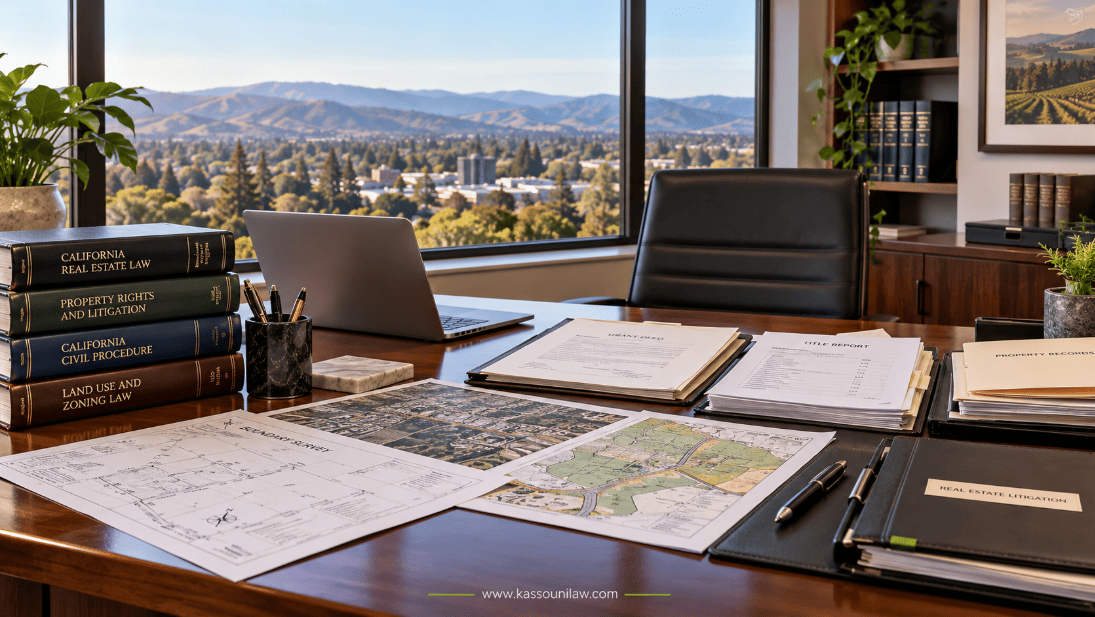 A co-investor disputes who owns a parcel. A recorded claim clouds title just before a sale. A development contract falls apart over who owes what. When a dispute over land reaches this point, negotiation alone may not protect a party’s position.
Anyone searching for a real estate litigation lawyer in Santa Rosa, CA needs a clear view of the claim, the evidence, and the options. That assessment should come before a lawsuit begins. Kassouni Law represents private property owners, investors, and businesses in complex property disputes. See the firm’s real estate litigation practice for its broader work.
What Is Real Estate Litigation?
Real estate litigation resolves legal disputes over ownership, use, possession, contracts, or other interests in real property. It happens in court, through pleadings, evidence, and rulings.
Not every dispute needs a lawsuit. Negotiation or mediation may resolve it, depending on the facts and the parties. Litigation becomes appropriate when those routes fail or a party needs a court order to protect its rights.
It also differs from related work. Real estate transactions involve buying, selling, leasing, and drafting agreements. Appeals challenge a court’s judgment after the trial court rules. Land-use and administrative litigation challenges government decisions, often through writ proceedings. This page addresses disputes among private parties.
Real Estate Disputes That May Require Litigation
The available claims and remedies depend on the agreements, title records, evidence, deadlines, and circumstances of each dispute.
Property Ownership and Title Disputes
These disputes involve competing ownership claims, title defects, or disagreements over recorded interests such as liens, deeds, and easements. Recorded documents and the chain of title usually drive the analysis.
Quiet Title Actions
A court determination may be needed when adverse claims cloud ownership. In a quiet title action, the complaint must be verified. It must identify the adverse claims the court is asked to resolve (Code of Civil Procedure section 761.020).
Boundary and Easement Disputes
Owners may disagree about a property line, an access route, or the scope of a recorded easement. Surveys, deeds, and easement language matter most. The firm’s articles on property line disputes and its easement law page cover these issues.
Real Estate Contract Disputes
Disputes can arise from purchase agreements, development contracts, or other property-related agreements. Typical questions are whether a breach occurred, whether a contingency was met, and what remedy the contract allows. Contract terms may also require mediation or arbitration first.
Trespass and Interference With Property Rights
Unauthorized entry, encroaching structures, or interference with an owner’s use of land may support a civil claim. Ordinary neighborly friction usually does not. The conduct, the harm, and the property rights involved decide the question.
Real Estate Investment Disputes
Co-owners, investors, and joint-venture participants sometimes disagree about property interests or contractual duties. The governing agreement is central. Co-owners may also have statutory options, such as a partition action to divide or sell jointly held property (Code of Civil Procedure section 872.210).
Property Disclosure and Misrepresentation Claims
A buyer may allege that a seller failed to disclose material information or misrepresented a condition. California has a residential transfer disclosure article for certain sales (Civil Code section 1102 and following). Liability depends on the facts, the transaction, and the duties involved. A nondisclosure alone does not settle the claim.
Real Estate Litigation in Santa Rosa and Sonoma County
Disputes in Santa Rosa may involve residential parcels, commercial property, land held for development, shared access, or boundary questions. Local land-use conditions can also bear on them.
For example, Santa Rosa’s zoning code includes hillside development standards for development on any portion of a site with a slope of 10 percent or greater. On a sloped parcel, those conditions can affect what a contract promised or what a neighbor built. Whether the rules apply depends on the property and project. A disagreement over a government land-use decision is an administrative matter. A dispute between private parties is a different kind of case.
The Sonoma County Superior Court serves the area and hears civil matters at its Santa Rosa courthouse. The court offers a civil mediation program, a mandatory settlement conference program, and other dispute resolution options. Actions to recover land, determine rights in it, or seek damages for injury to it are generally tried in the county where the property sits. Other claims can follow different venue rules, so not every dispute is filed in Sonoma County.
How a Real Estate Lawsuit Progresses
No fixed sequence fits every case, and timelines vary. In general:
- Review the facts and documents. Examine deeds, title reports, contracts, easements, communications, and other records.
- Identify claims and defenses. Decide which legal theories fit the facts and whether deadlines or contract requirements apply.
- Consider resolution before trial. Assess whether negotiation or mediation could resolve the dispute without a trial.
- File or respond to a lawsuit. A complaint starts the case, and the defendant answers or otherwise responds. A summons generally gives 30 days after service to respond (Code of Civil Procedure section 412.20). Missing it risks a default.
- Gather evidence. Discovery includes document requests, written questions, and depositions.
- Address motions and prepare for trial. Motions can narrow issues or resolve some claims, as with summary judgment. Cases that remain disputed may go to trial.
- Evaluate remedies and enforcement. Depending on the claim, a court may consider damages, declaratory relief, an injunction, quiet title relief, specific performance, or another authorized remedy.
The firm’s articles on when a real estate litigation lawyer is needed and on injunctions in property disputes add detail.
Evidence and Legal Strategy
Details decide these cases. Useful materials include recorded deeds, title documents, surveys, easement language, purchase agreements, inspection and disclosure records, written communications, photographs, and financial records.
The legal theory determines which evidence matters and which remedy is available. A claim for damages needs proof of loss. A request for specific performance depends on the agreement. For property transfers, it also involves a legal presumption about the adequacy of money damages (Civil Code section 3387). Unfairness or a strong disagreement alone does not establish a valid claim.
Deadlines also vary by claim. Written and oral contract claims, for instance, fall under different limitation periods (Code of Civil Procedure sections 337 and 339).
How Kassouni Law Can Assist
Kassouni Law represents private individuals and businesses. Its work spans real estate, construction, land use, and property rights. Counsel can:
- Evaluate claims and defenses against the documents
- Review title records, contracts, surveys, and communications
- Assess potential remedies and the evidence each requires
- Prepare and pursue or defend litigation
- Consider settlement where it serves the client
The firm does not represent government agencies. No lawsuit is certain to succeed, and litigation cannot always be avoided.
Speak With a Real Estate Litigation Lawyer
Private owners, investors, and businesses with a real estate dispute involving Santa Rosa or Sonoma County property can contact Kassouni Law to discuss the facts and possible legal options. The firm’s practice areas and real estate law pages describe its services. No result is guaranteed.
Call (877) 770-7379 or use the firm’s contact page. Submitting a contact form does not create an attorney-client relationship.
Frequently Asked Questions
What is real estate litigation?
It is the court process for resolving disputes over ownership, use, possession, contracts, or other interests in real property. It covers disputes among private parties.
Does every real estate dispute end up in court?
No. Many disputes resolve through negotiation or mediation. A lawsuit makes sense when those routes fail or a court order is needed.
How long do I have to respond if I am served with a lawsuit?
The summons states the deadline. In many civil cases it is 30 days after service. Missing it can lead to a default, so consult a lawyer promptly.
Can co-owners or investors sue each other over real property?
Yes, in appropriate cases. The claim depends on the co-ownership or investment agreement and the facts. Options can include contract claims or a partition action.
How long do I have to file a real estate lawsuit in California?
It depends on the claim. Contract, fraud, and property claims can carry different periods. Do not assume a deadline without legal advice.
The information provided here is for general informational purposes and does not constitute legal advice. Outcomes depend on the facts and the applicable law. Readers should consult a qualified California attorney about their specific situation.