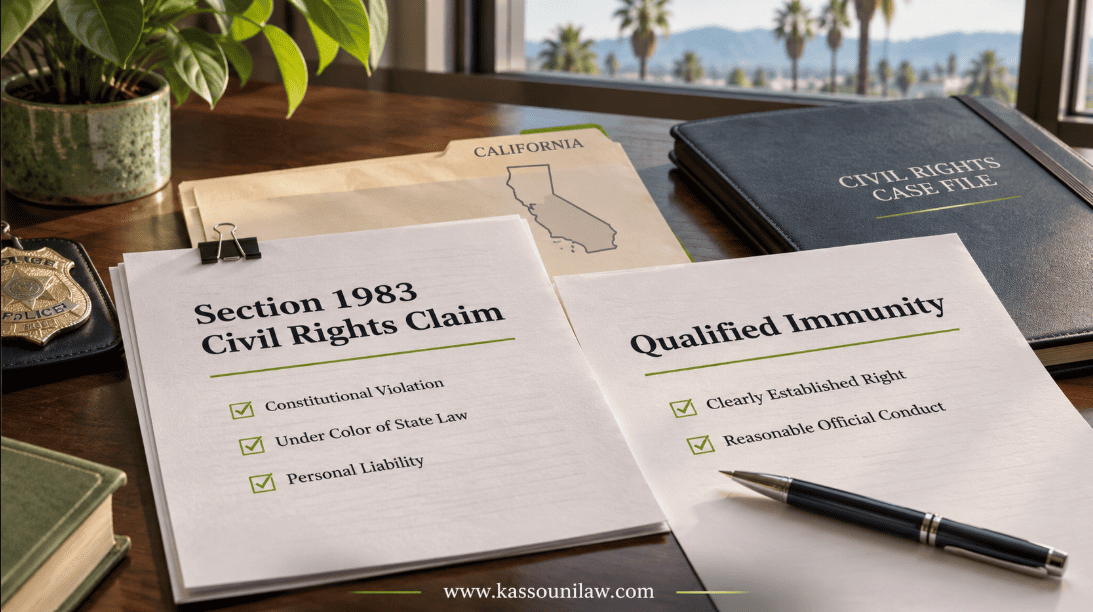
 A traffic stop leads to a vehicle search and an arrest. Prosecutors later drop the charges, but the driver believes the officer violated the Fourth Amendment. Can the driver sue the officer personally? Or will qualified immunity prevent the lawsuit?
Government officials can face personal liability for constitutional violations. However, the outcome depends on the specific conduct, the rights involved, and the law at the time. Qualified immunity can protect officials from certain claims, but it does not apply in every case.
How Do Federal Civil Rights Claims Work Under Section 1983?
Section 1983 of Title 42 allows people to sue officials who violate their federal rights. The law applies when someone acts under color of state law. A plaintiff must establish two elements:
- The defendant acted under color of state law.
- The defendant deprived the plaintiff of a right secured by federal law or the Constitution.
Not every mistake, policy disagreement, or unfair decision meets these requirements.
Section 1983 generally applies to state and local officials. It does not cover federal officers acting solely under federal authority. Claims against federal officers follow a different and narrower legal framework.
A plaintiff may sue an official in an individual capacity. This allows the plaintiff to seek personal liability. An official-capacity claim works differently. Courts generally treat it as a claim against the government entity, as Kentucky v. Graham explains.
However, plaintiffs face additional limits when they sue states or state agencies for damages. In Will v. Michigan Department of State Police, the Supreme Court held that states and state officials sued for damages in their official capacities are not “persons” under Section 1983.
What Is Qualified Immunity?
Qualified immunity can protect government officials from personal liability in certain civil rights lawsuits. The Supreme Court established the modern standard in Harlow v. Fitzgerald, 457 U.S. 800 (1982). Under that standard, an official may avoid damages if the conduct did not violate clearly established federal law.
Courts ask whether a reasonable official would have understood that the conduct violated someone’s rights. They do not base the decision on whether the official acted with good or bad intentions.
The Supreme Court later clarified what “clearly established” means. In Anderson v. Creighton, 483 U.S. 635 (1987), the Court said judges must define the right with enough detail. A general statement of constitutional rights may not be enough.
However, officials do not always need an earlier case with identical facts. In Hope v. Pelzer, 536 U.S. 730 (2002), the Court explained that existing law can give fair notice without an identical precedent. Later, Ashcroft v. al-Kidd, 563 U.S. 731 (2011), described the standard as requiring existing precedent to place the legal question “beyond debate.”
Qualified immunity comes from federal case law, not a California statute. It can protect individual officials from claims for money damages. It does not protect cities or counties from Section 1983 liability.
How Do Courts Apply the Clearly Established Law Test?
Courts examine two questions when officials claim qualified immunity. Did the official violate a federal right? Was that right clearly established at the time? In Pearson v. Callahan, 555 U.S. 223 (2009), the Supreme Court held that judges can address either question first.
The second question requires a close look at the facts. Courts cannot rely only on broad statements about constitutional rights. They must identify the right with enough detail to show what the official should have known.
The Supreme Court addressed this issue again in Zorn v. Linton (2026). The case involved an officer who used a rear wristlock to lift a seated protester after repeated warnings. The Court found that existing precedent did not clearly establish that this specific conduct violated the Fourth Amendment. It therefore granted the officer qualified immunity. Three Justices dissented.
A prior case does not always need identical facts. In Hope v. Pelzer, 536 U.S. 730 (2002), the Court rejected that strict requirement. However, existing law must still give officials fair notice. In Ashcroft v. al-Kidd, 563 U.S. 731 (2011), the Court explained that precedent must place the legal question “beyond debate.” A strong consensus among persuasive cases may also establish a right.
Zorn also left one question unresolved. The Court assumed, without deciding, that controlling circuit precedent can clearly establish the law. This distinction matters when a plaintiff relies on lower federal court decisions.
Courts consider the specific circumstances of each case. Differences in the facts can affect whether earlier decisions gave an official fair notice. An obvious constitutional violation may also support a claim without a closely similar prior case.
Which California Government Officials Can Claim Qualified Immunity?
Qualified immunity may apply to state and local officials sued under Section 1983. Police officers, sheriff’s deputies, corrections officers, and other government employees may raise the defense. Their job titles do not decide the issue. Courts examine the conduct and the legal claim.
Some officials may receive absolute immunity for specific functions. This protection differs from qualified immunity.
- Judges. Judicial immunity generally protects judges performing judicial acts within their jurisdiction. Section 1983 also restricts injunctive relief against judicial officers acting in that role, subject to statutory exceptions.
- Prosecutors. In Imbler v. Pachtman, 424 U.S. 409 (1976), the Supreme Court recognized absolute immunity for prosecutors’ work in initiating prosecutions and presenting the State’s case.
- Legislators. In Bogan v. Scott-Harris, 523 U.S. 44 (1998), the Court extended absolute immunity to local legislators performing legislative acts.
The nature of the conduct matters more than the official’s position. In Forrester v. White, 484 U.S. 219 (1988), a judge fired a probation officer. The Court treated that decision as administrative, not judicial. Absolute judicial immunity therefore did not apply. The official could still raise other available defenses.
Can Police Officers Be Personally Sued for Misconduct?
Yes. A person can sue a police officer under Section 1983 when the officer violates a federal right. Common claims involve unlawful searches, wrongful arrests, excessive force, and retaliation for protected activity. Claims may also involve deliberate indifference to serious medical needs while someone is in custody.
A plaintiff must establish the constitutional violation and address any immunity defense. The facts surrounding the officer’s conduct often determine whether the claim can proceed.
In Barnes v. Felix, 605 U.S. 73 (2025), the Supreme Court addressed how courts assess excessive-force claims. It held that courts must consider the full circumstances leading up to the use of force. They cannot limit their review to the final moments of an encounter.
That ruling concerns the Fourth Amendment’s excessive-force standard. It does not remove qualified immunity or guarantee that a lawsuit will succeed. A plaintiff still needs evidence supporting the claim and must address any applicable defenses.
Kassouni Law handles civil rights matters involving government conduct. Its civil rights practice provides more information about related legal issues.
How Does California Governmental Immunity Differ From Qualified Immunity?
California law provides separate immunity rules for public employees and government entities. These rules generally apply to state-law claims, not federal claims under Section 1983. A California immunity statute does not determine whether an official has qualified immunity under federal law. See Martinez v. California, 444 U.S. 277 (1980).
The Government Claims Act addresses employee and entity liability in several provisions:
- Employee liability. Government Code section 820 generally makes public employees liable for their acts and omissions. They face the same liability as private individuals, unless a statute provides immunity.
- Discretionary acts. Section 820.2 protects certain discretionary decisions from liability. In Caldwell v. Montoya (1995) 10 Cal.4th 972, the California Supreme Court limited this protection to basic policy decisions. The case involved school board members who voted against renewing a superintendent’s contract. Their decision qualified for immunity. Routine operational decisions do not automatically receive the same protection.
- Public entity liability. Section 815 generally requires a statutory basis for public entity liability. Section 815.2 addresses an entity’s liability for an employee’s conduct within the scope of employment. The entity may face liability when the employee’s conduct would support a claim. However, the entity generally shares any applicable employee immunity, subject to statutory exceptions.
Asgari v. City of Los Angeles (1997) 15 Cal.4th 744 explains how these provisions interact. The California Supreme Court discussed section 820.4, which does not protect employees from liability for false arrest. The Court also addressed section 815.2(b), which generally protects public entities when an employee has immunity.
These rules differ from federal qualified immunity in both source and application. Federal qualified immunity asks whether the official violated clearly established federal law. Section 820.2 instead addresses immunity for qualifying discretionary policy decisions. State-law claims may also involve government claim-presentation requirements. Those requirements generally do not apply to Section 1983 claims.
Can a City or County Be Held Liable for an Official’s Conduct?
A city or county can face liability for certain constitutional violations. However, an employee’s misconduct does not automatically make the government entity liable.
In Monell v. Department of Social Services, 436 U.S. 658 (1978), the Supreme Court recognized local governments as “persons” under Section 1983. But the Court rejected liability based solely on an employment relationship. A city or county cannot be held responsible simply because one of its employees violated someone’s rights.
Instead, the plaintiff must connect the violation to an official government policy, an established custom, or a decision by a final policymaker. This requirement applies even when an individual employee committed the underlying violation.
Municipal liability also differs from an individual officer’s immunity defense. In Owen v. City of Independence, 445 U.S. 622 (1980), the Supreme Court held that municipalities cannot claim qualified immunity based on their officials’ good faith. An officer’s qualified immunity therefore does not automatically defeat a properly supported Monell claim.
What Evidence Can Support a Civil Rights Claim?
The evidence needed depends on the alleged violation and the defendants. Records can help establish what happened, identify the people involved, and address immunity defenses.
Relevant evidence may include:
- Police reports and incident records. These may document the officer’s account, dispatch information, and timeline.
- Warrants and supporting documents. Search and arrest warrants can help establish the authority officers relied on.
- Video footage. Body-camera, dash-camera, and surveillance recordings may capture important events.
- Witness statements and medical records. These can help establish what happened and document injuries.
- Communications and government records. Emails, messages, and written orders may reveal relevant decisions or instructions.
- Policies and training materials. These may support a claim involving government practices. However, a policy violation alone does not establish municipal liability.
- Court decisions. Earlier decisions involving similar conduct may help determine whether the violated right was clearly established.
Not every case will involve all these records. Photographs, personal notes, and witness contact details can help preserve important information. Recording these details soon after an incident may also prevent memories from fading.
What Legal Remedies May Be Available?
The available remedies depend on the violation, the resulting harm, and the defendants involved. A successful Section 1983 claim may lead to several forms of relief:
- Compensatory and nominal damages. Compensatory damages address proven losses, including physical, emotional, or financial harm. Courts may award nominal damages when someone proves a violation but cannot establish measurable loss.
- Punitive damages. Courts may award punitive damages against individual defendants who act with reckless or callous indifference to federally protected rights. In Smith v. Wade, 461 U.S. 30 (1983), the Supreme Court explained this standard. However, City of Newport v. Fact Concerts, Inc., 453 U.S. 247 (1981), bars punitive damages against municipalities under Section 1983.
- Declaratory and injunctive relief. Courts may declare that government conduct violated someone’s rights or order officials to stop unlawful conduct. These remedies have separate requirements, including standing and, for injunctive relief, a sufficient showing of ongoing or threatened harm.
- Attorney fees. Under 42 U.S.C. section 1988, courts may award reasonable attorney fees to prevailing parties in qualifying Section 1983 cases.
Deadlines also depend on the type of claim. Federal civil rights claims generally borrow California’s personal injury limitations period. Federal law determines when the claim accrues. Certain state-law claims against public entities or employees may also require timely government claim presentation.
Personal Liability Depends on the Claim, the Conduct, and the Immunity
A government official’s position does not automatically protect them from a civil rights lawsuit. Courts examine the alleged violation, the official’s actions, and any available immunity. Claims against cities and counties involve separate requirements.
Kassouni Law represents private parties in civil rights matters. If you believe a government official violated your constitutional rights, the firm can review your circumstances and discuss the legal options that may be available.
Call Kassouni Law at (877) 770-7379 or contact the firm to discuss your situation. Submitting a contact form does not create an attorney-client relationship.
Frequently Asked Questions
Can you sue a police officer personally in California?
Sometimes. A person may bring a Section 1983 claim against an officer in an individual capacity for violating a federal right. The claim must prove the violation and overcome defenses such as qualified immunity.
What does qualified immunity protect government officials from?
It protects individual officials from personal liability for money damages when their conduct did not violate clearly established federal law. It does not protect government entities, and it does not apply to every official or every claim.
Can qualified immunity be denied if an official violated someone’s constitutional rights?
Yes. If the right was clearly established when the conduct occurred, immunity may be denied. A violation alone is not enough to defeat immunity, and courts look at the specific law and facts.
Can a city or county be sued when a government employee violates someone’s rights?
Sometimes. Under Monell, an entity is liable under Section 1983 only when a policy, custom, or final policymaker’s decision caused the violation. State-law claims follow the Government Claims Act.
How is qualified immunity different from California governmental immunity?
Qualified immunity is a federal judicial doctrine that applies to federal claims. California immunities, such as section 820.2, are statutory and apply to state-law claims. They use different tests and should not be treated as the same defense.
The information provided here is for general informational purposes only and is not legal advice. Civil rights claims and immunity defenses depend on the facts, the claim, and the law in effect at the time of the conduct. Consult a qualified attorney about your circumstances.