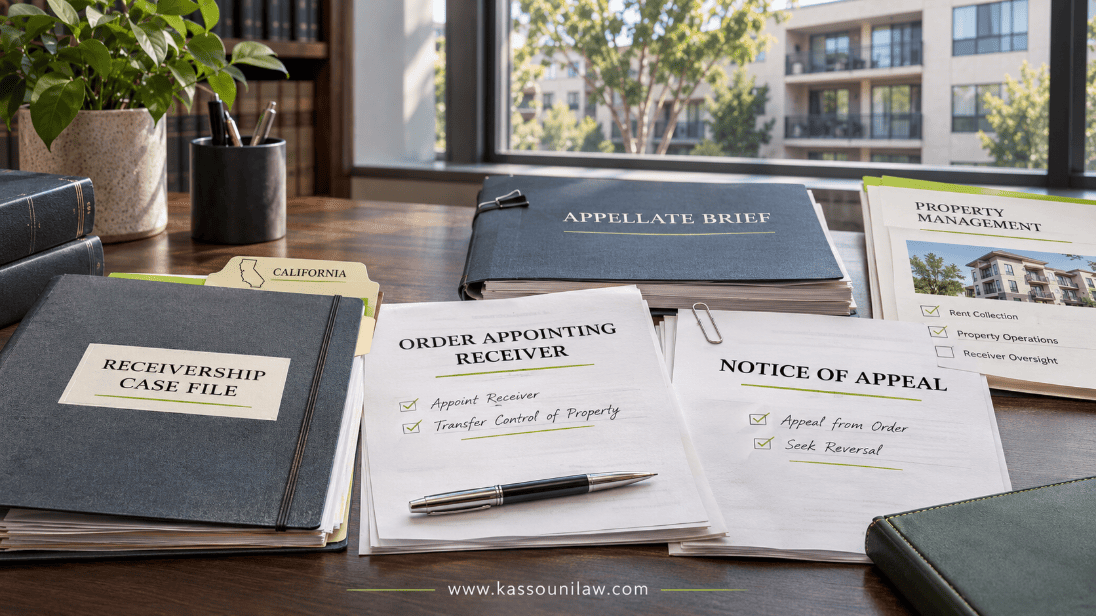
 A landlord opens an email from her tenants. The court has appointed a receiver over her apartment building. The receiver now collects rent, controls repairs, and answers to the judge. The landlord believes the evidence did not justify the appointment and wants to know how quickly she can challenge it.
California law allows an immediate appeal from certain receivership orders. A party generally does not have to wait until the entire case ends. Anyone challenging a receivership order should understand the available grounds, the standard of review, applicable deadlines, and whether the appeal can pause the receiver’s authority.
What Is a Court-Appointed Receiver in California?
A receiver is a person the court appoints to control property or a business while a dispute proceeds. Courts generally treat the receiver as an officer of the court, not an advocate for either side. Under Code of Civil Procedure section 568, a receiver acts under the court’s control. Authorized duties include taking and keeping possession of property, collecting rents and debts, bringing or defending lawsuits, and settling claims.
A receiver does not automatically become the owner. The appointment transfers control, not title. The parties’ ownership rights remain separate questions. The receiver’s authority also has limits. For example, section 568.5 permits a sale of property in the receiver’s possession only under a court order. The sale does not become final until the court confirms it.
Receivers must follow the court’s orders. This oversight explains how an appointment can affect daily operations. It also makes the terms of the appointment order important.
When Can a California Court Appoint a Receiver?
Code of Civil Procedure section 564 identifies when a court may appoint a receiver. The law may authorize an appointment in specific circumstances. Subdivision (b) also lists several categories, including:
- Disputes over property or funds. A party with a probable right or interest may seek a receiver when the property is “in danger of being lost, removed, or materially injured.”
- Foreclosure actions. A secured lender may seek a receiver when the property faces a risk of loss or damage. The statute also addresses situations involving default and inadequate security for the debt.
- Post-judgment needs. A court may appoint a receiver to carry a judgment into effect or preserve property during an appeal.
- Corporate situations. The statute covers dissolved corporations and corporations that are insolvent or have forfeited their corporate rights.
- Rent assignments. A lender enforcing a rent assignment clause may seek a receiver.
- Other cases. A catch-all provision applies when a receiver is necessary to protect a party’s property or rights.
The requesting party must establish a legally sufficient basis for the appointment. A disagreement, unpaid debt, or pending lawsuit does not automatically justify receivership. Courts describe this remedy as drastic and reserve it for appropriate circumstances. In Morand v. Superior Court (1974) 38 Cal.App.3d 347, 350–351, the court discussed this principle while reviewing a receiver appointed to aid judgment enforcement.
Many receiverships involve real property. Kassouni Law handles disputes involving these issues through its real estate law and property rights practice areas.
Can Someone Immediately Appeal an Order Appointing a Receiver?
Yes. In most cases, a party can immediately appeal an order appointing a receiver. Code of Civil Procedure section 904.1(a)(7) expressly allows this appeal.
California generally requires parties to wait for final judgment before appealing. However, the Legislature created exceptions for certain orders with immediate effects. Receiver appointments fall within these exceptions, along with certain orders involving injunctions and attachments.
This exception reflects the immediate impact of receivership. A receiver can take control of property and income while the case continues. Waiting for final judgment could leave an affected party without timely relief.
Who Can Appeal?
Code of Civil Procedure section 902 allows an appeal by any party who is aggrieved. An owner or business whose property falls under receivership will generally meet this requirement.
Creditors, tenants, and other interested parties should examine their status carefully. An interest in the property alone does not automatically establish the right to appeal.
Appointment Orders Versus Later Receivership Orders
Section 904.1(a)(7) covers the order appointing a receiver. It does not make every later receivership order appealable.
In City and County of San Francisco v. Shers (1995) 38 Cal.App.4th 1831, 1838–1840, the court held that an order appointing a successor receiver was not appealable under subdivision (a)(7). A postjudgment order may provide another basis for appeal if it meets the applicable requirements.
The court also limited review to issues covered by the order. A party could not use an appeal from the successor’s appointment to revive earlier challenges to the receivership itself.
The specific order therefore matters. A party should identify its date, terms, and legal effect before filing an appeal. A later order does not automatically reopen the deadline for challenging the original appointment.
What Legal Grounds Can Support an Appeal?
An appellant must identify a legal or factual error in the appointment order. Simply disagreeing with the judge does not establish grounds for reversal. Common arguments include:
- No statutory authority. The circumstances did not satisfy section 564 or another statute authorizing receivership.
- Insufficient evidence. The record did not support the findings required for the appointment.
- Incorrect legal standard. The court applied the wrong legal test.
- Failure to establish required grounds. The requesting party did not prove the necessary conditions, such as danger to the property.
- Improper considerations. The court ignored relevant evidence or relied on factors the law does not permit.
- Procedural errors. A defect in notice or procedure affected the appointment decision.
- Overbroad relief. The receiver’s authority exceeded what the circumstances justified.
The appellate record determines which arguments the reviewing court can consider. Kassouni Law’s article on the California appellate record explains what that record contains.
What Standard Do Appellate Courts Apply to a Receiver Appointment?
Appellate courts generally review receiver appointments for abuse of discretion. In Medipro Medical Staffing, LLC v. Certified Nursing Registry, Inc. (2021) 60 Cal.App.5th 622, the court described its review as “solely for an abuse of that discretion.” It also called receivership a remedy courts should exercise sparingly and cautiously.
However, different issues within the order receive different standards of review:
- Legal questions. Appellate courts review legal conclusions independently, without deference. In Haraguchi v. Superior Court (2008) 43 Cal.4th 706, the California Supreme Court explained that courts cannot exercise discretion under an incorrect legal standard.
- Factual findings. Appellate courts generally ask whether substantial evidence supports the trial court’s findings.
- The appointment decision. The reviewing court considers whether the decision fell within the bounds of the trial court’s discretion.
Appellate courts do not retry the case or reweigh conflicting evidence. This limits the arguments an appellant can raise, but it does not prevent reversal when the record shows an abuse of discretion.
In Medipro, the court reversed a receivership imposed to help enforce a money judgment. The record lacked evidence that the debtors had obstructed collection or that other enforcement methods were ineffective. The reversal was without prejudice to a renewed receivership motion supported by stronger evidence.
Does Filing an Appeal Stop the Receiver From Taking Control?
No. Filing an appeal does not automatically stop the receiver from exercising authority. Under Code of Civil Procedure section 916, an appeal generally stays proceedings affected by the appealed order. However, section 917.5 creates a specific exception for receiver appointments.
An appellant must provide an undertaking to stay enforcement of the appointment order. The trial court sets the amount. If the order is affirmed or the appeal is withdrawn or dismissed, the appellant must pay damages the other party suffered because of the stay.
Parties seeking interim relief should consider these options:
- Request an undertaking amount from the trial court. The court determines the required amount under section 917.5. The undertaking must cover damages caused by delaying enforcement if the appeal does not succeed.
- Petition the Court of Appeal for a writ of supersedeas. Under Rule 8.112, a party may ask the reviewing court to stay enforcement while the appeal proceeds. The petition must explain why the stay is necessary and include supporting legal arguments. If the appellate record has not been filed, the petition must show substantial issues likely to arise on appeal. It must also include the required supporting documents and verification.
- Follow the filing requirements. Rule 8.116 requires the document requesting a stay to display “STAY REQUESTED” prominently. It must also identify the proceeding or act the party wants to stay, along with the trial court, department, and trial judge.
Until a court grants a stay, the receiver may continue exercising authority under the appointment order. A party should therefore address interim relief promptly. Courts consider the applicable legal requirements and circumstances, and a stay is not automatic.
What Deadlines Apply to an Appeal From a Receiver Appointment Order?
Rule 8.104 establishes the standard deadline for appealing an appealable order. The notice of appeal is due by the earliest of these three dates:
- 60 days after the clerk serves notice. The period begins when the clerk serves a notice of entry or file-endorsed copy of the order, showing the service date.
- 60 days after a party serves notice. The period begins when a party serves a notice of entry or file-endorsed copy of the order with proof of service.
- 180 days after entry. This deadline applies when neither the clerk nor a party serves the required notice.
The entry date depends on how the court records the order. If the court enters the order in its permanent minutes, that date generally controls. However, when the minute order directs preparation of a written order, the signed order’s filing date controls.
Courts generally cannot extend the notice-of-appeal deadline. A late notice requires dismissal, subject to limited exceptions under the court rules.
A valid motion for reconsideration may extend the deadline. Under Rule 8.108(e), the extended deadline is the earliest of:
- 30 days after the clerk or a party serves the order denying reconsideration or notice of entry.
- 90 days after the first reconsideration motion is filed.
- 180 days after entry of the appealable order.
This extension applies to a valid motion under Code of Civil Procedure section 1008(a). The rule only extends the ordinary appeal period. It does not shorten it.
Later receivership proceedings do not necessarily restart the deadline for challenging the original appointment. Each later order must be assessed separately for appealability and timing. A party should not assume that ongoing proceedings preserve the right to challenge the initial appointment.
Kassouni Law’s guide to filing an appeal in California explains the general filing process.
What Happens After an Appellate Court Reviews the Appointment?
The appellate court may affirm the appointment, leaving the order in place. It may reverse the order or remand the matter for further proceedings.
A reversal does not necessarily resolve the underlying dispute. The trial court may still need to address the parties’ claims, an accounting, or the receiver’s actions. In Medipro Medical Staffing, LLC v. Certified Nursing Registry, Inc. (2021) 60 Cal.App.5th 622, the court reversed the appointment without prejudice to a renewed motion supported by stronger evidence.
Even after a successful appeal, further proceedings may follow. The final outcome depends on the appellate ruling, the record, and the legal issues that remain.
Receiver Appointment Orders Can Be Challenged, but Timing and Grounds Matter
A receiver appointment can affect property, income, and business operations before the underlying dispute ends. California law allows parties to challenge certain appointment orders through an immediate appeal. The available grounds and filing deadlines can affect how that challenge proceeds.
Kassouni Law represents private parties in appellate matters. If a court has appointed a receiver over your property or business, the firm can review your circumstances and discuss the legal options that may be available.
Call Kassouni Law at (877) 770-7379 or contact the firm to discuss your situation. Submitting a contact form does not create an attorney-client relationship.
Frequently Asked Questions
Can someone immediately appeal an order appointing a receiver in California?
Yes, generally. Section 904.1(a)(7) allows an appeal from an order appointing a receiver without waiting for final judgment.
What law allows an appeal from a receiver appointment order?
Code of Civil Procedure section 904.1(a)(7). It covers the appointment order itself. It does not make every later receivership order appealable.
Does filing an appeal stop a court-appointed receiver?
No. Under section 917.5, a stay requires an undertaking set by the trial court. A party may also ask the Court of Appeal for a writ of supersedeas. No stay is guaranteed.
What legal grounds can support an appeal of a receiver appointment?
Examples include lack of statutory authority, insufficient evidence, the wrong legal standard, and procedural errors. Review is for abuse of discretion.
How long does someone have to appeal a receiver appointment order in California?
Rule 8.104 sets the earliest of 60 days after notice of entry is served or 180 days after entry. A motion to reconsider can extend the time under rule 8.108. A late notice requires dismissal.
The information provided here is for general informational purposes only and is not legal advice. Whether a receiver appointment can be challenged depends on the facts, the order involved, and the law in effect. Consult a qualified attorney about your circumstances.