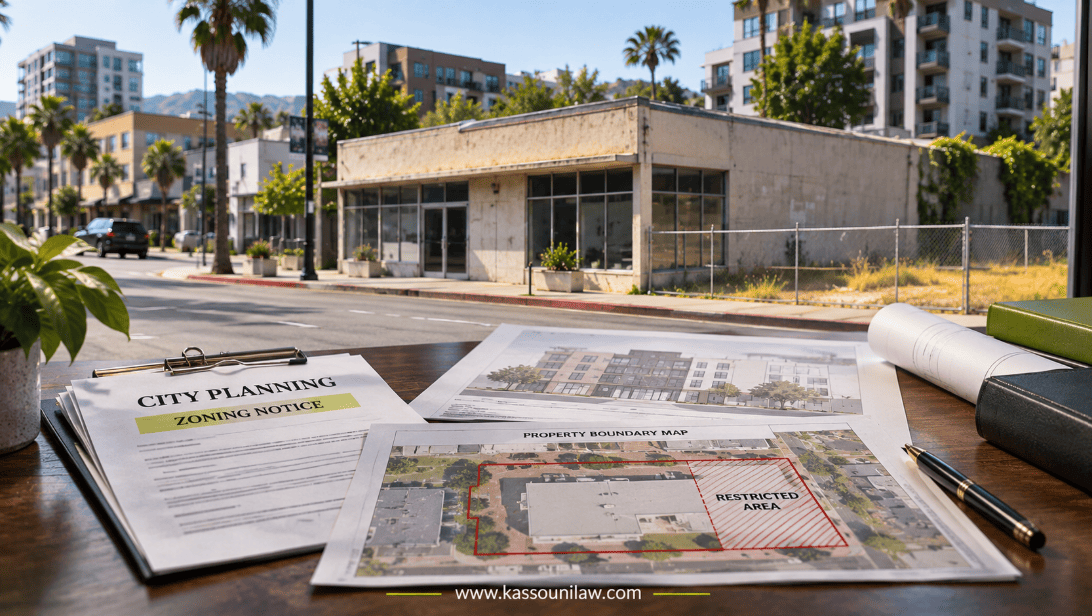
 Consider an owner who buys a mid-century office building in a California city and plans to replace it with apartments. After design work begins, the city designates the building as a historic landmark and denies the demolition permit. The owner can continue using the property as offices, but cannot pursue the planned redevelopment. Could this restriction amount to a regulatory taking that requires compensation?
A reduction in property value does not automatically amount to a taking. Most zoning, historic preservation, and development restrictions do not require government compensation. Courts assess disputed claims under the framework established in Penn Central Transportation Co. v. New York City, 438 U.S. 104 (1978).
What Is a Regulatory Taking in California?
The Fifth Amendment prohibits the government from taking private property for public use without just compensation. Through the Fourteenth Amendment, this protection applies to state and local governments. Article I, section 19 of the California Constitution also requires compensation when the government takes or damages private property for public use.
The two provisions offer related protections, but they are not identical. In San Remo Hotel v. City and County of San Francisco (2002) 27 Cal.4th 643, the California Supreme Court explained that it had generally interpreted the two clauses in the same way. However, the state provision also covers damage to property. The court described it as protecting a somewhat broader range of property values. A claim under the California Constitution may therefore raise issues that differ from those under federal law.
A regulatory taking occurs when a government restriction limits property rights so severely that it has the effect of a taking. The government does not need to acquire the property or physically occupy it. Zoning restrictions, development limits, historic preservation rules, and other land use regulations may give rise to these claims.
However, governments can restrict how owners use their property without paying compensation. A regulation becomes a taking only when its effect crosses the constitutional limit.
Regulatory takings differ from physical takings, which involve government occupation or appropriation of private property. Courts apply separate standards to those claims. The firm’s property rights attorneys page covers related disputes.
What Is the Penn Central Test?
In Penn Central, New York City’s Landmarks Law prevented the owners of Grand Central Terminal from building an office tower above the existing structure. The U.S. Supreme Court ruled that the restriction did not amount to a taking.
The Court described its approach as an “essentially ad hoc, factual” inquiry. It identified three factors that courts consider:
1. Economic impact. How much has the regulation reduced the property’s value or limited its use?
2. Investment-backed expectations. Did the restriction interfere with reasonable expectations the owner had when acquiring or investing in the property?
3. Character of the government action. Does the government action involve a physical invasion, or does it adjust the benefits and burdens of economic activity?
Courts weigh all three factors based on the circumstances. No fixed percentage or formula determines whether a taking has occurred. One factor does not decide the claim on its own.
In Lingle v. Chevron U.S.A. Inc., 544 U.S. 528 (2005), the Supreme Court explained that the Penn Central framework helps courts identify regulations that function like traditional takings.
How Does Economic Impact Affect a Regulatory Takings Claim?
Courts examine how a regulation affects the property’s value and remaining uses. They may compare its value before and after the restriction. However, a drop in market value does not establish a taking by itself.
In Penn Central, the landmark designation reduced the value of the owners’ air rights. The Supreme Court still found no taking. The Terminal could continue operating and generate a reasonable return from its existing uses.
No fixed percentage determines when a loss becomes a taking. In Avenida San Juan Partnership v. City of San Clemente (2011) 201 Cal.App.4th 1256, the Court of Appeal rejected the argument that an owner must lose all economic use to receive compensation under Penn Central. The court explained that a total taking is not required. The economic loss must still be considered alongside the other factors.
How Do Courts Define the Relevant Property?
Courts generally examine the property as a whole rather than isolating the part most affected by a regulation.
In Penn Central, the Supreme Court refused to treat the owners’ air rights as a separate parcel. Similarly, Tahoe-Sierra Preservation Council, Inc. v. Tahoe Regional Planning Agency, 535 U.S. 302 (2002), rejected an attempt to treat a 32-month development moratorium as a separate property interest.
An owner generally cannot separate one restricted part or period from the broader property interest to establish a taking. The definition of the relevant property can itself become a point of dispute.
What Are Distinct Investment-Backed Expectations?
This factor examines what an owner reasonably expected when buying and investing in the property. Courts may consider:
- Rules at the time of purchase. What zoning and land use restrictions applied when the owner acquired the property?
- Permits and government statements. Had the owner received approvals or relied on specific representations from public officials?
- Financial reliance. Had the owner spent money based on an approved or permitted use?
- Foreseeability of restrictions. Could the owner reasonably have anticipated the change, such as a pending rezoning or an existing historic preservation program?
In Kavanau v. Santa Monica Rent Control Board (1997) 16 Cal.4th 761, the California Supreme Court found only minor interference with the owner’s expectations. He had constructive knowledge of the rent increase cap when he chose to improve the building.
The circumstances differed in Avenida. The owners bought the parcel when it had the same zoning as neighboring properties. The city had also approved a four-lot subdivision plan years earlier.
An owner cannot assume that current land use rules will remain unchanged. Property ownership does not guarantee that every planned use will remain permitted. Courts consider whether the owner’s expectations were reasonable in light of the rules and circumstances at the time of purchase.
How Does the Character of Government Action Matter?
Courts are more likely to find a taking when the government physically occupies or invades private property. A regulation that adjusts the benefits and burdens of economic activity presents a different question.
Courts also consider how broadly the government applies the restriction. A rule affecting many properties may weigh against finding a taking. In Penn Central, New York City’s landmarks law covered hundreds of properties, not just Grand Central Terminal.
A regulation’s public purpose does not settle the issue. In Lingle, the Supreme Court explained that courts examine the burden imposed on owners and how the government distributes that burden. They do not decide a takings claim by asking whether the regulation achieves its stated goal.
How Is Spot Zoning Different From a Regulatory Taking?
Spot zoning and regulatory takings involve separate legal questions. Spot zoning concerns whether a government irrationally applies a different zoning classification to a particular parcel. A successful challenge may result in the zoning decision being set aside.
A regulatory takings claim asks whether a government restriction requires compensation. In Avenida, the court considered both issues but analyzed them separately. A finding of unlawful spot zoning does not automatically establish a taking. A takings claim also requires its own analysis.
The firm’s article on spot zoning in California discusses challenges to zoning decisions affecting individual parcels.
How Do California Courts Apply the Penn Central Test?
California courts apply the three Penn Central factors. They do not use a separate state test for regulatory takings. In Kavanau, the California Supreme Court described the factors as “not a comprehensive enumeration.” It also cautioned against applying them mechanically. Courts must consider the facts of each case.
Kavanau involved rent control. The challenged cap delayed rent increases rather than preventing them altogether.
How Did the Court Rule in Avenida?
Avenida involved a 2.85-acre parcel that the owners purchased in 1980. The zoning then allowed much denser development. The city later restricted the parcel to one home per 20 acres, even though surrounding properties allowed much denser development.
The trial court found the downzoning arbitrary and ruled that it caused a partial taking. The Court of Appeal upheld the writ and the taking finding. However, it reversed the damages calculation and sent that issue back for further proceedings.
What Does Landgate Say About Permit Delays?
Landgate, Inc. v. California Coastal Commission (1998) 17 Cal.4th 1006, addresses temporary delays in the approval process.
The California Supreme Court held that a delay of about two years did not amount to a temporary taking. The delay arose from a genuine dispute over a threshold issue. The court treated it as an incident of property ownership and stressed the need for a final agency decision.
Landgate predates Lingle. Its reasoning should therefore be read alongside later decisions addressing regulatory takings.
When Does a Regulation Become a Categorical Taking Instead?
Most regulatory takings claims follow the Penn Central test. However, the Supreme Court has recognized two categories where a different rule applies.
Physical Appropriations
In Cedar Point Nursery v. Hassid, 594 U.S. 139 (2021), the Supreme Court held that a California regulation allowing union organizers to enter private farm property amounted to a per se physical taking.
The Court explained that a regulation resulting in a physical appropriation generally constitutes a taking without a Penn Central analysis. However, the rule has limits. The Court discussed exceptions involving isolated invasions, background restrictions on property rights, and certain health and safety inspections.
Total Loss of Economically Beneficial Use
In Lucas v. South Carolina Coastal Council, 505 U.S. 1003 (1992), the Supreme Court held that a regulation denying all economically beneficial use of land generally amounts to a taking.
The rule has an exception for restrictions that already existed under background principles of state property and nuisance law. If a property retains some economically beneficial use, the Lucas rule generally does not apply. Courts then return to the Penn Central test.
How Do Temporary Restrictions Fit In?
A temporary restriction does not automatically qualify as a categorical taking. In Tahoe-Sierra Preservation Council, Inc. v. Tahoe Regional Planning Agency, 535 U.S. 302 (2002), the Supreme Court rejected a per se takings claim based on development moratoria lasting about 32 months. It directed courts to consider the restriction under Penn Central, including its duration.
In Lingle, the Court also clarified that a regulation’s failure to advance its stated purpose does not establish a taking. That issue belongs under due process analysis.
What Evidence Can Support a Regulatory Takings Claim?
The evidence should address the three Penn Central factors and any other legal standard that applies. Useful records may include:
- Appraisals and valuation reports. These can establish the property’s value before and after the restriction.
- Records of permitted and remaining uses. These show how the regulation affects the owner’s ability to use the property.
- Past and current zoning records. These establish which rules applied when the owner bought the property and whether later changes were foreseeable.
- Purchase and investment records. Deeds, design contracts, improvement costs, and construction records can show the owner’s financial commitments.
- Development applications and permit decisions. These document the proposed project, the agency’s response, and whether the government has issued a final decision.
- Planning department correspondence. Emails, letters, and meeting records may show what officials told the owner and whether the owner relied on those statements.
Appraisers, land use planners, and engineers may also provide expert testimony. Their analysis can help establish the property’s value, development restrictions, and remaining uses.
A title report can identify recorded restrictions and easements that may affect the property’s use or the owner’s expectations.
What Legal Options May Be Available to Property Owners?
The appropriate response depends on the type of government action and the legal grounds for challenging it. Property owners may have several options:
- Administrative appeals. Local procedures may allow owners to challenge a permit denial, zoning decision, or other agency action. Some procedures must be completed before filing a lawsuit.
- Land use applications. A variance, rezoning request, or other approval may allow the proposed use to proceed.
- Constitutional claims. An owner may bring a takings or inverse condemnation claim to seek just compensation. A separate claim may also ask the court to set aside an unlawful government decision.
Owners should check administrative exhaustion requirements, claim-presentation rules, finality and ripeness requirements, and filing deadlines before starting a lawsuit. These rules vary by claim. Missing a required deadline or procedural step can prevent a court from hearing the case.
Kassouni Law handles related real estate law disputes involving government action and private property rights.
When Can a Government Regulation Amount to a Taking?
The Penn Central test helps courts decide whether a land use restriction goes far enough to require compensation. Courts examine its economic impact, its effect on the owner’s reasonable investment-backed expectations, and the nature of the government action.
A restriction that reduces property value does not automatically amount to a taking. The legal outcome depends on the applicable constitutional standard and the circumstances surrounding the property.
Kassouni Law represents private parties in real estate litigation and property rights disputes. If a government restriction has limited how you can use or develop your property, the firm can review the government action and explain whether a legal challenge may be available.
Call Kassouni Law at (877) 770-7379 or contact the firm to discuss your situation. Submitting a contact form does not create an attorney-client relationship.
Frequently Asked Questions
What are the three factors of the Penn Central test?
The factors are the regulation’s economic impact, its interference with distinct investment-backed expectations, and the character of the government action. Courts weigh them together, and no single factor automatically decides the outcome.
Does a decrease in property value qualify as a regulatory taking?
Not by itself. Courts also consider the uses that remain, the owner’s expectations, and the nature of the government action. A large loss may support a claim but does not guarantee one.
Can zoning restrictions result in a taking in California?
They can in some circumstances, but most zoning restrictions do not. Avenida involved a partial taking after a downzoning, while Penn Central found no taking from a landmark restriction. The result depends on the facts and the applicable law.
How is a regulatory taking different from eminent domain?
Eminent domain is the formal process by which a government acquires property and pays for it. A regulatory taking claim arises when a regulation restricts property so heavily that the owner argues compensation is owed, though the government never acquired title. Owners often bring these claims as inverse condemnation actions.
What can a California property owner do if government regulations restrict the use of their land?
Owners can gather records, pursue available local review or approvals, and consult an attorney about constitutional claims. Procedures and deadlines vary, so early review matters.
The information provided here is for general informational purposes only and is not legal advice. Whether a regulation constitutes a taking depends on the facts, the claim, and the law in effect. Consult a qualified attorney about your circumstances.