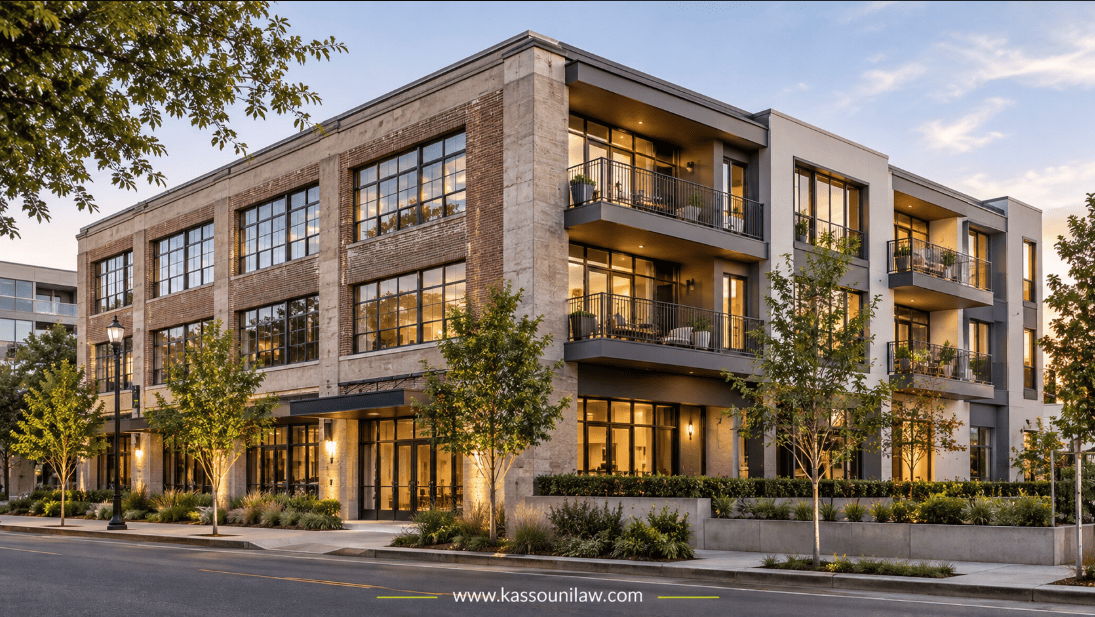
 Many California cities have vacant office buildings and other underused commercial properties. At the same time, the state needs more housing. Adaptive reuse converts existing buildings to new uses, including housing.
In 2025, the California Legislature passed a statewide law covering certain commercial-to-residential conversions. The law became operative on July 1, 2026. It provides a faster approval process for qualifying projects. However, local rules, building codes, and private property rights still matter.
What Is Adaptive Reuse Under California Law?
Adaptive reuse involves renovating an existing building for a different use. Under the statewide Office to Housing Conversion Act, an adaptive reuse project converts an existing building into residential or mixed-use space. This includes office-to-housing conversions.
Government Code section 65658.1 defines the term and excludes certain industrial-zone projects and hotel conversions.
California cities had local adaptive reuse programs before the new law. Los Angeles adopted its first adaptive reuse ordinance in 1999. AB 507 adds a statewide process alongside these local programs.
What Changed Under California’s 2026 Adaptive Reuse Law?
AB 507 and the Operative Date
Assembly Bill 507 (Chapter 493, Statutes of 2025) added Article 11.5 to the Government Code. The article begins at section 65658 and is known as the Office to Housing Conversion Act.
The law took effect on January 1, 2026. However, its provisions became operative on July 1, 2026, under Government Code section 65658.16. The bill text is available through CalMatters Digital Democracy.
Which Projects Qualify?
The Act covers projects that meet its eligibility requirements. These requirements determine whether a conversion can use the state approval process.
Projects that do not meet every condition cannot use that process. They may still qualify under a city’s or county’s local rules.
Streamlined Approval and Its Limits
Qualifying projects receive ministerial review and are treated as a use by right in most zones. This means the local agency reviews the application against objective standards rather than making a discretionary land-use decision.
Under Government Code section 65658.8, the agency must approve a project that meets the statutory standards. It has 60 days to review projects with 150 units or fewer and 90 days for larger projects.
If the agency fails to provide timely written notice identifying a conflict with the objective standards, the project is deemed to satisfy those standards.
The Act also sets limits on eligible projects:
- Projects cannot use this process in industrial zones that prohibit residential uses.
- Nonresidential uses in a mixed-use project must comply with local zoning or qualify as continuing nonconforming uses.
- Tourist hotel uses remain subject to existing local approval requirements.
How Does State Law Interact With Local Ordinances?
Cities and counties can adopt ordinances to implement the Act. They can also maintain local programs with alternative procedures and requirements. However, those ordinances cannot prevent an applicant from choosing the state process.
Government Code section 65658.3 addresses this relationship. A local agency without an adaptive reuse ordinance must review qualifying applications ministerially under the Act.
The law also applies to charter cities and general law cities. The Legislature declared office-to-housing conversion a matter of statewide concern under Government Code section 65658.4.
Because the Act is new, property owners should check its current provisions and any amendments before relying on it.
Which Commercial Properties May Qualify?
Not every commercial property qualifies for the state approval process. Government Code section 65658.5 sets out several eligibility requirements:
- Location. The parcel must be in an urbanized area. At least 75 percent of its perimeter must adjoin parcels developed with urban uses.
- Site size. The project site cannot exceed 20 acres.
- Zoning. The state process excludes industrial zones that do not allow residential uses.
- Building age and historic status. Buildings under 50 years old meet the age requirement. Older buildings and historic resources face additional conditions, including a local historic evaluation and compliance with the separate historic resource provisions.
- Affordable housing. Rental projects must reserve a specified share of units for lower-income households for 55 years. Ownership projects have different set-aside requirements and a 45-year term. Local rules may require a higher share.
- Mixed-use projects. At least half of the project’s square footage must be residential. Underground space does not count toward this calculation.
- Environmental review. The locality must require a Phase I environmental assessment. Any identified hazards must be addressed before the project receives a certificate of occupancy.
Construction labor standards also apply. The specific requirements depend on the project’s size and building height. Qualifying projects may also use density bonus law.
Meeting these conditions requires more than checking the building’s current use. Owners should review the parcel, zoning, building history, property records, and proposed design before assuming the project qualifies.
How Do Zoning and Local Land Use Rules Affect Conversions?
The state Act changes the approval process for qualifying projects. It does not remove every zoning or development requirement. Projects must still meet the applicable objective standards. Any nonresidential uses in a mixed-use project must also comply with local zoning or qualify as continuing nonconforming uses.
When Does Local Review Still Apply?
Projects that do not qualify for the state process generally follow the local zoning code. Depending on the property and proposed use, the city may require discretionary approval, a public hearing, or a conditional use permit.
Local development standards may also apply to qualifying projects where the Act allows them. Specific plans and overlay zones can affect what an owner may build.
How Does Los Angeles Handle Adaptive Reuse?
Los Angeles has its own Citywide Adaptive Reuse Ordinance, which took effect in early 2026. It expanded the city’s existing program beyond the areas covered by earlier rules.
According to Los Angeles City Planning, the approval process depends on the building’s age, zoning, historic status, and requested incentives. Buildings at least 15 years old in listed zones may qualify for streamlined review. Newer buildings and certain other projects may need additional approvals.
The local ordinance has its own requirements. Owners should confirm the current rules with the city before choosing an approval route. They should also compare the local program with the state Act. The two processes may differ in eligibility, review times, and affordability requirements.
Disputes can arise when a city and property owner disagree over how zoning or development rules apply. Kassouni Law discusses related issues in its articles on land use disputes with local governments and its California land use law practice.
What Building Code and Safety Requirements Still Apply?
A faster planning approval does not waive building code requirements. A conversion still needs building permits and must comply with applicable local codes and the California Building Standards Code in Title 24.
Historic buildings may also fall under the California Historical Building Code, found in Part 8 of Title 24.
How Does the Act Address Building Code Compliance?
Government Code section 65658.10 addresses alterations needed to meet building code requirements. Those alterations do not disqualify an otherwise eligible project from streamlined review.
Section 65658.5 also limits certain local development standards. A locality cannot require changes to the existing building envelope unless the local building code requires them.
What Technical Issues Can Affect a Conversion?
Office buildings were not designed for residential use. Converting them can raise questions about fire safety, natural light, ventilation, accessibility, plumbing, and structural capacity.
Assembly Bill 529 (2023) directed the Department of Housing and Community Development (HCD) to convene an adaptive reuse working group. HCD’s adaptive reuse page describes the group’s work and its draft report, released in May 2025.
The report discusses several technical barriers, including:
- Energy standards.
- Fire and life safety.
- Emergency exits and egress.
- Natural light and ventilation.
- Accessibility.
- Plumbing and acoustics.
- Structural requirements.
HCD has indicated that the final report may incorporate public comments. Owners should check for later reports and code changes before relying on the draft recommendations.
Building officials must still review life safety, accessibility, and required system upgrades. These requirements can affect project costs, design, and construction schedules. Disagreements may also arise between property owners, contractors, design professionals, and permitting agencies.
What Legal Disputes Can Arise During an Adaptive Reuse Project?
Adaptive reuse projects can involve land use, construction, and property law. Disputes may arise at different stages, including:
- Zoning and eligibility. Owners and local agencies may disagree over whether a building qualifies for the state process. They may also dispute whether a development standard is objective or whether the agency issued a required notice on time.
- Boundaries, easements, and access. Older commercial properties may have unclear boundaries, shared driveways, or recorded easements that affect parking and utilities. See the firm’s articles on boundary line disputes and how to read a California title report.
- Neighbor disputes. Nearby property owners may object to construction noise, access changes, or effects on shared property rights.
- Construction and development contracts. Owners, contractors, and developers may disagree over project scope, delays, change orders, defects, payments, or liens.
- Permits and approvals. Agency delays, disputed conditions, denials, or inconsistent decisions can hold up a project.
- Owner and investor disputes. Business partners may disagree over funding, project control, cost overruns, or exit rights.
Some disputes can be resolved through negotiation, mediation, or administrative review. Others may lead to litigation if the parties cannot reach an agreement or someone challenges a government decision. Depending on the facts, a lawsuit may involve breach of contract, declaratory relief, quiet title, or a petition for judicial review of an agency decision.
Claims against public agencies may have short filing deadlines. Owners and developers should review those deadlines before deciding how to proceed.
What Should Property Owners and Developers Review Before Starting?
Reviewing the property and project documents early can reveal problems before design and construction costs increase. Owners and developers should check the following:
- Title and ownership records. Confirm who owns the property and identify any liens, recorded restrictions, or easements. A title report can help identify these issues.
- Existing leases. Check tenant leases for termination rights, renewal options, and use restrictions that could affect the conversion.
- Zoning and land use rules. Confirm the property’s zoning, applicable overlays, and specific plans. Determine whether the project qualifies under the state Act or a local ordinance.
- Building condition. Arrange a professional assessment of the structure, building systems, life safety features, accessibility, and hazardous materials.
- Approval procedures. Identify the agencies involved, their review requirements, and the deadlines that apply.
- Easements and neighboring properties. Check access, utility, and parking rights. Consider whether construction or the proposed use could affect adjoining owners. The firm’s property rights page covers related disputes.
- Construction and development agreements. Review payment terms, project schedules, change-order procedures, warranties, and dispute resolution clauses before signing.
Legal Issues That Can Affect a California Adaptive Reuse Project
California’s 2026 adaptive reuse law gives some commercial-to-residential projects a faster approval process. However, qualifying properties must still meet the law’s conditions. Local ordinances, building codes, and private property rights also remain relevant.
Kassouni Law represents private parties in real estate litigation, land use conflicts, and property rights disputes. If a commercial property conversion has led to a disagreement over zoning, title, access, contracts, or permits, the firm can review the dispute and explain the available legal options. Learn more about the firm’s real estate law practice.
Call Kassouni Law at (877) 770-7379 or contact the firm to discuss your situation. Submitting a contact form does not create an attorney-client relationship.
Frequently Asked Questions
What is California’s Office to Housing Conversion Act?
It is the statewide framework added by AB 507 in 2025, codified beginning at Government Code section 65658. It provides streamlined, ministerial approval for qualifying adaptive reuse projects, including office conversions, and became operative on July 1, 2026. A project must meet the Act’s conditions to receive that treatment.
Can an office building be converted into apartments in California?
It may be possible. The Act contemplates converting office buildings to residential or mixed uses, and local programs may offer other routes. Whether a particular building can be converted depends on its location, zoning, age, condition, design, and the required approvals.
Does California’s adaptive reuse law eliminate zoning restrictions?
No. A qualifying project is a use by right in most zones, but it must still satisfy the statute’s objective standards. The Act excludes industrial zones that do not allow residential uses, and it does not preempt local ordinances that provide alternative procedures. Projects that do not qualify remain subject to the local zoning process.
What building code requirements apply to commercial-to-residential conversions?
The project must meet the applicable local code and Title 24, and historic buildings may use the California Historical Building Code. Issues often include fire and life safety, egress, light and ventilation, accessibility, plumbing, energy, and acoustics. A licensed design professional and the local building department can identify the requirements for a specific building.
Can neighboring property owners challenge an adaptive reuse project?
It depends on the claim and the type of approval. Streamlined ministerial approval limits the discretionary review that neighbors might otherwise use. Neighbors may still raise private-law issues, such as recorded easements or restrictions, or contest whether the project meets the statute’s conditions. Available claims turn on the facts.
The information provided here is for general informational purposes only and is not legal advice. Whether a property or project qualifies under state or local adaptive reuse rules depends on the facts and the law in effect. Consult a qualified attorney about your circumstances.