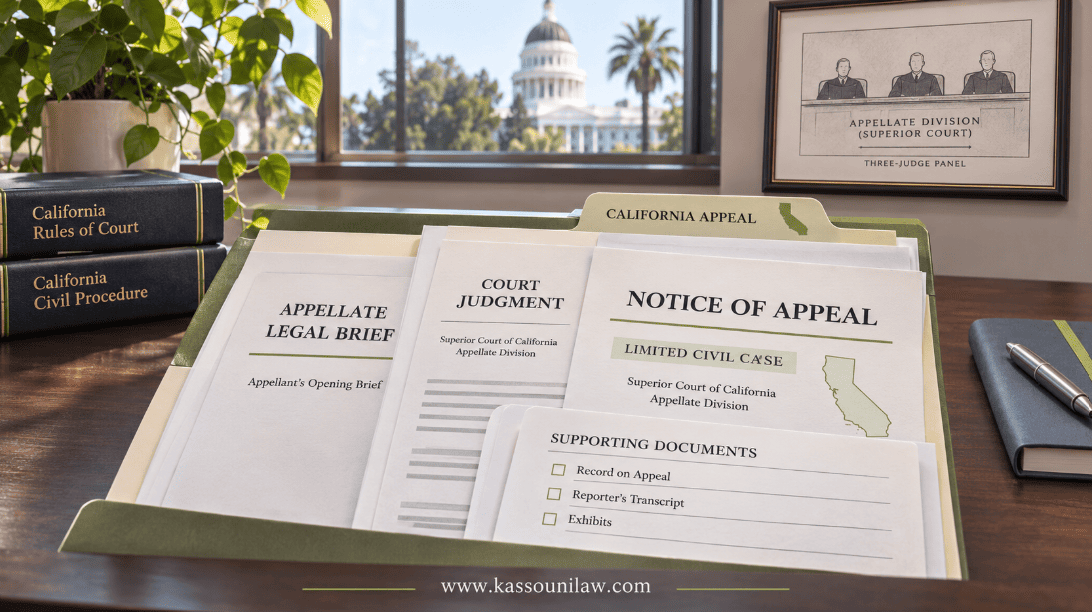
 A small business loses a $28,000 contract dispute in superior court. The owner believes the judge misread the contract and wants to appeal. A search for the next step reveals something unexpected. The appeal ordinarily does not go to the California Court of Appeal.
A limited civil case appeal in California generally goes to the superior court’s appellate division. That division has its own judges and appellate procedures. It also follows shorter filing deadlines than an unlimited civil appeal.
What Is a Limited Civil Case in California?
A limited civil case is a lawsuit within the superior court’s limited jurisdiction. Code of Civil Procedure section 85 sets the main requirements.
The amount in controversy cannot exceed $35,000. It generally reflects the demand, recovery sought, property value, or disputed lien. Attorney’s fees, interest, and costs do not count toward this limit.
However, the amount alone does not determine the case classification. The requested relief must also qualify for limited civil treatment. Code of Civil Procedure section 86 identifies several qualifying cases:
- Money or property claims at law. Contract and personal injury claims may qualify when the demand or property value does not exceed $35,000.
- Unlawful detainer actions. These eviction cases qualify when the total damages claimed do not exceed $35,000.
- Certain lien actions. Some personal property and real property lien proceedings qualify within the statutory limit.
The same statute excludes certain disputes, including cases challenging the legality of taxes, assessments, tolls, or municipal fines. Therefore, a claim below $35,000 does not automatically qualify.
The amount originally demanded also matters because the final judgment may differ from the amount in controversy. Classification generally depends on the claims and relief sought, rather than the court’s final award.
A court may reclassify a case when the statutory requirements support that change. However, a judgment below $35,000 does not automatically convert an unlimited civil case into a limited one.
Classification also determines where an appeal goes. Small claims cases follow a separate process under Rule 8.820, which excludes them from the limited civil appeal rules.
Where Do Limited Civil Appeals Go?
Code of Civil Procedure section 904.2 directs appeals from specified limited civil rulings to the superior court’s appellate division. Unlimited civil appeals generally go to the California Court of Appeal under section 904.1.
The two appellate bodies differ in their structure. Under section 77, each county has an appellate division. It consists of three judges or four when the Chief Justice finds that necessary. The division operates within the superior court rather than as a separate statewide court.
Limited civil appeals also follow different procedural rules. Rules 8.800 through 8.843 and 8.880 through 8.891 govern appellate division proceedings. They address notices of appeal, records, briefs, hearings, decisions, and costs.
For example, rule 8.822 generally gives a party 30 days after service of notice of entry or a filed-endorsed judgment. If neither document triggers the deadline, the party generally has 90 days after entry of judgment. Certain rules provide limited extensions.
The firm’s guide to filing an appeal explains the general process for unlimited civil cases. However, its deadlines and procedures should not be assumed to apply to limited civil appeals.
The appellate division’s decision generally ends the ordinary appeal process. In exceptional circumstances, a case may transfer to the Court of Appeal under specific rules. That transfer is not a routine second appeal.
How Does the Superior Court Appellate Division Work?
Who hears the appeal
The Chief Justice assigns judges to each appellate division under Code of Civil Procedure section 77. Assigned judges may serve in the same county or another county. Retired superior court and higher court judges may also serve.
Each division has three judges, or four when the Chief Justice finds that necessary. The presiding judge selects up to three judges to hear each case. Two judges must agree on the decision.
The appellate division must provide a brief statement of reasons for its judgment. However, it does not need to prepare a full written opinion in every case.
Briefs and the record
Rule 8.882 sets the briefing deadlines. The appellant’s opening brief is generally due within 30 days after the appellate division files the record. A different deadline applies when the appeal proceeds without a reporter’s transcript. In that situation, the opening brief is generally due within 60 days after the appellant files the election under rule 8.845.
The respondent’s brief is due 30 days after the opening brief. The appellant’s reply brief is due 20 days after the respondent’s brief. Parties may also seek extensions under the rule.
Rule 8.830 explains what the appellate record must contain. For written trial court documents, the appellant may use:
- A clerk’s transcript.
- An appendix.
- The original trial court file, if local rules permit.
- An agreed statement.
An appellant must also provide a record of oral proceedings when an issue depends on what happened in court. Available options include a reporter’s transcript, an official electronic recording when local rules permit, an agreed statement, or a statement on appeal.
Without a reporter’s transcript, the appellate division presumes the record contains all material needed to decide the issues. However, that presumption applies only when the claimed error appears on the face of the record.
The firm’s article on the appellate record explains why the record matters.
Oral argument and decisions
Rule 8.885 governs oral argument. Each side generally receives 10 minutes to present its position. Parties may waive oral argument by filing a notice within seven days after the clerk sends the argument notice.
The appellate division issues its decisions under rule 8.887. Judges do not have to prepare a full written opinion in every case. However, Code of Civil Procedure section 77 requires the judgment to include a brief statement of reasons. A judgment stating only “affirmed” or “reversed” is insufficient.
Which Judgments and Orders Can Be Appealed in a Limited Civil Case?
Code of Civil Procedure section 904.2 identifies the judgments and orders that may be appealed. These include:
- Final judgments. A party may appeal a judgment that resolves the case, but not an interlocutory judgment.
- Orders after judgment. A party may appeal an order made after an appealable final judgment.
- Venue orders. Orders changing or refusing to change the place of trial are appealable.
- Service and forum orders. These include orders granting a motion to quash service of summons or staying the action because of an inconvenient forum. Certain written dismissal orders following an inconvenient-forum ruling are also appealable.
- New trial and JNOV orders. A party may appeal an order granting a new trial or denying a motion for judgment notwithstanding the verdict.
- Attachment orders. A party may appeal an order discharging or refusing to discharge an attachment. An order granting a right to attach is also appealable.
- Injunction orders. Orders granting or dissolving an injunction, or refusing to do either, may be appealed.
- Receiver orders. An order appointing a receiver is appealable.
The list differs from section 904.1, which governs most unlimited civil appeals. For example, section 904.2 expressly includes venue orders. Section 904.1 covers other orders, including certain monetary sanctions exceeding $5,000, that section 904.2 does not list.
Many unfavorable rulings cannot be appealed immediately. A party generally must wait until the court enters a final judgment. The firm’s article on interlocutory appeals explains exceptions in unlimited civil cases.
An appeal also differs from a motion filed in the trial court. A motion for a new trial asks the trial judge to reconsider the result. A motion to reconsider an appealable order asks the court to revisit that ruling. These motions may affect the appeal deadline, but neither replaces a notice of appeal.
Under rule 8.821, an appellant must serve and file a notice of appeal in the superior court that issued the judgment or order. The notice must identify the specific ruling being challenged. The notice of appeal starts the appellate process, but it does not replace the separate requirement to designate the record.
What Deadlines Apply to a Limited Civil Case Appeal?
Limited civil appeals have shorter deadlines than unlimited civil appeals. Rule 8.822 sets the ordinary deadline. A notice of appeal is due by the earliest of three dates:
- 30 days after the clerk serves notice. The period starts when the clerk serves a notice of entry or file-endorsed judgment.
- 30 days after a party serves notice. The notice must include proof of service.
- 90 days after entry of judgment. This period applies when neither type of notice starts an earlier deadline.
Rule 8.104 sets different periods for ordinary appeals to the Court of Appeal. Rule 8.100(a)(1) excludes limited civil cases from those ordinary procedures. Limited civil appeals follow rule 8.822 instead.
A notice filed after the court renders judgment but before formal entry remains valid. The appellate division treats it as filed immediately after entry.
The presiding judge cannot extend the deadline to file a notice of appeal. Under rule 8.822(d), the appellate division must dismiss an appeal filed late.
Certain posttrial motions extend the deadline. Rule 8.823 covers motions for a new trial, to vacate a judgment, for judgment notwithstanding the verdict, and to reconsider an appealable order.
The extension depends on the motion:
- New trial motion denied. The deadline becomes the earliest of 15 days after service of the denial order or notice of entry, 15 days after denial by operation of law, or 90 days after entry of judgment.
- Motion to vacate denied. The deadline becomes the earliest of 15 days after service of the denial order or notice of entry, 45 days after the first motion was filed, or 90 days after entry of judgment.
- Judgment notwithstanding the verdict denied. The deadline becomes the earliest of 15 days after service of the denial order or notice of entry, 15 days after denial by operation of law, or 90 days after entry of judgment.
- Motion to reconsider an appealable order denied. The deadline becomes the earliest of 15 days after service of the denial order or notice of entry, 45 days after the first motion was filed, or 90 days after entry of the appealable order.
These extensions apply only when the party files a valid motion within the required period. Rule 8.823 does not shorten the ordinary appeal deadline.
The appellant must serve and file the notice in the superior court that issued the judgment or order. The notice must include the required filing fee or a fee waiver application. Under rule 8.821, the clerk must accept the notice even if the appellant does not pay the fee immediately. The clerk then gives the appellant 15 days to pay or submit a fee waiver application. Failure to respond may lead to dismissal.
What Issues Can the Appellate Division Review?
The appellate division reviews alleged errors based on the existing record. Common issues include:
- Legal errors. The trial court applied the wrong legal rule or misinterpreted a statute or contract.
- Insufficient evidence. The evidence does not support the court’s factual findings.
- Evidence rulings. The court improperly admitted or excluded evidence.
- Jury instructions. The instructions misstated the law or confused the jury.
- Procedural errors. A mistake during the proceedings affected the outcome.
The standard of review depends on the issue:
- De novo review. The appellate division independently examines questions of law.
- Substantial evidence review. The court examines whether sufficient evidence supports the factual findings.
- Abuse of discretion. The court examines whether a discretionary ruling exceeded the bounds of reason.
An error alone does not justify reversal. Article VI, section 13 of the California Constitution requires a miscarriage of justice before a reviewing court sets aside a judgment for trial error.
An appeal is not a new trial. The appellate division reviews the existing record. It does not hear new witnesses or consider new evidence.
Can Someone Challenge an Appellate Division Decision?
A party cannot file another ordinary appeal from an appellate division decision. Further review is limited and does not happen automatically.
Under rule 8.888, the decision generally becomes final 30 days after the clerk sends it to the parties. A party may petition for rehearing within 15 days under rule 8.889. The appellate division must order rehearing before its decision becomes final.
Transfer to the Court of Appeal is another possible route. Code of Civil Procedure section 911 and rules 8.1005 through 8.1008 govern this process. Transfer is available when necessary to secure uniformity of decision or settle an important question of law.
There are three ways a case may reach the Court of Appeal:
- Certification by the appellate division. Under rule 8.1005, the appellate division may certify a case for transfer. A party may apply for certification after the record is filed. The application must arrive no later than 15 days after the clerk sends the decision or another qualifying notice.
- Petition to the Court of Appeal. Under rule 8.1006, a party may petition for transfer only after the appellate division denies an application for certification. The petition is due within 15 days after the appellate division decision becomes final. The deadline generally cannot be extended.
- Transfer on the Court of Appeal’s own motion. Under rule 8.1008, the Court of Appeal may order transfer within 30 days after the decision becomes final. The court may extend that period by up to 20 days. If it does not order transfer within the applicable period, transfer is deemed denied.
A transfer request is not another appeal. The Court of Appeal may deny the request, and that denial cannot be challenged through a petition for review in the California Supreme Court. Rule 8.500 expressly excludes transfer denials from Supreme Court review.
The California Supreme Court may become involved if the Court of Appeal accepts the transfer and decides the case. A party may then petition for review within 10 days after the Court of Appeal’s decision becomes final. Rule 8.500 governs that deadline.
In Snukal v. Flightways Manufacturing, Inc. (2000) 23 Cal.4th 754, the Supreme Court addressed the scope of review after a transfer. It held that the Court of Appeal must resolve the issues necessary to decide the appeal. It cannot decide only selected issues and send the remaining appellate issues back to the appellate division.
What Happens After the Appellate Division Issues Its Decision?
The appellate division may affirm, reverse, or modify the judgment. It may also send the case back for further proceedings.
An affirmance leaves the judgment in place. A reversal sets aside the judgment or affected portion. A modification changes the judgment where the law permits.
Rule 8.888(c) addresses a specific situation involving money judgments. If affirmance depends on a party consenting to a change in the judgment amount, the appellate division must reverse unless that party files consent before the decision becomes final.
After the decision becomes final, rule 8.890 requires the appellate division to issue a remittitur. This document formally returns the case to the trial court. The clerk sends it with a file-endorsed copy of the opinion or order.
If the Court of Appeal accepts a transfer, the remittitur follows that court’s decision instead.
The appellate decision controls further proceedings. A reversal does not automatically resolve the underlying dispute in the appellant’s favor. The trial court may need to conduct additional proceedings or take other action consistent with the appellate ruling.
Limited Civil Appeals Turn on Appealability, Deadlines, and the Record
Limited civil appeals follow specific procedures through the superior court’s appellate division. The type of ruling, applicable deadlines, and available record can all affect a party’s options.
Kassouni Law represents private parties in appellate matters. If you are considering an appeal from a limited civil judgment in California, the firm can review your circumstances and discuss the legal options that may be available.
Call Kassouni Law at (877) 770-7379 or contact the firm to discuss your situation. Submitting a contact form does not create an attorney-client relationship.
Frequently Asked Questions
What is the monetary limit for a limited civil case in California?
The limit is $35,000 under section 85, excluding attorney’s fees, interest, and costs. The case must also seek relief the law treats as limited.
Where do limited civil appeals go in California?
They go to the appellate division of the superior court under section 904.2. Unlimited civil appeals go to the Court of Appeal.
How long does someone have to appeal a limited civil judgment?
Rule 8.822 sets the earliest of 30 days after the clerk or a party serves notice of entry, or 90 days after entry of judgment. Rule 8.823 extends the time after certain posttrial motions. A late notice leads to dismissal.
Can the appellate division overturn a limited civil court judgment?
Yes, when the record shows prejudicial legal error or insufficient evidence. The court defers to factual findings, and no outcome is guaranteed.
Can someone challenge an appellate division decision in the California Court of Appeal?
Only through transfer. The appellate division may certify a case, or a party may petition for transfer. Transfer must be necessary to secure uniformity or settle an important question of law.
The information provided here is for general informational purposes only and is not legal advice. Whether a limited civil judgment can be appealed depends on the facts, the ruling involved, and the law in effect. Consult a qualified attorney about your circumstances.