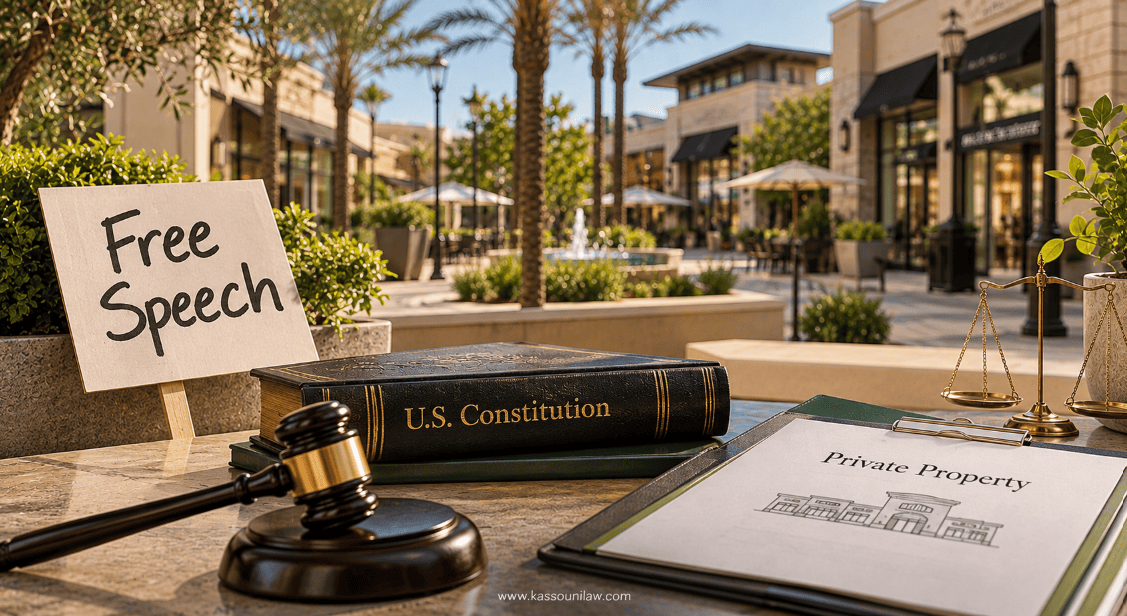
 Whether someone may speak on private property often depends on who owns the property and what legal protections apply. On government property, such as a public sidewalk or park, the First Amendment limits what the government can do. On privately owned property, the analysis changes.
The First Amendment generally protects speech from government restrictions. It does not ordinarily give people a constitutional right to use another person’s private property for speech.
California provides an additional layer of protection. The California Constitution contains its own free speech clause, and the California Supreme Court has interpreted it to protect some speech in certain privately owned places that function as public gathering spaces. That protection has limits. It does not make every private property a public forum.
Free speech rights on private property in California therefore depend on the property, the expressive activity, and the circumstances.
Does the First Amendment Protect Speech on Private Property?
Generally, no. The First Amendment restricts government action. Its protection against abridging free speech applies to the federal, state, and local governments. A private property owner is not the government for this purpose.
That distinction shapes the federal rule:
- Government action: a First Amendment claim ordinarily requires that a government actor imposed the restriction.
- Public forums: speech rights are strongest on government-owned property that the government has opened for expression, such as streets and parks.
- Private property and businesses: owners generally control who may enter and what activities occur on their premises.
The U.S. Supreme Court applied this rule to shopping centers. In Lloyd Corp. v. Tanner (1972) 407 U.S. 551, it rejected a First Amendment claim to distribute handbills in a private center. In Hudgens v. NLRB (1976) 424 U.S. 507, it confirmed that the First Amendment did not protect picketing in a privately owned shopping center.
A property owner’s decision to restrict speech is therefore not automatically a First Amendment violation. State law and statutes can still create separate rights, which is where California differs.
Does California Law Provide Broader Free Speech Rights?
In some settings, yes. Article I, Section 2 of the California Constitution provides that “every person may freely speak, write and publish his or her sentiments on all subjects, being responsible for the abuse of this right.” It adds that “a law may not restrain or abridge liberty of speech or press.”
A state constitution can protect individual liberties more broadly than the federal Constitution does. The U.S. Supreme Court has recognized that states may do so. California courts have used that room to apply Article I, Section 2 in certain privately owned places.
Statutes can also create separate speech-related rights in particular settings, apart from either constitution. State constitutional protection does not automatically apply to every privately owned property. California courts ask what kind of property is involved and how it is used. The next sections show how.
What Did Pruneyard Shopping Center v. Robins Decide?
Pruneyard is the central California authority on this subject. It produced two decisions: one from the California Supreme Court and one from the U.S. Supreme Court.
The California Supreme Court Decision
In Robins v. Pruneyard Shopping Center (1979) 23 Cal.3d 899, several high school students set up a table at a large shopping center in Santa Clara County. They sought signatures for a petition opposing a United Nations resolution. Security guards told them to leave, citing a center policy against expressive activity unrelated to its commercial purposes.
The students sued. The California Supreme Court held that the California Constitution protects speech and petitioning in a shopping center, even though the center is privately owned. The court overruled its earlier decision in Diamond v. Bland.
The ruling was not unlimited. The court recognized that a center may adopt reasonable regulations on the time, place, and manner of expression. It focused on a large shopping center open to the public, not on every private property.
The U.S. Supreme Court Decision
The owner appealed. In PruneYard Shopping Center v. Robins (1980) 447 U.S. 74, the U.S. Supreme Court affirmed. The owner argued that requiring it to allow the activity violated its property rights under the Fifth and Fourteenth Amendments and its own First Amendment rights.
The Court rejected both arguments on the facts before it. It held that the requirement did not amount to an unconstitutional taking, and it found no violation of the owner’s own speech rights. The center was open to the public, and the students’ views were unlikely to be attributed to the owner.
The Court also held that Lloyd did not limit a state’s power to adopt, in its own constitution, individual liberties more expansive than the federal Constitution provides. That is why Pruneyard stands for state-law protection, not a federal right to speak on private property.
Pruneyard did not create a general right to free speech on all private property. It addressed a large shopping center and left room for reasonable owner regulation.
Why Shopping Centers Can Be Different From Other Private Property
The type and function of the property matter. A shopping center invites the public to gather, shop, and spend time. In that sense, parts of it can resemble a traditional town square, even though the owner holds title.
Later California Supreme Court decisions confirm that the analysis is property-specific:
- Fashion Valley Mall v. NLRB (2007) 42 Cal.4th 850 treated a shopping mall as a place where people may reasonably exercise Article I, Section 2 rights. It held that the mall could not enforce a rule banning speech urging a boycott of its tenants, because the rule targeted content.
- Ralphs Grocery Co. v. UFCW Local 8 (2012) 55 Cal.4th 1083 held that the area outside a stand-alone grocery store’s customer entrance was not a public forum. The court looked to design: common areas furnished to encourage lingering differ from entrance areas used mainly for entering and leaving.
- Golden Gateway Center v. Golden Gateway Tenants Assn. (2001) 26 Cal.4th 1013 held that Pruneyard did not give a tenants association a constitutional right to distribute newsletters in a private apartment complex. The complex restricted access, unlike the open shopping center in Pruneyard.
Applying this reasoning, the analysis for a shopping center can differ from the analysis for:
- A private residence
- A private office
- A restricted commercial facility
- Industrial property
- Private land not generally open to the public
These categories are not a rigid list. A property’s design, public accessibility, and use can all affect the outcome, and courts examine the particular space involved.
Can a California Property Owner Restrict Speech on Private Property?
Yes, within limits. Property owners retain significant rights to control and manage their premises. California free speech protection, where it applies, does not necessarily prevent reasonable rules about how speech occurs.
Pruneyard itself recognized reasonable regulation. Owners may adopt rules concerning:
- Time: limiting activity to certain hours.
- Place: designating areas that avoid blocking entrances or walkways.
- Manner: setting rules about noise, displays, or the number of participants.
- Safety and access: keeping exits, aisles, and emergency routes clear.
- Business operations and property management: preventing interference with tenants, customers, and routine operations.
- Unrelated conduct: enforcing rules against behavior that is not protected speech.
Not every restriction is valid, and not every restriction is unconstitutional. Fashion Valley shows the difference. A neutral time, place, and manner rule may be permissible. A rule that bans speech because of its message faces stricter scrutiny.
What About Businesses Open to the Public?
A business that welcomes customers does not become government property. Public access and government ownership are different things. Most businesses open to the public remain private property under federal law.
California constitutional protections apply to only certain privately owned, public-facing spaces. Shopping centers are the primary example because of the way they are designed and used. Ralphs shows that a single store, even a busy one, is not treated the same way.
Businesses and property managers with public-facing space often review their rules with counsel experienced in business law before a dispute arises. The right answer depends on the property, not on the label “open to the public.”
What Types of Speech or Activity May Raise Legal Questions?
Disputes tend to involve familiar kinds of expressive activity:
- Petitioning and signature gathering
- Political expression
- Leafleting and distribution of literature
- Demonstrations
- Peaceful advocacy
Whether the law protects a particular activity depends on the property and circumstances. The same activity may be protected in one location and not in another.
Protected speech does not permit trespassing, threats, violence, harassment, obstruction, or other independently unlawful conduct. A speaker who commits those acts is not shielded by the free speech clause.
Free Speech Rights vs. Private Property Rights
This area of law is a balance between competing interests. Neither side has absolute rights.
- Speakers may have protected rights in some settings.
- Property owners retain property and management rights.
- California constitutional protections can differ from federal protections.
- The specific location and circumstances can determine which protections apply.
Pruneyard addressed the property-rights side directly. The U.S. Supreme Court held that the requirement there was not a taking on those facts. That does not mean California law overrides property rights in every dispute. In Cedar Point Nursery v. Hassid (2021) 594 U.S. 139, the Court held that a California regulation granting union organizers access to private farmland was a per se physical taking. It distinguished Pruneyard because the shopping center was open to the public, while the farms were not. Our page on constitutional property rights and related property rights law describes how owners protect their interests against government action.
What Can a Property Owner Do When Speech Creates a Property Dispute?
Owners benefit from slowing down before acting. At a high level, they may consider:
- Reviewing their existing property rules and how they are applied
- Identifying whether the property falls within a California free speech doctrine
- Determining whether the activity interferes with legitimate operations
- Reviewing applicable statutes and case law
- Seeking legal advice before taking significant enforcement action
Enforcement against a speaker can carry legal risk if the property falls within California’s protections, so the characterization of the property matters first.
What Can Someone Do If Their Speech Rights Are Restricted?
A person who believes a restriction was improper may need to determine:
- Who owns the property
- Whether the property is open to the public
- What type of speech or activity occurred
- What rule or restriction was imposed
- Whether California constitutional protections apply
- Whether another legal right or statutory protection is involved
No claim is certain to succeed. Cases like Golden Gateway and Ralphs show that courts decline to extend Pruneyard where the property is not openly accessible or not designed for public gathering.
When Should a California Property Owner or Speaker Talk to a Lawyer?
Legal advice may help in situations such as these:
- A property owner faces a dispute over political activity or demonstrations.
- A business receives demands concerning speech activity on its property.
- A speaker is prohibited from distributing literature or gathering signatures.
- A shopping center or other public-facing property has a dispute over expressive activity.
- A property owner is considering enforcement against an organized speech activity.
- A dispute may involve both constitutional and property rights.
Balancing Free Speech and Private Property Rights
California law does not treat all private property the same when free speech is involved. The First Amendment generally limits government action, while California’s Constitution can provide broader protections in certain privately owned settings.
The property’s nature, public accessibility, the type of expressive activity, applicable rules, and the circumstances of the dispute can all affect the legal analysis. Property owners and speakers should review the specific facts before assuming that either property rights or free speech rights are absolute.
Kassouni Law represents California property owners and others in constitutional and property rights disputes. If you have questions about speech activity on private property, call (877) 770-7379 or schedule a consultation through our contact page. Submitting a contact form does not create an attorney-client relationship.
Frequently Asked Questions
Does the First Amendment protect speech on private property in California?
Generally, no. The First Amendment restricts government action, and a private owner is not the government. California’s own Constitution can provide protection in certain private places.
Can a property owner prohibit free speech on private property?
Often, yes, but not in every case. Owners have broad control over their premises. Where California protections apply, owners may still adopt reasonable rules but may face limits on content-based bans.
Does California have broader free speech protections than the First Amendment?
In certain settings, yes. Article I, Section 2 of the California Constitution has been applied to some privately owned places that function as public gathering spaces.
What is the Pruneyard case?
Pruneyard Shopping Center v. Robins is the case in which the California Supreme Court held that the state Constitution protects speech and petitioning at a large shopping center. The U.S. Supreme Court affirmed in 1980.
Do free speech rights apply in California shopping centers?
They can, subject to reasonable time, place, and manner rules. The outcome depends on the specific area of the center and the nature of the activity.
Can a business open to the public restrict political speech?
It depends on the property. A stand-alone store is analyzed differently from a shopping center, as Ralphs shows. Content-based bans in the type of space covered by Pruneyard can raise constitutional problems.
The information provided here is for general informational purposes only and does not constitute legal advice. Laws and individual circumstances vary, so readers should consult a qualified California attorney about their specific situation.