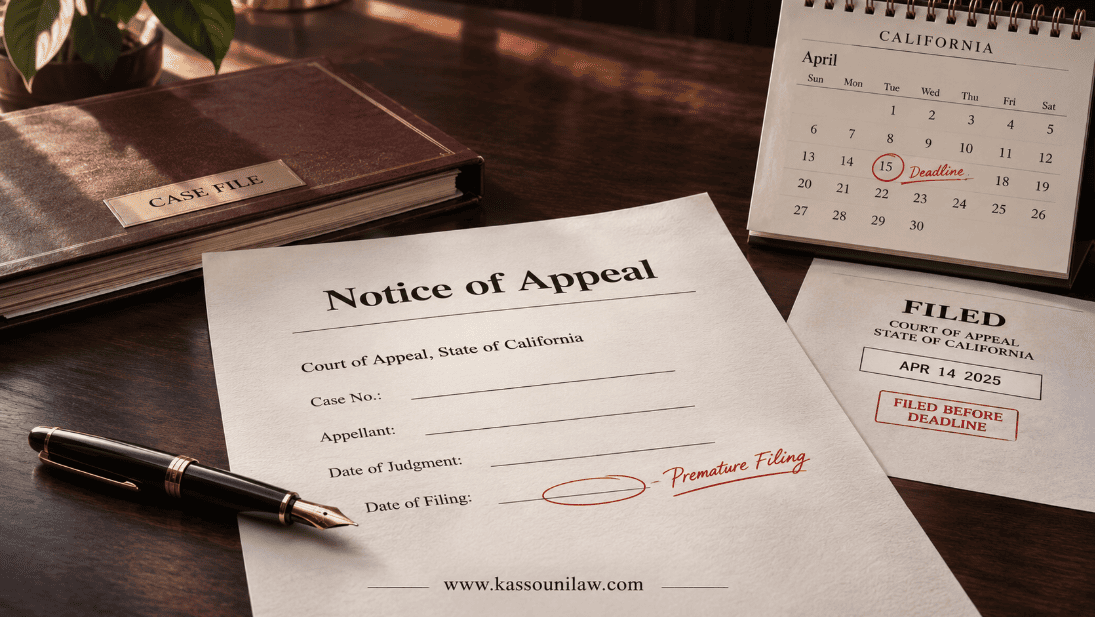
 A business owner files a notice of appeal, then notices that the wrong order was named. Another litigant files a notice the day after a judge announces a ruling. The court has not entered judgment yet. Both wonder whether their appeals can proceed.
California courts interpret notices of appeal liberally. However, some errors can prevent appellate review. Liberal construction cannot create jurisdiction where none exists. The outcome depends on the type of error.
What Makes a Notice of Appeal Defective in California?
Rule 8.100(a) of the California Rules of Court sets the basic requirements for most civil appeals. The appellant must file and serve the notice in the superior court that issued the judgment or order. The appellant or their attorney must also sign it. Appeals in limited civil cases follow a parallel rule, rule 8.821.
What Must the Notice Identify?
The notice does not require extensive detail. Under rule 8.100(a)(2), courts “must liberally construe” it. The notice is sufficient if it identifies the judgment or order being appealed. The appellant does not need to name the reviewing court.
Does Failure to Serve the Notice Invalidate It?
Rule 8.100(a)(3) addresses service separately. Failure to serve the notice does not prevent the appellant from filing it or affect its validity. However, the appellant may still need to correct the service failure.
Filing Fees and Deposits
The appellant must submit the filing fee, a fee waiver application, or a waiver order with the notice. A deposit must also be made with the superior court clerk.
However, an unpaid fee does not automatically invalidate the notice. Under rule 8.100(b)(3), the clerk must still file it.
The clerk then sends written notice and gives the appellant 15 days to pay the fee or deposit, or apply for a waiver. If the appellant does not resolve the deficiency, the court may dismiss the appeal. Under rule 8.100(c) and (d), the court may vacate that dismissal for good cause.
Filing requirements and content defects receive different treatment. A late notice or one filed in the wrong court presents a filing problem. A notice that misidentifies an order or omits a party presents a content issue. This distinction can determine whether the appeal proceeds.
Can a Court Accept a Notice of Appeal With Technical Errors?
Yes, in many cases. The standard comes from Luz v. Lopes (1960) 55 Cal.2d 54, 59-60. Courts interpret a notice liberally when it is “reasonably clear what appellant was trying to appeal from.” The opposing party must not have been misled or prejudiced.
In Luz, the notice identified an order denying relief from a default. However, it also referred to “all orders and rulings” adverse to the defendants. The Supreme Court interpreted this language to include the default judgment. The plaintiffs had not been misled.
In re Joshua S. (2007) 41 Cal.4th 261 applied the same standard. The appellant challenged a juvenile court order terminating jurisdiction. The Department argued that additional language about funding limited the appeal. The Supreme Court rejected this argument as overly technical. The Department had shown no prejudice.
Naming the Wrong Order
Vibert v. Berger (1966) 64 Cal.2d 65, 67-70, involved a notice that identified a nonappealable order. The trial court had already entered a judgment. The Supreme Court interpreted the notice as an appeal from that judgment. The opposing party had suffered no prejudice.
However, the court rejected a second notice filed 249 days after judgment. The filing deadline had already passed. Liberal construction could not cure that delay.
The K.J. Decision on an Omitted Party
K.J. v. Los Angeles Unified School District (2020) 8 Cal.5th 875 addressed a notice that omitted a party. The trial court had personally sanctioned a lawyer. The client’s attorney filed a notice in the client’s name. The notice identified the sanctions order but omitted the sanctioned lawyer. The Court of Appeal dismissed the appeal for lack of jurisdiction.
The Supreme Court reversed that decision. It interpreted the notice to include the sanctioned lawyer. The record showed that the lawyer intended to participate in the appeal. The school district had not been misled or prejudiced. The sanctions order affected the lawyer personally. The lawyer had also challenged the order in the trial court.
The Court limited its ruling to the circumstances before it. It noted that the record may not clearly establish an omitted lawyer’s intent in other cases. Prejudice to the opposing party may also prevent a court from including an omitted party. The decision did not give a client standing to appeal sanctions imposed on a lawyer. The Court also described expressly naming the lawyer as the better practice.
The appellate record can help establish who participated in the trial court proceedings and what each person challenged. The firm’s guide to appellants and appellees explains the parties’ roles during an appeal.
Liberal construction can preserve an appeal despite a technical defect. However, it cannot extend a missed deadline or make a nonappealable order appealable.
What Happens If You File a Notice of Appeal Too Early?
When Is a Judgment Rendered or Entered?
A judgment is rendered when the court decides the case and announces its decision. Entry occurs when the judgment is filed or recorded in the judgment book. Under rule 8.104(c), the entry date is the date the judgment is filed or entered in the judgment book. These events do not always occur on the same day.
Three Situations Involving Premature Notices
- After judgment is rendered but before entry. Rule 8.104(d)(1) provides that the notice “is valid.” It is treated as filed immediately after entry of the judgment.
- After the court announces its intended ruling but before judgment is rendered. Under rule 8.104(d)(2), the reviewing court “may treat” the notice as filed immediately after entry. This provision gives the court discretion.
- Before an intended ruling or appealable decision is announced. Neither provision covers this situation. The appeal may be dismissed as premature.
First American Title Co. v. Mirzaian (2003) 108 Cal.App.4th 956, 959-961, illustrates the third situation. A default was entered against the defendant by the clerk. A motion to set aside the default was denied. The defendant then filed a notice of appeal before the default prove-up hearing. No default judgment had yet been entered.
The Court of Appeal dismissed the appeal. A clerk’s entry of default is not appealable. Neither was the order denying the motion to set aside that default. The notice was filed before judgment was rendered or an intended ruling announced. The premature filing provisions therefore did not apply.
A default judgment was entered months later. The court declined to treat the earlier notice as a premature appeal from that judgment.
An early notice does not always preserve an appeal. The rules protect notices filed in the first two situations. They do not cover every premature filing.
Which Mistakes Can Actually Invalidate an Appeal?
Some defects can be overcome through liberal construction. Others can prevent appellate review. The following errors may lead to dismissal or limit the issues an appellate court can review:
- A late notice. Under rule 8.104(b), the reviewing court must dismiss an appeal if the appellant files the notice late. A drafting correction cannot fix a missed deadline.
- An appeal from a nonappealable order. In Mirzaian, the court dismissed the appeal because the order was not appealable. Vibert involved different circumstances. The trial court had already entered an appealable judgment.
- A judgment omitted from the notice. In Unilogic, Inc. v. Burroughs Corp. (1992) 10 Cal.App.4th 612, 625, the notice identified judgments on two causes of action. The wording was “not in the least ambiguous.” The court therefore lacked jurisdiction to review the judgment on the third cause of action.
- An unclear record of a party’s intent to appeal. In K.J., the record clearly showed that the omitted lawyer intended to appeal. A less clear record may not support the same result.
- Filing in the wrong court. Rule 8.100(a)(1) requires appellants to file the notice in the superior court that issued the judgment or order. Filing it elsewhere may not satisfy this requirement.
Not every wording error affects an appeal. In Mirzaian, the court treated a reference to the appellate department as unnecessary language. That wording did not cause the court to dismiss the appeal.
Can You Correct or Amend a Defective Notice of Appeal?
Some defects do not require an amendment. In Luz and K.J., the courts interpreted the notices liberally. They considered the information already provided. However, this approach does not allow appellants to add new information without limits.
Other defects can be corrected. Under rule 8.100(a)(3), the appellant may need to correct a failure to serve the notice. The appellant may also pay an outstanding fee within the 15-day period allowed by the clerk.
Adding a judgment, order, or party raises a different issue. In Unilogic, the court refused to review a judgment that the notice did not identify. In Vibert, the court rejected a second notice filed 249 days after judgment. Rule 8.104(b) does not allow courts to extend the deadline for filing a notice of appeal.
Rule 8.108 gives appellants additional time in certain cases involving postjudgment motions. However, it does not fix a defective notice. An appellant should seek legal advice before relying on an amended notice to preserve an appeal.
What Should You Check Before Filing a Notice of Appeal?
- Appealability. Confirm that the judgment or order is appealable.
- Dates. Verify when the court rendered and entered the decision.
- Deadline. Calculate the filing deadline under rule 8.104.
- Parties. Identify everyone who intends to appeal, including an attorney sanctioned personally.
- Judgment or order. Specify each judgment or order being challenged.
- Signature and court. Sign the notice and file it in the correct superior court.
- Service. Complete the required service.
- Fee and deposit. Check the filing fee and deposit requirements. Apply for a waiver if applicable.
- Records. Keep copies of the notice, proof of service, and filing confirmation. Under rule 8.25(b), a document is deemed filed on the date it is received by the clerk.
The firm’s guide to filing an appeal covers the filing process for property owners. Its timeline of a civil appeal explains what happens after the notice is filed.
Some Notice Errors May Be Corrected, but Appellate Jurisdiction Matters
A technical error does not always invalidate a notice of appeal. However, deadlines, appealability, and jurisdiction still matter. The outcome depends on the type of defect and the record.
Kassouni Law represents private parties in appellate matters. A defective or prematurely filed notice may raise questions about available remedies. The firm can review the circumstances and discuss possible legal options.
Call Kassouni Law at (877) 770-7379 or contact the firm to discuss your situation. Submitting a contact form does not create an attorney-client relationship.
Frequently Asked Questions
Can a California court dismiss an appeal because of a mistake in the notice?
Yes, in some cases. Minor errors are often excused under liberal construction. A late notice, an appeal from a nonappealable order, or a notice that clearly omits a judgment can lead to dismissal.
Can I correct a defective notice of appeal after filing?
It depends on the defect. Courts may interpret the notice liberally, and appellants may correct service failures. However, adding a judgment or party generally requires a notice filed within the applicable deadline. A legal review can help identify the available options.
Is a notice of appeal valid if I file it before judgment is entered?
Yes. Under rule 8.104(d)(1), the notice remains valid if you file it after the court renders judgment but before entry. However, the rules cover notices filed before judgment is rendered only in limited circumstances.
What happens if I forget to include a party in the notice of appeal?
The result turns on the record. K.J. allowed an omitted attorney to join where the record showed intent and the other side was not prejudiced. It does not apply automatically to every omitted party.
Can I appeal an order that the court has not yet entered?
Sometimes. California courts may treat a notice as filed after entry if the court has rendered judgment or announced its intended ruling. However, if the court has not issued a ruling or appealable order, it may dismiss the notice as premature.
The information provided here is for general informational purposes only and is not legal advice. Whether a notice of appeal is valid depends on the type of proceeding, the dates involved, the record, and the law in effect. Consult a qualified attorney about your circumstances.