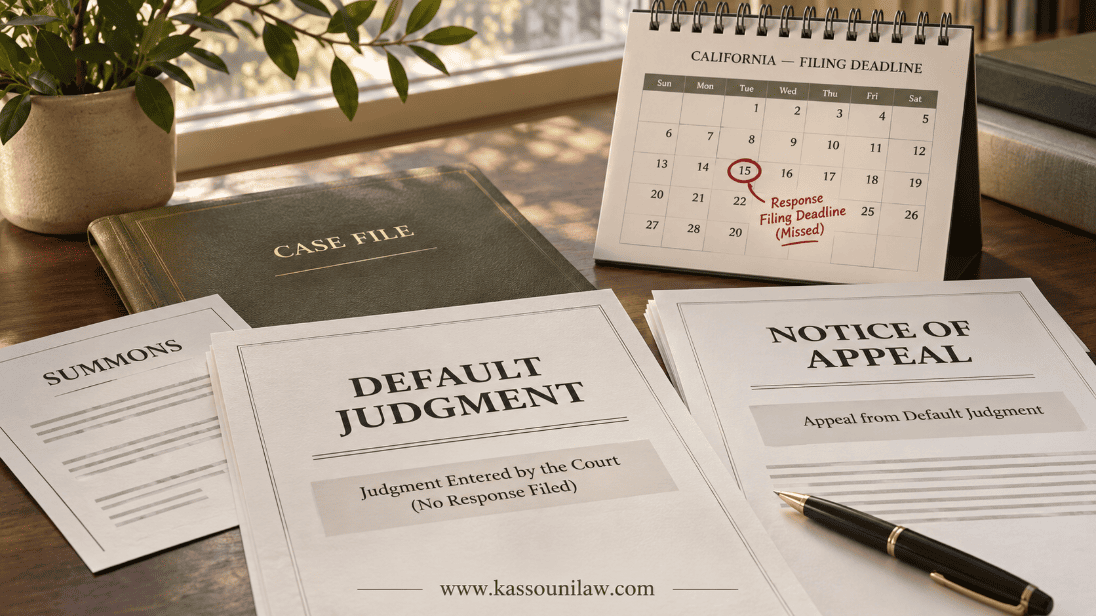
 California law generally allows an appeal from a default judgment, just like other civil judgments. However, the defendant’s default limits the issues they can raise.
A party has three possible paths. They can appeal the judgment, ask the trial court to set it aside, or appeal an order denying that request in some cases.
Each path has different requirements and deadlines. They are not interchangeable.
What Is a Default Judgment in California?
A default occurs when a defendant fails to respond to a lawsuit on time. The plaintiff can then ask the clerk to enter the defendant’s default. Entry of default and entry of default judgment are separate steps.
Entry of default cuts off the defendant’s right to file pleadings and motions. Steven M. Garber & Associates v. Eskandarian (2007) 150 Cal.App.4th 813 explains this rule.
Section 585 governs entry of default judgment:
- In certain money cases involving a sum certain, the clerk can enter judgment without a hearing.
- In other cases, the plaintiff applies to the court. The court hears the plaintiff’s evidence and determines the relief, up to the amount demanded in the complaint.
The statute also prohibits default when the defendant timely files a listed response, such as an answer or demurrer.
A default judgment can have serious consequences, including financial liability. Responding on time matters. Proper notice of the lawsuit matters too.
Can You Appeal a Default Judgment in California?
Generally, yes. Misic v. Segars (1995) 37 Cal.App.4th 1149 states that “a default judgment is reviewable on appeal the same as any other civil judgment.” A defendant does not lose the right to appeal by defaulting.
An appeal differs from a request to reopen the case. A motion asks the trial court to set aside the default or judgment. An appeal asks a higher court to review legal errors in the existing record.
The appeal must identify the judgment actually entered. The defendant who appeals becomes the appellant. Appellant vs. Appellee in California explains these roles.
However, the right to appeal does not restore the right to contest the case’s merits. A defaulting defendant receives narrower appellate review than a defendant who appeared and defended.
What Can You Challenge on Appeal?
Garber defines the scope of review. An appeal from a default judgment “is limited to questions of jurisdiction, sufficiency of the pleadings and excessive damages.”
Personal Jurisdiction
A court needs personal jurisdiction over a defendant to enter a binding judgment. Proper service of the summons is part of that requirement. A judgment entered without personal jurisdiction may be void.
Falahati v. Kondo (2005) 127 Cal.App.4th 823 explains that a party can attack a void judgment at any time. The party may file a motion under section 473(d) or bring a collateral action.
On direct appeal, the court reviews the existing record. The appellate record guide explains which materials the record includes. Whether the defendant preserved or waived the jurisdictional objection may also matter.
Sufficiency of the Complaint
A default admits properly pleaded material facts. It does not admit unsupported legal conclusions. In Vasey v. California Dance Co. (1977) 70 Cal.App.3d 742, the court stated that a defaulting defendant “admits only facts which are well pleaded.”
Vasey involved an alter ego claim against individual defendants. The complaint relied on a bare conclusion. The court reversed the judgments against those individuals.
Relief Exceeding the Complaint
Section 580 limits relief when the defendant does not answer. The judgment “cannot exceed that demanded in the complaint.” This rule protects the defendant’s right to notice of the potential judgment.
Becker v. S.P.V. Construction Co. (1980) 27 Cal.3d 489 held that courts cannot enter default judgments beyond section 580’s limits. The judgment included excessive damages and unpleaded attorney fees. Those amounts could not stand. The Court allowed the trial court to modify the judgment and preserve its valid portion.
Sass v. Cohen (Dec. 24, 2020, No. S255262) applied this rule to an accounting claim. The Court held that the plaintiff must plead a specific dollar amount to support a default money judgment.
Julius Schifaugh IV Consulting Services, Inc. v. Avaris Capital, Inc. (2008) 164 Cal.App.4th 1393 described a default judgment as void when it exceeded the amount demanded.
Procedural Defects
A defendant may also challenge certain procedural errors in the entry of default or judgment. Section 585 provides one example. It prohibits default when the defendant timely files a listed response. Published decisions apply these rules based on the specific record.
A direct appeal cannot dispute properly admitted allegations. Nor can the defendant litigate the merits as though no default occurred.
What Can You Not Usually Challenge After Default?
A default admits the complaint’s properly pleaded facts. Garber describes the judgment as “res judicata on the issue of the right to the relief awarded.” The defendants could not later dispute the arbitration clause, billing, or alleged breach.
An appeal does not give the defendant another chance to answer. Defenses not raised before default are generally unavailable. Garber also treated merits defenses raised after default as barred.
The key distinction is between legal sufficiency and disputed facts. A defendant may argue that the pleaded facts do not establish a valid claim. The defendant generally cannot dispute whether those facts occurred.
Default does not eliminate every possible challenge. Defendants may still raise jurisdictional, pleading, relief-related, and procedural issues.
Can You Set Aside a Default Judgment Instead of Appealing?
Sometimes. A motion to set aside goes before the trial court. It may rely on evidence outside the existing record, such as why the defendant missed the response deadline. An appeal cannot consider new evidence.
The options differ in their legal grounds and deadlines:
| Option | What it asks | Timing |
|---|---|---|
| Appeal from the judgment | The appellate court finds legal error in the record. | Rule 8.104. Earliest of 60 days after qualifying notice of entry, or 180 days after entry. |
| Section 473(b) motion | The trial court grants relief for mistake, inadvertence, surprise, or excusable neglect. | Within a reasonable time, no more than six months. |
| Section 473.5 motion | The trial court grants relief when service gave no actual notice in time. | Within a reasonable time and the statutory outer limit. See below. |
| Section 473(d) motion | The trial court sets aside a void judgment or order. | *Falahati* says a void judgment can be attacked at any time. |
| Appeal from an order denying relief | The appellate court reviews the order, not the judgment. | Rule 8.104 applies to an appealable order. See below. |
Relief Under Section 473(b)
Section 473(b) allows relief from a judgment or default caused by mistake, inadvertence, surprise, or excusable neglect. The party must apply within a reasonable time and no later than six months. The application must also include the proposed answer or other pleading.
The statute also provides mandatory relief in certain cases. This applies when an attorney submits a sworn affidavit admitting their own mistake, inadvertence, surprise, or neglect. The application must arrive within six months of entry. The court may still deny relief if the attorney’s conduct did not cause the default.
Mandatory relief does not apply whenever a defendant claims attorney error. The application must satisfy the statute’s requirements.
Relief Under Section 473.5
Section 473.5 addresses cases where service failed to provide actual notice in time to defend. Under the version effective through December 31, 2026, the party must file within a reasonable time. The statute also sets an outside deadline. The party must file by the earlier of two years after entry of default judgment or 180 days after service of written notice of entry.
The motion must include a sworn affidavit. The affidavit must state that the lack of notice did not result from avoiding service or inexcusable neglect. The party must also attach the proposed answer.
The statute changes on January 1, 2027. Assembly Bill 747 enacted a replacement version. That version applies only when service was “lawfully effected.” New section 473.2 addresses service that was not lawful. New section 473(e) allows a party to seek relief “at any time” from a default judgment void for lack of proper service. Check the applicable statutory version before filing.
Relief Under Section 473(d)
Section 473(d) allows a court to “set aside any void judgment or order.” A judgment is void when the court lacked power to enter it. A judgment that contains a legal error is not necessarily void.
Under Schifaugh, a default judgment exceeding the complaint’s demand may be void as to the excess. A judgment entered without personal jurisdiction may also be void.
The reason for challenging the judgment determines the proper procedure.
Can You Appeal an Order Denying a Motion to Set Aside Default?
Sometimes. An appeal from an order denying relief is separate from an appeal from the default judgment.
Section 904.1(a)(2) allows an appeal “from an order made after a judgment made appealable by paragraph (1).” Courts have applied this provision to orders on statutory motions to set aside judgments.
Shapiro v. Clark (2008) 164 Cal.App.4th 1128 explains the distinction. An order denying relief from default before judgment is interlocutory. It is not separately appealable. An order denying a statutory motion to set aside a judgment qualifies as a special order after judgment. That order is appealable.
People v. Totari (2002) 28 Cal.4th 876 reached a similar result under a different statute. The Court held that an order denying a statutory motion to vacate was appealable. That case arose in criminal proceedings.
Leader v. Health Industries of America (2001) 89 Cal.App.4th 603 also addresses this issue. It holds that an order denying relief from a judgment or dismissal under section 473 is appealable. However, not every order denying a request to set aside default qualifies.
The notice of appeal must identify the correct judgment or order. In Shapiro, the appeal was timely as to the denial order but late as to the default judgment. Rule 8.100(a)(2) requires liberal construction of notices of appeal. It does not excuse a missed deadline.
What Is the Deadline to Appeal a Default Judgment?
Rule 8.104 sets the general appeal deadline. The notice of appeal must arrive by the earliest of these three dates:
- 60 days after the clerk serves a notice of entry or a file-endorsed copy showing the service date.
- 60 days after a party serves or receives such a notice or copy with proof of service.
- 180 days after entry of judgment.
The earliest date controls. Entry means the date the court files the judgment under Code of Civil Procedure section 668.5 or enters it in the judgment book. A late notice generally requires dismissal.
This deadline differs from the deadlines for relief under sections 473(b) and 473.5. Filing a set-aside motion does not automatically extend the appeal deadline. Rule 8.108 applies only when the motion meets its requirements.
An appeal from an order denying relief does not revive an expired appeal from the judgment. Shapiro illustrates this rule. The guide to filing an appeal explains the filing process.
What Happens After a Successful Appeal?
The appellate court may reverse or modify the default judgment. Becker illustrates modification. The Court allowed the trial court to remove the excess amount and preserve the valid portion.
The case may return to the trial court for further proceedings. These may include a new determination of damages or other relief. The appellate opinion and issues on appeal determine what happens next.
Reversal does not guarantee a favorable final judgment. It may only reopen the case. Appeals take time. How long a civil appeal takes explains the typical timeline.
A Default Narrows Your Options, Not All of Them
A default judgment is generally appealable, but default limits the issues a defendant can raise. A motion to set aside may provide another option when the law permits relief.
Kassouni Law represents private parties in appellate matters. Individuals and businesses facing default judgments can contact the firm about their cases and possible legal options.
Call Kassouni Law at (877) 770-7379 or contact the firm to discuss your situation. Submitting a contact form does not create an attorney-client relationship.
Frequently Asked Questions
Can a defendant appeal a default judgment in California?
Generally, yes. A default judgment is appealable like other civil judgments. Default limits the issues, though. Review focuses on jurisdiction, pleading sufficiency, excessive relief, and procedural defects.
Can you appeal a default judgment if you were never properly served?
Possibly. A lack of personal jurisdiction is a reviewable issue if the record shows it. A section 473.5 motion is a separate route and relies on lack of actual notice. Not every service problem produces the same result.
Can you challenge the amount of a default judgment?
Yes, in some cases. Section 580 limits relief to what the operative complaint demanded. An award above that amount may be reversed or modified.
Is it better to appeal a default judgment or ask the court to set it aside?
It depends. The reason for the challenge, the record, available evidence, and deadlines all matter. A motion can use new evidence. An appeal is limited to the record.
How long do you have to appeal a default judgment in California?
Rule 8.104 generally allows 60 days after qualifying service of a notice of entry. The outside limit is 180 days after entry. The earliest applicable deadline controls.
The information provided here is for general informational purposes only and is not legal advice. Appealability and deadlines depend on the type of case, the dates involved, and the law in effect. Consult a qualified attorney about your circumstances.