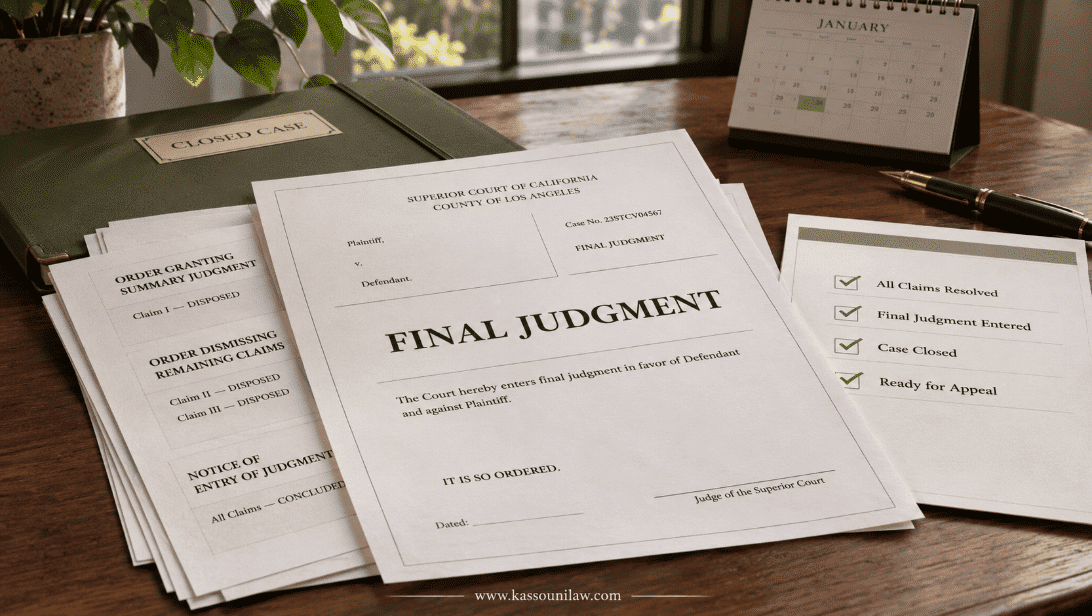
 A trial court rules against a party on one claim. Other claims remain unresolved. The losing party wants to appeal immediately.
California law generally requires parties to wait. Under the one final judgment rule, an appeal usually follows a judgment that ends the dispute. An unfavorable ruling does not always give a party an immediate right to appeal.
However, statutes provide specific exceptions. Code of Civil Procedure section 904.1 lists judgments and orders that parties may appeal earlier.
What Is the One Final Judgment Rule in California?
Section 577 defines a judgment as “the final determination of the rights of the parties in an action or proceeding.”
California law allows appeals only when a statute authorizes them. Section 904.1(a)(1) permits appeals from judgments, except interlocutory judgments. An interlocutory judgment resolves preliminary issues but leaves further proceedings.
A reviewing court has jurisdiction over direct appeals only from appealable judgments or orders. The California Supreme Court confirmed this rule in Griset v. Fair Political Practices Commission (2001) 25 Cal.4th 688.
The rule prevents parties from filing repeated appeals during one lawsuit. Griset explained that piecemeal decisions and multiple appeals would create unnecessary costs and burdens. One appeal after the case ends lets the reviewing court consider the rulings together.
In Morehart v. County of Santa Barbara (1994) 7 Cal.4th 725, the trial court heard some claims first and entered judgment on them. The damages claims remained pending. The Supreme Court held that the judgment was not appealable. It had not resolved every cause of action. Separate trials did not change that result.
The rule has statutory exceptions. A party does not always have to wait until the entire lawsuit ends. The following sections explain when an earlier appeal may be available.
When Is a Judgment Final and Appealable?
Courts examine what the ruling actually resolves. In Griset, the Court asked whether the trial court needed to take further judicial action. If nothing remained, the ruling could qualify as final.
The document’s title does not control. In Griset, the Court treated a 1991 order denying a writ petition as a final judgment. The order resolved every cause of action. In Dhillon v. John Muir Health (2017) 2 Cal.5th 1109, the Court treated an order granting a writ and remanding the matter to a hospital as a final, appealable judgment.
A document labeled “judgment” may still fail the finality test. In Kurwa v. Kislinger (2013) 57 Cal.4th 1097, the parties dismissed certain claims without prejudice. However, they agreed to preserve those claims. The claims therefore remained alive in substance. The Supreme Court directed the Court of Appeal to dismiss the appeal.
Meinhardt v. City of Sunnyvale (2024) 16 Cal.5th 643 addresses judgment entry in administrative mandate cases. The Court held that the appeal period starts with judgment entry or service of notice of entry. An earlier order or ruling does not start that period. This decision concerns appeal timing. It does not create a general exception to the one final judgment rule.
Consider a plaintiff who sues for breach of contract and fraud. The court grants summary judgment on the contract claim. However, the fraud claim remains set for trial. Under Morehart, the plaintiff generally cannot appeal yet. The plaintiff must wait until the court resolves the remaining claim. Different parties or a complete resolution between particular parties may change the analysis.
Can You Appeal When Some Claims Remain Unresolved?
Generally, no. A judgment that leaves causes of action pending between the same parties is not final. Courts consider each cause of action, regardless of its legal theory.
Unresolved requests for substantive relief can also prevent finality. In Morehart, pending damages claims kept the judgment from becoming final. Kurwa also prevents parties from creating appeal rights through dismissals that preserve unresolved claims.
However, some outstanding matters do not prevent an appeal. Courts may address costs, attorney fees, and enforcement after judgment. Section 904.1(a)(2) permits appeals from certain orders made after an appealable judgment.
In Lakin v. Watkins Associated Industries (1993) 6 Cal.4th 644, the Court applied an earlier version of that provision. The Court required the postjudgment order to raise issues distinct from the judgment appeal. The order also had to affect the judgment or relate to its enforcement. The Court found an attorney fee order appealable.
A pending attorney fee request does not always produce the same result. Its effect on finality depends on the circumstances. Parties should examine the specific ruling before assuming they can appeal.
How Does the Rule Apply When a Case Involves Multiple Parties?
Lawsuits involving several parties can leave different claims unresolved. Section 579 gives courts discretion to enter judgment against one or more defendants. The action can then continue against the remaining defendants, “whenever a several judgment is proper.”
A judgment that resolves every claim between a plaintiff and fewer than all defendants may be final as to those defendants. In Hydrotech Systems, Ltd. v. Oasis Waterpark (1991) 52 Cal.3d 988, the Court recognized that an order dismissing fewer than all defendants can be final as to them.
Justus v. Atchison (1977) 19 Cal.3d 564 applied a similar exception to plaintiffs. The judgment left no issues to resolve concerning the appealing husbands.
The court must still examine what remains unresolved. A party cannot claim finality while claims or cross-claims remain pending against the same opponent. Section 579 does not make every partial judgment appealable.
Consider a plaintiff who sues three defendants. The court enters judgment for Defendant A on every claim against A. A leaves the case, and the plaintiff may be able to appeal that judgment.
The court then grants Defendant B summary adjudication on one of two claims. The second claim remains pending, so the ruling probably cannot support an immediate appeal. Defendant C still awaits trial. Each ruling requires a separate finality analysis.
The parties’ roles also matter during an appeal. Appellant vs. Appellee in California explains who holds each role once an appeal begins.
Which Orders Can You Appeal Before Final Judgment?
California law allows appeals from certain orders before final judgment. Section 904.1(a) lists these exceptions. The following examples show when a party may appeal early. The guide to interlocutory appeals in California discusses other exceptions.
Orders Granting or Denying Certain Injunctions
Section 904.1(a)(6) allows appeals from orders granting or dissolving injunctions. It also covers orders refusing to grant or dissolve them.
An injunction directs a party to take or stop a specific action. The statute allows an appeal without waiting for final judgment.
Orders Concerning Receivers
Section 904.1(a)(7) allows appeals from orders appointing receivers. A receiver manages or protects property under court supervision during a case. Other orders involving receivers require separate analysis.
Other Appealable Orders
Section 904.1(a) also allows appeals from several other orders:
- An order granting a new trial or denying judgment notwithstanding the verdict.
- An order granting or denying an anti-SLAPP special motion to strike.
- An interlocutory judgment in a partition action that determines the parties’ interests.
- An order imposing monetary sanctions above $5,000. Parties generally challenge sanctions of $5,000 or less through an appeal from the final judgment or a writ petition.
Writ Review Is Not an Appeal
A writ petition asks an appellate court to direct a trial court to act or refrain from acting. Morehart identified writ review as the available route for challenging a nonappealable judgment.
Writ review remains discretionary. An appellate court may deny a petition without deciding its merits. Dhillon recognized this distinction.
In Morehart, the Supreme Court considered treating the appeal as a writ petition. Unusual circumstances prompted that consideration. The Court reached the merits but still directed dismissal of the appeal. Parties should not expect appellate courts to follow that approach.
What Is the Collateral Order Doctrine?
California courts recognize a narrow, judge-made exception for certain collateral orders. This doctrine differs from the statutory exceptions in section 904.1.
Sjoberg v. Hastorf (1948) 33 Cal.2d 116 provides the basic rule. An interlocutory order may qualify if it finally resolves a collateral matter. The order must also direct the appellant to pay money or perform an act.
Courts generally examine three requirements:
- The order addresses a matter separate from the main litigation.
- The order finally resolves that separate matter, leaving no further judicial action.
- The order directs payment of money or performance of an act by or against the appellant.
The doctrine does not cover every ruling on a separate issue. In Conservatorship of Rich (1996) 46 Cal.App.4th 1233, the court rejected an appeal from an order denying substitute counsel. The order required neither payment nor an act.
Courts have not applied the third requirement uniformly. Parties should examine the relevant published decisions before relying on this doctrine.
Can an Appellate Court Review Earlier Rulings After Final Judgment?
Often, yes. Section 906 allows appellate courts to review certain earlier rulings. A party must appeal from an appealable judgment or order first.
The earlier ruling must involve the merits, necessarily affect the judgment, or substantially affect a party’s rights.
This distinction matters. Section 906 review does not give parties an independent right to appeal an earlier ruling. Instead, it allows review during an appeal from an appealable judgment or order.
| Type of ruling | How it reaches an appellate court | Example |
|---|---|---|
| Independently appealable order | The party appeals the order within its own deadline. | An order granting an injunction. |
| Intermediate ruling that affects the judgment | The party appeals the final judgment. The appellate court may then review the ruling. | An order sustaining a demurrer to one cause of action. |
Section 906 has limits. It does not permit review of an order that a party could have appealed earlier. A party who misses the deadline to appeal an independently appealable order generally cannot challenge it later. Section 906 does not make every earlier ruling independently appealable.
What Happens If You Appeal Before the Case Is Over?
A reviewing court has jurisdiction only over appealable judgments and orders. An appeal from a nonappealable ruling generally must be dismissed.
In Sullivan v. Delta Air Lines, Inc. (1997) 15 Cal.4th 288, the Supreme Court addressed an appeal from a nonfinal judgment. The Court allowed an amendment to cure the defect.
Some premature appeals can survive. Others cannot. These cases and rules explain the difference:
- Premature notices. A notice filed after judgment but before entry remains valid. Rule 8.104(d) treats it as filed immediately after entry. A court may apply the same rule to a notice filed after an announced ruling.
- Orders that resolve the entire case. In Griset, an order resolved the entire action but never became a formally entered judgment. The Supreme Court treated it as an appealable judgment. A notice filed after the order may therefore remain valid.
- Curable judgments. In Sullivan, the Court ordered an amendment to address claims omitted by mistake. The plaintiff waived one claim set for retrial, and the Court dismissed that claim.
- Fatal defects. In Kurwa, unresolved claims required dismissal of the appeal. Morehart also required dismissal because the judgment did not resolve all causes of action.
Rule 8.100(a)(2) requires courts to interpret notices of appeal liberally. This rule helps when a notice describes an appealable judgment imperfectly. It does not make a nonappealable ruling appealable.
Parties should identify the correct appealable decision before filing. The guide to filing an appeal in California explains the filing process.
A dismissed appeal can cost valuable time. How long a California civil appeal takes explains the timeline.
Finality Depends on the Case
An unfavorable ruling does not always give a party an immediate right to appeal. The answer depends on the claims, parties, ruling, and applicable statutory exceptions.
Kassouni Law represents private parties in appellate matters. If you question whether a judgment or order qualifies for appeal, the firm can review your circumstances and discuss your legal options.
Call Kassouni Law at (877) 770-7379 or contact the firm to discuss your situation. Submitting a contact form does not create an attorney-client relationship.
Frequently Asked Questions
Can you appeal a court ruling before the entire case is over in California?
Sometimes. The general rule requires a final judgment. Section 904.1 makes certain orders appealable earlier, and some judgments resolving all claims against fewer than all parties may qualify.
What happens if a judgment leaves some claims unresolved?
The judgment generally is not final between the parties who still have pending claims. An appeal from it is usually subject to dismissal. Collateral matters may receive different treatment.
Can you appeal a judgment involving only one defendant?
Possibly. A judgment that resolves all claims between the plaintiff and one defendant may be final as to that defendant. Pending claims or cross-claims against the same opponent can change the answer.
Are all interlocutory orders appealable in California?
No. An interlocutory order is appealable only if a statute authorizes it or a narrow doctrine applies, such as the collateral order doctrine. Many orders can be reviewed only after final judgment.
Can an appellate court review earlier trial court rulings after final judgment?
Often yes. Section 906 allows review of certain intermediate rulings that affect the judgment. It does not allow review of an order that could have been appealed independently.
The information provided here is for general informational purposes only and is not legal advice. Appealability depends on the type of case, the rulings involved, and the law in effect. Consult a qualified attorney about your circumstances.