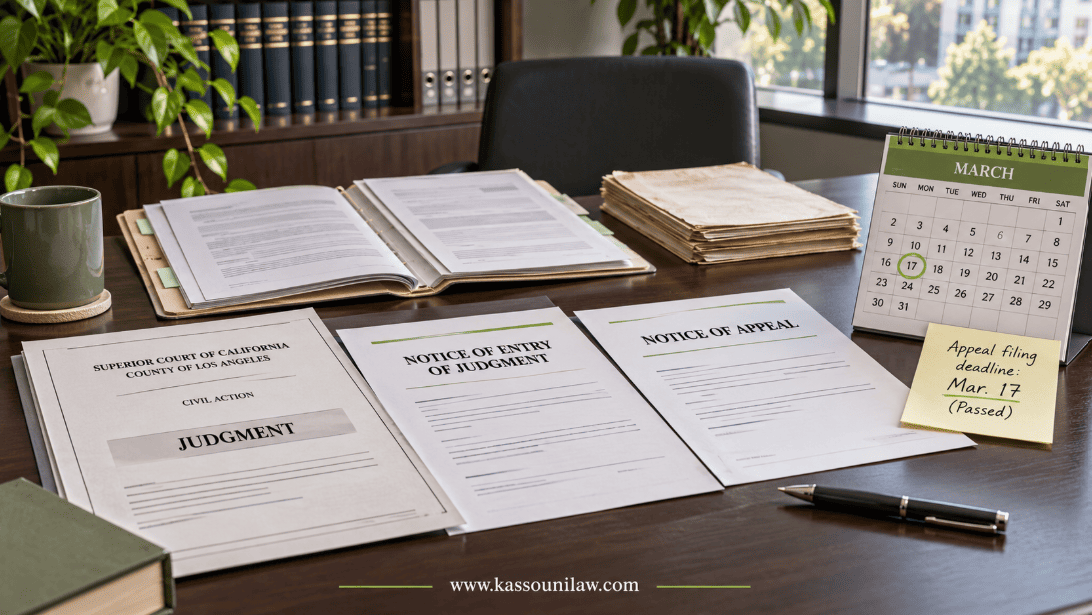
 A homeowner loses a property dispute at trial. Her attorney mentions an appeal, and she plans to file one. Months later, she checks the calendar and realizes the court entered judgment some time ago. She wonders whether she has lost her right to appeal.
Missing the deadline can prevent appellate review. California strictly enforces the deadline for filing a notice of appeal. However, the deadline may not have passed when someone thinks it did. Certain rules extend the filing period, and narrow exceptions apply to specific cases. These exceptions are limited. Many do not apply to ordinary civil appeals.
What Happens When You Miss the Deadline to Appeal in California?
A timely notice of appeal gives the Court of Appeal jurisdiction. This means the court has legal authority to hear the case. In Garg v. Garg (2022) 82 Cal.App.5th 1036, the court quoted the Supreme Court’s description of a timely notice as “an absolute prerequisite to the exercise of appellate jurisdiction.”
Rule 8.104 of the California Rules of Court sets the ordinary deadline. A notice of appeal must be filed by the earliest of these three dates:
- 60 days after the superior court clerk serves notice of entry of judgment. The clerk may serve a notice of entry or a file-endorsed copy of the judgment.
- 60 days after a party serves notice of entry. This applies when a party serves, or receives, a notice of entry or file-endorsed copy with proof of service.
- 180 days after entry of judgment. This outside limit applies even when no one serves notice.
The rule does not allow courts to extend the filing deadline. It also requires reviewing courts to dismiss late appeals. The Supreme Court reached the same conclusion in Hollister Convalescent Hospital, Inc. v. Rico (1975) 15 Cal.3d 660, 674. A court must dismiss an appeal without a timely notice, regardless of claims of estoppel or excuses for delay.
The notice deadline is separate from the deadlines for preparing appellate briefs. Other rules govern briefing, and courts may extend those deadlines for good cause under Rule 8.60(b). However, courts cannot extend the notice of appeal deadline. The timeline of a California civil appeal explains what happens after someone files the notice.
Hardship and honest mistakes do not change the deadline. Someone who forgets the date or misreads the rules should not assume the court can excuse the delay.
Can a California Court Extend the Appeal Deadline?
There are two separate issues. A court cannot extend an expired appeal deadline. However, certain rules may give a party more time to file.
Rule 8.108 and Postjudgment Motions
Rule 8.108 extends the appeal deadline when a party files certain qualifying motions. It does not shorten the period under Rule 8.104. The rule covers four types of motions:
- Motion for new trial. After a valid notice of intention to move for a new trial, the deadline becomes the earliest of three dates: 30 days after service of the denial or notice of entry, 30 days after denial by operation of law, or 180 days after entry of judgment.
- Motion to vacate the judgment. A qualifying motion or notice of intention must be filed within the Rule 8.104 period. The deadline becomes the earliest of 30 days after service of the denial, 90 days after the first filing, or 180 days after entry of judgment.
- Motion for judgment notwithstanding the verdict. A qualifying motion that the court denies extends the deadline under the same schedule as a new trial motion.
- Motion to reconsider an appealable order. A qualifying motion under Code of Civil Procedure section 1008(a) extends the deadline for appealing that order only. The deadline becomes the earliest of 30 days after service of the denial, 90 days after the first motion, or 180 days after entry of the order.
The advisory committee comment explains that a motion can qualify even if the court denies it. However, the motion must meet the applicable procedural requirements.
The extension depends on the motion type, service dates, and filing history. Not every postjudgment motion extends the appeal deadline. Motions outside Rule 8.108 do not qualify. Anyone relying on an extension should check the motion against the rule’s requirements. The guide on motions for reconsideration and appeals explains how these options differ.
What Rule 8.60 Does Not Allow
Rule 8.60 allows a presiding justice to extend many appellate deadlines for good cause. It also allows reviewing courts to relieve parties from certain defaults. However, subdivision (d) excludes one specific failure. A court cannot grant relief for “the failure to file a timely notice of appeal.”
Rule 8.104(b) recognizes another limited exception. Rule 8.66 allows the Chief Justice to toll or extend deadlines during a public emergency. This authority can apply to emergencies such as earthquakes or fires.
When Can a Late Notice of Appeal Still Be Accepted?
Exceptions in civil cases are narrow. Courts consider the specific circumstances and applicable filing rules.
Misleading Information and Equitable Arguments
In Hollister, the appellants claimed court staff gave them the wrong judgment entry date by telephone. They filed within 30 days of that reported date, but 31 days after actual entry (pp. 665–666).
The Supreme Court dismissed the appeal. It explained that the parties’ actions cannot change an expired jurisdictional deadline (p. 674). Reliance on incorrect information, personal hardship, or misunderstanding the rules does not reopen the deadline in an ordinary civil appeal.
The Prison-Delivery Rule
Silverbrand v. County of Los Angeles (2009) 46 Cal.4th 106 involved a civil case. The Supreme Court held that a self-represented incarcerated litigant’s notice of appeal is filed when delivered to prison authorities.
This rule determines the filing date. It does not excuse a notice delivered after the deadline. Rule 8.25(b)(5) contains a similar provision for documents mailed by incarcerated litigants.
Constructive Filing in Criminal Cases
In In re Benoit (1973) 10 Cal.3d 72, the Supreme Court considered late notices in a criminal case. Two incarcerated defendants had arranged for counsel to file notices of appeal. Their attorneys failed to file on time.
The court allowed the appeals to proceed because the defendants showed diligence and compelling circumstances (pp. 88–89). However, it warned against applying the doctrine “indiscriminately.”
Benoit concerned criminal appeals, not ordinary civil cases. Its constructive filing doctrine should not be presented as a general exception for civil litigants.
Neither doctrine gives civil litigants a general extension for attorney errors or unfamiliarity with appeal rules.
Can a Court Filing Error Affect the Appeal Deadline?
A notice of appeal received by the clerk on time differs from one submitted late. Under Rule 8.25(b), a document is generally filed when the clerk receives it. The rule’s mail-based exceptions cover briefs and certain petitions, but not notices of appeal.
Electronic filing follows separate rules. Rule 8.77 treats an electronically submitted document as filed when the court receives it. Documents received after 11:59 p.m. count as received the next court day. If the court rejects a document, the clerk must send a notice explaining the reasons.
A clerk also cannot reject a notice of appeal solely because the filing fee is missing. Under Rule 8.100(b)(3), the clerk must file the notice even without the fee, deposit, or fee waiver application.
What Garg v. Garg Decided
Garg illustrates when an electronic filing problem may justify relief. Judgment was entered on April 4, 2022, and the court electronically served notice of entry two days later. The appeal deadline was June 6.
On May 23, trial counsel’s staff uploaded a notice through an electronic filing provider. However, the superior court clerk did not file it. The clerk eventually filed the notice on June 21, 15 days late.
The Court of Appeal dismissed the appeal. However, it recognized that Rule 8.77(d) can apply to notices of appeal. A party seeking relief must file a motion in the Court of Appeal. Good cause may exist when evidence shows an attempted transmission before the deadline and a prompt filing afterward.
The appellants waited 29 days after their first attempt. The court found that delay was not prompt.
The court also discussed Rule 2.259(c). This rule addresses technical failures within the court’s own electronic filing system. It requires the court to treat a document as filed on the date the technical problem prevented filing. A party must raise this issue with the trial court.
The appellants did not invoke this rule or provide evidence of a court-system failure.
The rejection reason, submission method, supporting evidence, and timing of another attempt all matter. A rejected filing does not automatically preserve the appeal.
Do Different Rules Apply to Criminal and Dependency Appeals?
Yes. Criminal and juvenile appeals follow different deadlines and procedures. Criminal appeals fall under Rule 8.308. Juvenile appeals fall under Rule 8.406.
Both generally require a notice of appeal within 60 days. Neither allows extensions except under Rule 8.66. The clerk marks a late notice “Received [date] but not filed.”
Dependency cases also recognize a specific remedy for appointed counsel’s failure to file. In In re A.R. (2021) 11 Cal.5th 234, appointed counsel filed a parent’s notice after the deadline. The appeal challenged an order terminating parental rights.
The Supreme Court held that the parent could seek relief based on the statutory right to competent counsel. The parent must apply to the Court of Appeal and show that she directed counsel to appeal. She must also show that counsel failed to file the notice and that she acted promptly.
The court did not extend the Benoit constructive filing doctrine to dependency cases. Instead, it limited its ruling to that specific context.
These remedies do not automatically apply to ordinary civil appeals. Each decision addresses a different legal setting.
What Should You Do After Missing an Appeal Deadline?
Waiting can make it harder to assess any remaining options. Start by reviewing these documents and dates:
- Obtain the judgment or appealable order. This document helps establish the relevant dates.
- Confirm the entry date and service details. Check for a notice of entry, a file-endorsed copy, and proof of service.
- Review postjudgment motions and orders. Record each filing date, motion type, and denial date.
- Check whether Rule 8.108 or another rule affects the deadline. A qualifying motion may extend the time to appeal.
- Gather proof of attempted filings. Keep clerk communications, rejection notices, and electronic submission records.
- Identify the type of proceeding. Civil, criminal, and dependency appeals follow different rules.
- Ask an appellate attorney to review the circumstances promptly. An attorney can assess the deadlines and available options. However, no attorney can guarantee that a court will restore an expired deadline.
The guide to filing an appeal explains the notice of appeal process for property owners and other civil appellants.
Missing an Appeal Deadline Has Serious Consequences, but the Dates Deserve Careful Review
Missing the notice of appeal deadline can end the right to appellate review. However, the applicable deadline may differ from the date someone initially assumes. Any remaining option depends on the case type and procedural record. Reviewing the relevant dates and documents is the first step.
Kassouni Law represents private parties in appellate matters. If you missed an appeal deadline, the firm can review your circumstances and discuss any remaining legal options.
Call Kassouni Law at (877) 770-7379 or contact the firm to discuss your situation. Submitting a contact form does not create an attorney-client relationship.
Frequently Asked Questions
Can I appeal a California judgment after the deadline has passed?
Usually not. A late notice generally must be dismissed. The deadline may not have expired, though, if a rule such as rule 8.108 extended it. Narrow exceptions exist in certain proceedings. The answer depends on the type of case and the facts.
Can a California court grant an extension to file a notice of appeal?
Generally no. Rule 8.104(b) says no court may extend the time, and rule 8.60(d) does not allow relief for a late notice. The only rule-based exception is a public emergency order under rule 8.66.
Does filing a motion for reconsideration extend the appeal deadline?
Sometimes. A valid motion under Code of Civil Procedure section 1008(a) may extend the time to appeal the order it challenges, under rule 8.108(e). The motion must be valid, and the extension has outer limits. Other motions, and invalid motions, may not extend anything.
What happens if the court clerk rejects my notice of appeal?
The result depends on why the clerk rejected it, when it was submitted, and what proof exists. Rule 8.77(d) allows a motion for relief in some electronic filing failures. Garg shows that delay can defeat the request.
Can I appeal if my former attorney missed the filing deadline?
In an ordinary civil case, an attorney’s mistake is not an automatic basis for a late notice. Narrow relief exists in some dependency and criminal cases. A civil litigant should have an appellate attorney review the specific circumstances.
The information provided here is for general informational purposes only and is not legal advice. Appeal deadlines and any available relief depend on the type of proceeding, the dates involved, and the law in effect. Consult a qualified attorney about your circumstances.