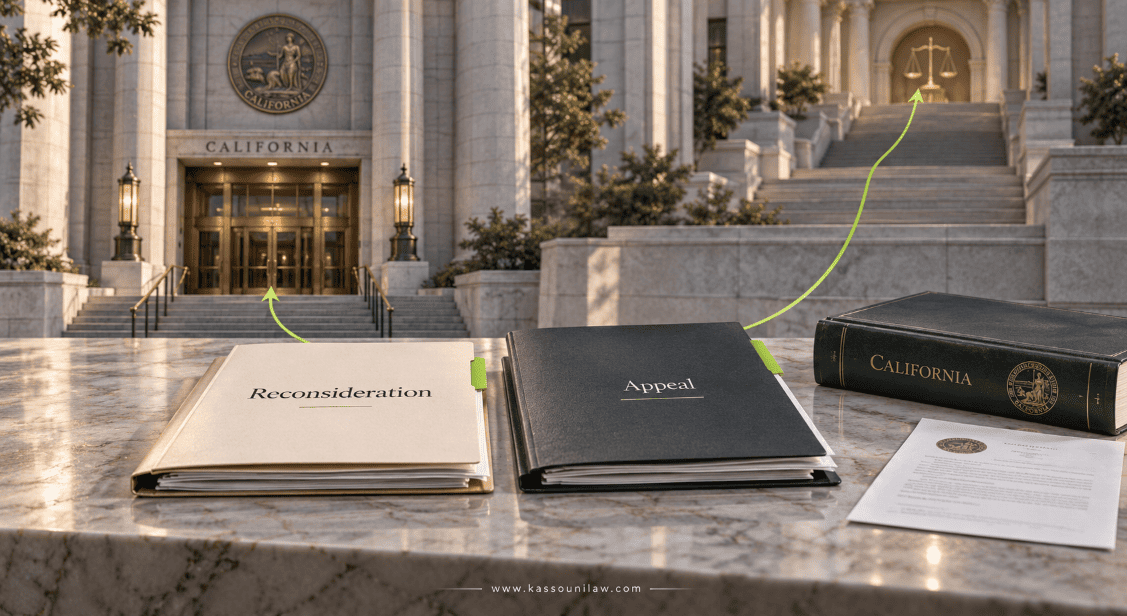
 A motion for reconsideration and an appeal can both follow an unfavorable court ruling, but they serve different purposes. Reconsideration asks the trial court to revisit an eligible order. An appeal asks a higher court to review an appealable judgment or order for legal error.
The difference matters because the requirements and deadlines are not the same. A motion for reconsideration may be available when new or different facts, circumstances, or law support reconsideration under California law. An appeal, by contrast, depends on whether the ruling is appealable and whether the deadline to appeal has been preserved.
Choosing between the two is not simply a matter of repeating the same argument in a different filing. The type of ruling, the grounds available, and the timing of the case all matter. Missing a deadline can also affect the right to seek appellate review.
What Is a Motion for Reconsideration in California?
A motion for reconsideration asks the same judge or court to modify, amend, or revoke an earlier order. The governing statute is Code of Civil Procedure section 1008. Subdivision (a) allows a party affected by an order to ask for reconsideration. The request must rest on “new or different facts, circumstances, or law” and must be supported by an affidavit describing the earlier application and the new grounds.
Timing is a core requirement. Under section 1008(a), the motion must be made within 10 days after service of written notice of entry of the order. The California Courts self-help guidance on options other than appealing describes the same 10-day period.
Three limits matter:
- Reconsideration is not a vehicle to repeat arguments the court already rejected.
- Under section 1008(f), “new or different law” does not include a later enacted statute that has no retroactive application.
- Under section 1008(e), no application to reconsider an order may be considered unless it follows the statute.
The 10-day period applies to the motion under subdivision (a). It does not describe every reconsideration-related application. A renewed application under subdivision (b), for example, follows its own requirements. The court may also reconsider its own order under subdivision (c) if a change in law warrants it.
What Is an Appeal in California?
An appeal asks a higher court to review a trial-court decision. In most civil cases, that court is the California Court of Appeal. Code of Civil Procedure section 904.1 provides that an appeal, other than in a limited civil case, goes to the Court of Appeal.
An appeal is not a new trial. The appellate court generally reviews the existing record rather than hearing new witnesses or taking new evidence. It asks whether the trial court committed reversible legal error.
The standard of review depends on the issue. Courts review some questions independently, defer to factual findings that substantial evidence supports, and review other rulings for abuse of discretion.
Not every trial-court ruling can be appealed right away. Section 904.1 lists the judgments and orders that are appealable. They include final judgments, many orders made after a judgment, and several specific orders such as those granting or denying certain injunctions. Many interim rulings are not appealable when made. A party may challenge some of them later, on appeal from the final judgment, or sometimes through a writ petition.
Motion for Reconsideration vs. Appeal: Key Differences
| Aspect | Motion for Reconsideration | Appeal |
|---|---|---|
| Court | Trial court | Reviewing appellate court |
| Main purpose | Ask the trial court to reconsider an eligible order | Seek appellate review of an appealable judgment or order |
| Legal basis | CCP § 1008 and applicable procedural rules | California appellate statutes and Rules of Court |
| Typical focus | New or different facts, circumstances, or law | Claimed legal error in the trial court’s ruling |
| Evidence | May involve the new facts or law supporting reconsideration | Generally based on the existing appellate record |
| Result | Trial court may affirm, modify, or reconsider the order | Appellate court may affirm, reverse, modify, or otherwise dispose of the appeal as permitted by law |
| Deadline | Specific statutory deadline applies | Strict appellate deadline applies |
| Review level | Same trial court | Higher reviewing court |
When Might a Motion for Reconsideration Make Sense?
Reconsideration may be relevant when the statute’s requirements are met. Situations that can matter include:
- New or different facts become available.
- New or different circumstances affect the ruling.
- A change in applicable law matters to the order.
- The order qualifies for reconsideration under section 1008.
- The party can satisfy the statute’s procedural requirements, including timing and the affidavit.
Disagreement with the judge is not enough. Reconsideration is also not available for every unfavorable ruling. A party should be able to point to what is new or different and explain why it was not presented earlier.
When Might an Appeal Be Appropriate?
An appeal may be worth considering when:
- The ruling is appealable.
- The party believes the trial court committed reversible legal error.
- The party wants review by the Court of Appeal.
- The issue cannot be adequately addressed through reconsideration.
- The applicable appellate deadline remains open.
An appeal is not available from every trial-court order. It also does not allow new evidence as a general matter. Whether an appeal stays enforcement of a ruling depends on the type of order or judgment and the applicable statutes. An appeal does not automatically stop enforcement in every case.
Can You File a Motion for Reconsideration and Then Appeal?
Sometimes. The answer depends on the type of order and the procedural circumstances.
Reconsideration does not replace the right to appeal an appealable order. Under California Rules of Court, rule 8.108(e), a valid motion to reconsider an appealable order under section 1008(a) can extend the time to appeal from that order. The extension is subject to the specific limits in the rule.
That does not mean every motion labeled “reconsideration” extends an appeal deadline. The Advisory Committee Comment says “valid” means the motion complies with all procedural requirements. It does not require the motion to be substantively meritorious. A motion that fails section 1008’s procedural requirements, or that targets something the rule does not cover, may not qualify.
Section 1008(g) adds a related point. An order denying reconsideration under subdivision (a) is not separately appealable. If the underlying order is appealable, however, the denial is reviewable as part of an appeal from that order. See the statute at section 1008.
How Does a Motion for Reconsideration Affect the Appeal Deadline?
Start with the ordinary rule. Under California Rules of Court, rule 8.104(a), a notice of appeal is due by the earliest of three dates:
- 60 days after the superior court clerk serves a “Notice of Entry” of judgment or a file-endorsed copy, showing the service date.
- 60 days after the party filing the appeal serves, or is served with, a notice of entry or file-endorsed copy, accompanied by proof of service.
- 180 days after entry of judgment.
Under rule 8.104(e), “judgment” includes an appealable order when the appeal is from that order. Rule 8.104(b) provides that no court may extend the time to appeal, except as rule 8.66 provides.
Rule 8.108(e) creates a limited exception. If a party serves and files a valid motion to reconsider an appealable order under section 1008(a), the time to appeal that order is extended for all parties. The extended deadline is the earliest of:
- 30 days: after the clerk or a party serves an order denying the motion, or a notice of entry of that order.
- 90 days: after the first motion to reconsider is filed.
- 180 days: after entry of the appealable order.
The applicable limit is whichever date comes first. The 180-day limit matters even when the court takes a long time to rule on reconsideration. The Advisory Committee Comment explains that the 90-day limit exists because section 1008 sets no deadline for the court to rule on the motion.
The rule extends the time to appeal under rule 8.104(a). It does not shorten that time. Readers should not apply a generic “30 days after reconsideration” rule. The correct deadline comes from the actual dates of entry, service, and filing in the case, and from the specific documents in the record.
What Is the Difference Between Reconsidering an Order and Appealing a Judgment?
A judgment is the court’s final determination of the parties’ rights in the action. An appealable order is a ruling that the law makes appealable, even though it is not the final judgment. Procedural posture matters because the rules differ for each.
Rule 8.108(e) specifically concerns a motion to reconsider an appealable order. It does not mean a motion to reconsider a judgment always affects the time to appeal from that judgment.
The Advisory Committee Comment makes the limits clear. The rule does not decide whether judgments can be reconsidered, and it does not decide whether an order denying reconsideration is appealable. It applies to any appealable order, whether made before or after judgment. It covers only motions made by a party, so it does not apply when a court reconsiders an order on its own motion.
Other motions follow different subdivisions of rule 8.108. They include motions for a new trial, motions to vacate a judgment, and motions for judgment notwithstanding the verdict. Each has its own timing limits. Mixing them up is a common source of error.
What Happens If You Miss the Appeal Deadline?
California appellate deadlines are generally strict. Under rule 8.104(b), a court cannot extend the time to file a notice of appeal, and a late notice requires the reviewing court to dismiss the appeal.
Parties should not assume that a pending motion preserves their appellate rights. A motion that does not qualify for the rule 8.108 extension does not pause the clock.
The cost of a missed deadline can be the loss of appellate review. Prompt legal review is important when a deadline may be approaching.
Common Mistakes When Choosing Between Reconsideration and Appeal
- Treating reconsideration as a second chance to repeat the same arguments.
- Assuming every adverse order can be appealed.
- Assuming every reconsideration motion extends the appeal deadline.
- Waiting for a reconsideration ruling without calculating the applicable appeal deadline.
- Failing to determine whether the motion satisfies section 1008.
- Confusing a judgment with an appealable order.
- Missing a mandatory filing or service requirement.
How Should You Decide Between Reconsideration and Appeal?
No fixed rule fits every case. The following questions help organize the review:
- What exactly did the trial court decide?
- Is the ruling appealable?
- Does section 1008 provide a basis for reconsideration?
- Are there genuinely new or different facts, circumstances, or law?
- When does the appeal deadline expire?
- Would reconsideration address the problem?
- Is appellate review needed?
- Could filing one procedure affect the timing or availability of another?
These questions require review of the actual order and the procedural history. Different rules may apply in criminal, family, probate, juvenile, small claims, and limited civil matters, so the civil rules discussed here do not apply universally.
When Should You Talk to a California Appeals Attorney?
Prompt appellate advice may be useful in situations such as these:
- An unfavorable appealable order has just been entered.
- A reconsideration deadline is approaching.
- An appeal deadline is approaching.
- The party is considering filing both procedures.
- The party is unsure whether an order is appealable.
- A motion for reconsideration has already been filed.
- The trial court has denied reconsideration.
- The case involves a significant judgment or an important legal issue.
Choosing Between Reconsideration and Appeal
A motion for reconsideration and an appeal are different procedures with different purposes. Reconsideration asks the trial court to revisit an eligible order under specific statutory requirements. An appeal seeks review by a higher court and is governed by strict appellate rules and deadlines.
The appropriate option depends on the ruling, appealability, available legal grounds, procedural posture, and applicable deadlines.
Kassouni Law represents clients in California appeals. If you have received an unfavorable ruling or have concerns about an approaching deadline, call (877) 770-7379 or schedule a consultation online to discuss your options. Submitting a contact form does not create an attorney-client relationship.
Frequently Asked Questions
What is the difference between a motion for reconsideration and an appeal in California?
A motion for reconsideration asks the trial court to revisit an eligible order based on new or different facts, circumstances, or law. An appeal asks a higher court to review an appealable judgment or order for legal error.
Is a motion for reconsideration the same as an appeal?
No. Reconsideration stays in the trial court under section 1008. An appeal goes to a reviewing court under the appellate rules.
Can you appeal after filing a motion for reconsideration in California?
Often, if the order is appealable and the appeal is timely. A valid motion to reconsider an appealable order may extend the time to appeal under rule 8.108(e), within that rule’s limits.
Does a motion for reconsideration extend the California appeal deadline?
Not automatically. The motion must be valid under section 1008(a), and the order must be appealable. The extension ends on the earliest of three dates in rule 8.108(e).
How long do you have to file a motion for reconsideration in California?
Under section 1008(a), generally within 10 days after service of written notice of entry of the order. Other reconsideration-related applications follow different requirements.
The information provided here is for general informational purposes and does not constitute legal advice. Appellate deadlines and procedures vary based on the type of case, order, judgment, and applicable rules. Readers should consult a qualified California appeals attorney about their specific situation.