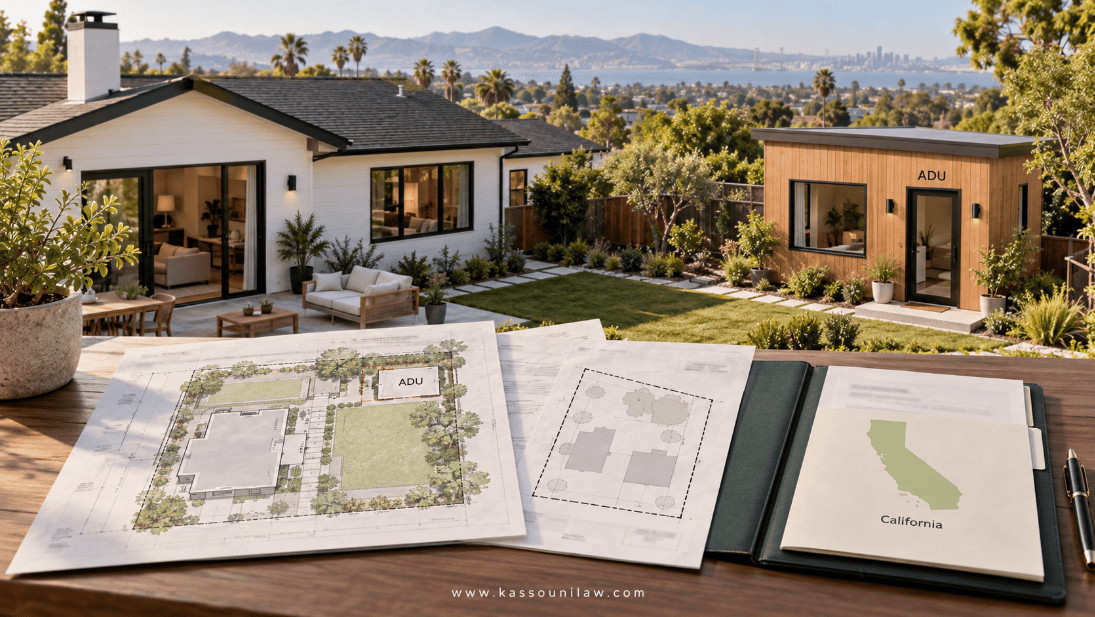
 California ADU laws set statewide rules that limit what cities and counties can require for accessory dwelling units. Local governments still process permits and apply many local standards. The legal question is where state law ends and local discretion begins.
State law requires ministerial review of qualifying ADU applications. It caps certain local standards and sets deadlines for decisions. A city may still apply objective standards the statutes allow. It may also deny applications that are incomplete or do not comply.
Whether a particular rule is lawful depends on the statute, the type of unit, and the property.
What Is an Accessory Dwelling Unit Under California Law?
An accessory dwelling unit (ADU) is an attached or detached residential unit with complete independent living facilities. It sits on a lot that has a proposed or existing primary residence. The statutory definition includes efficiency units and manufactured homes.
Common configurations include:
- Detached units: a new freestanding structure, such as a backyard cottage.
- Attached units: an addition built onto the primary home.
- Conversions: existing space turned into a unit, such as a garage, basement, attic, or other accessory structure.
A junior accessory dwelling unit (JADU) is a smaller category. It is built within the walls of a proposed or existing single-family residence and is limited to 500 square feet. The two categories carry different rules, covered below.
How California’s Statewide ADU Laws Work
The statutes aim to expand ADU construction by removing local barriers. They allow local ordinances but restrict what those ordinances may require. Where a city has no compliant ordinance, the state rules still govern applications.
The ADU statutes now appear at Government Code sections 66310 through 66342. Earlier sources cite the former locations, Government Code sections 65852.2 and 65852.22. SB 477, enacted in 2024, moved the provisions without substantive change. Many local codes and older articles still use the old numbers.
The framework works in three layers:
- State minimums and limits. The statutes set maximum local standards for size, setbacks, height, and parking, and bar certain requirements outright.
- Local ordinances. A city may adopt objective standards within those limits and designate areas where ADUs are allowed.
- Site facts. The property, the unit type, and the building and fire codes determine how the rules apply.
The statutes were amended effective January 1, 2026. SB 543 changed several provisions, including how size is measured and how applications are processed. AB 1154 changed the JADU rental rules. The Department of Housing and Community Development (HCD) publishes ADU guidance and a handbook for current details. Readers should confirm the version in effect when they apply.
What Are the Main California ADU Requirements?
The statutes set outer limits. Local ordinances may be more permissive but, in many areas, cannot be stricter. The main requirements are:
- Size. Cities may set minimum and maximum sizes. A maximum cannot fall below 850 square feet of interior livable space, or 1,000 square feet for a unit with more than one bedroom. Local rules cannot prevent an 800-square-foot ADU with four-foot side and rear setbacks. Statutory caps also apply: attached ADUs may be limited to 50 percent of the primary dwelling’s floor area, and detached ADUs to 1,200 square feet.
- Setbacks. New construction cannot be required to have side and rear setbacks greater than four feet. Existing structures converted to ADUs have separate setback rules.
- Height. Cities must allow at least 16 feet for a detached ADU. The minimum rises to 18 feet near major transit stops, with two more feet for a matching roof pitch. Attached ADUs may be held to 25 feet or the primary dwelling’s height limit, whichever is lower.
- Parking. A city cannot require more than one space per ADU or per bedroom, whichever is less. It cannot require replacement parking when a garage is converted or demolished. Section 66322 also bars parking standards in listed situations, such as within one-half mile walking distance of public transit, in a historic district, or when the ADU is part of the primary residence or an accessory structure.
- Fire and building standards. Building codes still apply. The statutes bar fire sprinkler requirements for the ADU when the primary residence does not need them. They also bar a required passageway from the street.
- Utilities and fees. Septic systems may require a percolation test. State law also limits impact fees for smaller ADUs.
- Rental and ownership. Rentals must run longer than 30 days. An ADU generally cannot be sold separately from the primary residence. Section 66315 bars owner-occupancy requirements for ADUs.
These rules vary by ADU type, lot type, and the specific statute that applies.
When Can a Local Government Require an ADU Permit?
Local governments may require permits. But Government Code section 66317 requires them to consider ADU applications ministerially, “without discretionary review or a hearing.” Ministerial review means checking the application against fixed, objective standards. It does not allow officials to weigh the project’s merits.
Planning review and building permit review are different:
- Planning or zoning review checks the project against objective standards such as setbacks, height, and size.
- Building permit review covers plans, structural and fire safety, and construction requirements.
The statute adds procedural deadlines:
- Completeness. The agency must determine completeness within 15 business days. If it does not, the application is deemed complete.
- Decision. The agency must approve or deny within 60 days of receiving a completed application, where a dwelling already exists on the lot.
- Deemed approval. If the agency does not act in time, the statute deems the application approved.
Different timing applies when the ADU is filed with a new dwelling. The agency may delay its ADU decision until it decides the new dwelling application.
How Do California ADU Laws Limit Local Zoning Restrictions?
State law treats an ADU as a residential use consistent with the general plan and zoning. A conforming ADU is not considered to exceed allowable density. Local zoning cannot be used to avoid the statutory framework.
The statutes bar several specific local requirements, including:
- Minimum lot size requirements
- Standards that prevent an 800-square-foot ADU with four-foot setbacks
- A requirement to correct unrelated nonconforming zoning conditions as a condition of approval
- Discretionary review, hearings, variances, or special use permits for qualifying units
State law also provides that no local ordinance, policy, or regulation other than a consistent ADU ordinance may be the basis for delaying or denying a permit. Section 66323 adds that agencies cannot impose objective development or design standards beyond those the section authorizes for the categories it covers.
Local governments keep real authority. A city may:
- Designate areas where ADUs are allowed, based on water and sewer capacity, traffic, and public safety
- Adopt objective standards for parking, height, setbacks, landscaping, architectural review, and maximum size, within state limits
- Apply protections for properties listed on the California Register of Historical Resources
- Require compliance with building and fire codes
A city may not use that authority to build a discretionary approval process back into ADU review.
Can a California City Deny an ADU Application?
Yes, but only on limited grounds. A lawful denial rests on documented noncompliance with objective requirements the statutes permit. State law does not guarantee approval of every ADU application.
A denial is more likely to be lawful when:
- The application is incomplete, and the city identified the missing items in writing
- The project violates an objective standard that state law allows, such as a valid height or size limit
- The project does not fit a category the statute covers, or falls in a zone where ADUs are not allowed
- The project fails an applicable building or fire code requirement
The statute also controls how the city explains its decision. A denial must come with written comments listing the defects and how to fix them. If the city found the application incomplete, it must list the missing items. On resubmittal, it cannot add items that were not on that list.
An applicant can appeal an incomplete or denied determination in writing to the governing body. The agency must issue a final written determination within 60 business days of the appeal.
A denial may conflict with state law when it:
- Rests on subjective concerns such as neighborhood character
- Applies a standard the statutes do not authorize
- Requires a hearing, variance, or special use permit
- Offers no written reasons or remedies
- Misses the statutory deadlines without a valid reason such as tolling
Each situation depends on the reasons the city actually gave.
What Happens When a Local ADU Rule Conflicts With State Law?
State ADU law overrides conflicting local ordinances. A city may adopt rules that are less restrictive than the statute. It may not adopt rules that are more restrictive where the statute sets the limit.
Section 66316 provides that an existing ADU ordinance failing to meet the statute is null and void. The agency must then apply the statutory standards until it adopts a compliant ordinance. HCD also reviews local ADU ordinances, can issue findings of noncompliance, and in some cases may notify the Attorney General.
That does not mean every local rule is invalid. Nor does every conflict automatically result in approval. A conflict with one provision does not excuse compliance with valid objective standards. The application still must meet requirements that state law permits.
Outdated local codes create many disputes. A city’s ordinance may predate the 2026 amendments, or city staff may apply an older version of the rules. In those cases, the question is which provision the statute actually permits.
Are the Rules Different for Junior ADUs?
Yes. JADUs follow Government Code section 66333 and related provisions. The main differences from a standard ADU are:
- Location. A JADU must be built within the walls of a proposed or existing single-family residence. Enclosed spaces such as an attached garage count as part of the residence.
- Size. A JADU is limited to 500 square feet.
- Number. A lot may have one JADU.
- Entrance. A JADU needs a separate entrance. Without its own bathroom, it also needs interior access to the main living area.
- Kitchen. A JADU needs an efficiency kitchen with a cooking facility, a food preparation counter, and storage.
- Occupancy and restrictions. The owner may be required to live on the property when the JADU shares sanitation with the main house. A recorded deed restriction must bar separate sale and limit the JADU’s size and attributes.
- Rental. Rentals must run longer than 30 days.
The statutes allow one ADU and one JADU on a qualifying single-family lot in some configurations. Both go through ministerial review. Because the details were amended for 2026, confirm current JADU requirements before applying.
What Should Property Owners Check Before Applying for an ADU?
A short review before applying can prevent most disputes:
- Local ordinance. Read the city’s current ADU ordinance. Check whether it reflects the 2026 amendments.
- Zoning and lot type. Confirm the zone and whether the lot has a single-family or multifamily dwelling. The categories of eligible units differ.
- Unit type. Decide whether the project is a conversion, an addition, a detached unit, or a JADU.
- Site constraints. Check easements, septic systems, utility capacity, slopes, and historic status. Coastal Zone properties may face added steps, covered in our article on ADUs in the California Coastal Zone.
- Private restrictions. HOA rules and recorded covenants follow separate law. For single-family lots in planned developments, Civil Code section 4751 voids governing-document provisions that effectively prohibit or unreasonably restrict ADUs, with an exception for reasonable restrictions.
- Application requirements. Collect the plans, site survey, and forms the city lists. Complete submittals reduce delay.
- Building and fire requirements. Confirm which building, fire, and utility rules apply to your unit type.
Legal review can help when a city’s requirement appears to conflict with the statutes, or when the ordinance and the staff’s explanation do not match.
When Should You Consult a California Land Use Attorney?
Legal advice may help in several situations. They include a denial that appears to rest on subjective grounds, local standards that conflict with state limits, and unusual site restrictions. Repeated delays in processing a complete application can also warrant review. A California land use attorney can compare the city’s reasons to the statutes. Broader restrictions that burden how an owner may use property can also raise property rights questions.
Reviewing ADU Requirements Under California Law
California’s ADU laws set statewide limits and procedures. Local governments keep authority to apply permitted objective standards and building codes. They must follow ministerial review, deadlines, and written-reasons requirements. Owners should confirm the current rules for their property before they apply.
Property owners with a disputed ADU application or a legal question can contact Kassouni Law at (877) 770-7379 or through the firm’s contact page.
Frequently Asked Questions
What are the main ADU laws in California?
They are codified at Government Code sections 66310 through 66342, formerly sections 65852.2 and 65852.22. The statutes cover ADUs, JADUs, local ordinances, ministerial review, and limits on local standards. Amendments took effect January 1, 2026.
Can a California city deny an ADU application?
Yes, on limited grounds. A city may deny an incomplete or noncompliant application. It must give written reasons and a way to fix the defects. Discretionary or unauthorized grounds may conflict with state law.
Can local governments impose ADU size and setback requirements?
Yes, within state limits. Cities may adopt objective standards. They cannot set a maximum size below the statutory floors or block an 800-square-foot ADU with four-foot side and rear setbacks.
Does California law require a permit for an ADU?
Yes. A building permit is generally required, and the city may require related permits. State law requires the city to review the application ministerially, within set deadlines.
Are ADU and JADU requirements different?
Yes. A JADU must sit within the walls of a single-family residence and is limited to 500 square feet. It has its own entrance, kitchen, and deed restriction rules. An ADU can be detached or attached and may be larger.
What can a property owner do if a city applies an unlawful ADU restriction?
The owner can first use the city’s written appeal process. The owner may also raise the issue with HCD, which reviews local ADU compliance. Court review may be available. Deadlines apply, so consult an attorney promptly.
The information provided here is general information and not legal advice. Readers should consult a qualified California attorney about their specific circumstances.