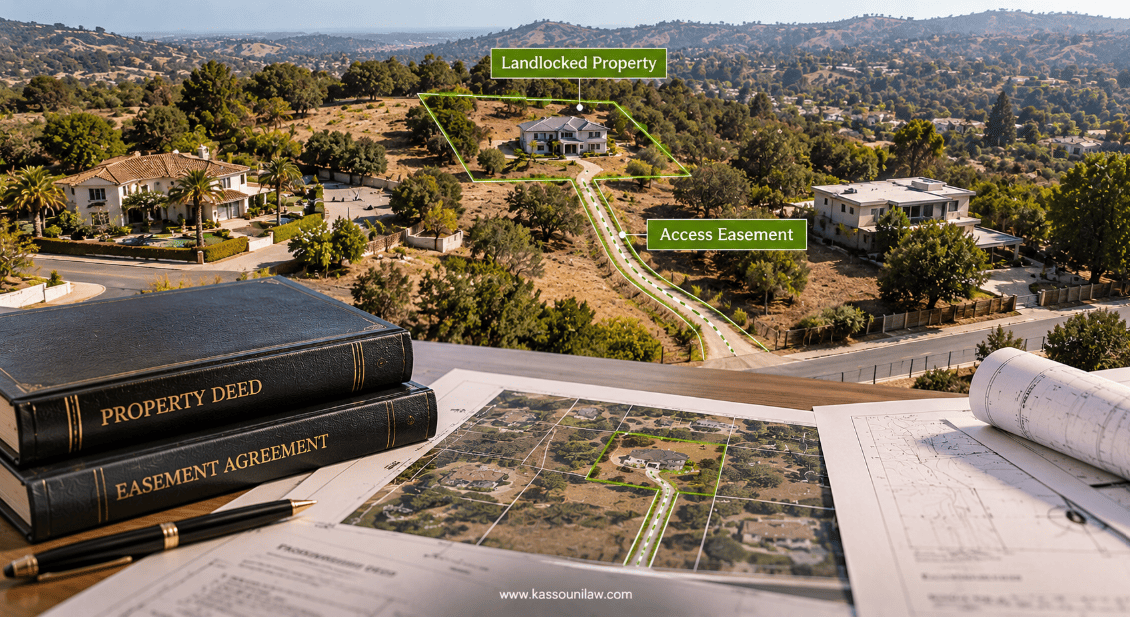
 A parcel without legal access to a public road can be difficult to use, finance, or sell. In limited circumstances, California law may recognize an easement by necessity that allows access across neighboring land. Being landlocked does not automatically create that right.
To establish an easement by necessity, a claimant generally must show strict necessity and prior common ownership of the parcels. The property’s ownership history matters alongside the lack of access.
In Murphy v. Burch (2009) 46 Cal.4th 157, the California Supreme Court explained the legal requirements for an easement by necessity. Whether a claim succeeds depends on the property’s history, available access, and supporting evidence.
What Is an Easement by Necessity in California?
An easement by necessity is a right to cross another owner’s land to reach a landlocked parcel. It is a type of implied easement. Courts imply it from the circumstances when one owner divides property and leaves a parcel without access.
Two terms appear in the cases. The dominant tenement is the parcel that benefits from the easement. The servient tenement is the parcel that carries the burden.
Several access rights can look alike but follow different rules:
- Express easement. A deed or written agreement grants the right. Civil Code section 801 lists the right-of-way among recognized easements.
- Implied easement from prior use. Civil Code section 1104 creates an easement over other land of the transferor. It applies where the transferor “obviously and permanently” used the other land for the benefit of the transferred property when the transfer was agreed upon or completed.
- Easement by necessity. The right arises from the division of property and the resulting lack of access. Strict necessity is the core requirement.
- Prescriptive easement. The right arises from long, open use without the owner’s permission. It involves different requirements and does not depend on prior common ownership.
An easement by necessity is not a general right to use a neighbor’s land when access would be convenient. For a broader overview, see the firm’s page on California easement law.
What Are the Requirements for an Easement by Necessity?
The Supreme Court in Murphy stated that “two circumstances are indispensable to the implication and must be shown.” They are strict necessity for the claimed right-of-way and common ownership of the parcels. The court added that no easement is implied where it is contrary to the parties’ intentions.
Common Ownership Before the Property Was Divided
The dominant and servient parcels must have been under common ownership at the conveyance that gave rise to the necessity. The claimed easement arises from that conveyance. Ownership history therefore decides whether the doctrine applies at all.
Murphy shows how much the history matters. The claimed common owner there was the federal government, and the parcels passed by federal patent. The court found no common ownership at the time of the later patent, because the government no longer owned the neighboring land. The court said “extreme caution must be exercised” in implying an access easement in that setting. A claimant must produce evidence on the government’s intent to reserve access and on its lack of condemnation power. The claim in Murphy failed.
Common ownership is not always formal legal title. In Roemer v. Pappas (1988) 203 Cal.App.3d 201, the court held that equitable title under an installment land contract satisfied the requirement. The court treated the buyer as the owner for this purpose.
Strict Necessity for Access
Necessity means more than convenience. Murphy states that no easement will be implied where there is another possible means of access, even if that access is inconvenient. A shorter or cheaper route does not establish necessity.
The decisions treat the requirement as strict. In Daywalt v. Walker (1963) 217 Cal.App.2d 669, the court affirmed a judgment against a claimant who did not prove a way of necessity. Roemer likewise described strict necessity as the only access.
Whether another route is legally and practically adequate is a question of fact. A difficult alternative does not automatically establish necessity. An alternative also does not automatically defeat a claim. The evidence about the actual routes controls.
The Circumstances When the Property Was Conveyed
An easement by necessity rests on the presumed intent of the parties at the time of the conveyance. The circumstances at that moment therefore matter. They include what access the parcel had, what the parties knew, and how the ownership history relates to the claimed easement.
In Roemer, the court described the presumption of an intended easement as rebuttable. The party resisting the easement could rebut it by showing the parties did not intend one. In Daywalt, evidence that the buyer knew the parcel lacked access supported a finding that the parties intended no right of way.
These cases show reasoning on particular facts. They do not create a checklist that guarantees an outcome.
Does Landlocked Property Automatically Qualify for an Easement?
No. Lack of direct road access does not establish an easement by necessity. The claimant must also show that the parcels were commonly owned at the relevant conveyance and that the conveyance created the necessity. The claim in Murphy failed even though the claimant’s parcels were landlocked.
Prior ownership, the circumstances of the severance, available access, and the evidence all shape the analysis. A claim that fails on one point may fail entirely.
When an easement by necessity is unavailable, other access rights may exist. An express easement may appear in a deed or recorded agreement. An implied easement from prior use may arise under Civil Code section 1104. A prescriptive easement may arise from long use. Each follows its own rules, and none follows from landlocked status alone.
How Is an Easement by Necessity Established?
Establishing the easement starts with the records. Relevant evidence typically includes:
- Current and historical deeds
- Parcel maps and subdivision records
- The chain of title
- Records showing prior common ownership
- Evidence of existing routes and physical access restrictions
- Surveys and other property records
The parties may negotiate an access agreement. A written agreement can document the route and permitted use. An agreement is not the same as a court-established easement. A court decides the claim when the parties dispute the facts or the law.
A claimant may ask a court to resolve the dispute. One option is a quiet title action under Code of Civil Procedure section 760.010 and following. Another is a declaratory relief claim under section 1060. Whether those procedures fit depends on the claim. In Roemer, the Court of Appeal affirmed an easement by necessity.
Where Can an Easement by Necessity Be Located?
Establishing that an easement exists does not resolve every question about its location or scope. Those are separate issues.
The extent of an easement generally depends on its source. Civil Code section 806 provides that a servitude’s extent is determined by the terms of the grant or the nature of the enjoyment by which it was acquired. For an implied easement, no written grant exists. The facts and circumstances supply the content.
The route, the permitted use, and the burden on the affected properties depend on the legal basis and the facts. Murphy did not decide how a route is selected. A claimant cannot assume the right to choose any route across a neighboring parcel.
The existence of an access right differs from a dispute about where or how it may be used. Courts can address both, but each requires its own evidence.
Can an Easement by Necessity End?
Yes, in some circumstances. Murphy states that an easement by necessity “continues only as long as the need for it exists.” The easement is tied to the necessity that created it. Adequate alternative access may end that necessity.
Daywalt recited the same rule. A way of necessity ceases when the necessity to use it ceases.
This rule belongs to easements by necessity. It does not describe other easements. An express easement does not end merely because another route exists. Other easements end under other rules. Examples are the statutory grounds in Civil Code section 811, which includes merger of the dominant and servient parcels in one owner.
Whether alternative access is adequate is a factual question. A claim that necessity has ended can itself become a dispute.
What Disputes Can Arise Between Neighboring Property Owners?
Common disputes include:
- Whether the legal requirements have been satisfied
- Whether an alternative access route is adequate
- The location and scope of a claimed easement
- Interference with an established access right
- Private road maintenance, gates, fences, or permitted use
- Disagreements about property records or ownership history
Available remedies depend on the facts and the legal basis of the claim.
Related claims are not interchangeable:
- An easement dispute concerns a right to use another’s land.
- A trespass claim concerns unauthorized entry onto property.
- A boundary dispute concerns where one parcel ends and another begins.
- A quiet title claim asks a court to settle adverse claims to an interest in property.
A single access conflict can involve more than one of these. Broader California property rights disputes may overlap with them.
When Should a Property Owner Consult a California Real Estate Attorney?
Legal review can help in several situations:
- Purchasing a parcel with uncertain access
- Discovering that a property may be landlocked
- Reviewing historical deeds or subdivision records
- Disputing a neighbor’s claimed access rights
- Negotiating an easement agreement
- Facing interference with an existing access route
- Considering a legal claim involving access to property
Early review of the title documents often clarifies what rights exist. It does not guarantee a particular result.
Resolving California Property Access Disputes
Access rights depend on the legal basis for the claimed easement, the property’s ownership history, and the available evidence. An easement by necessity is not automatic. It requires strict necessity and common ownership, and it may end when the necessity ends.
Property owners facing a significant access dispute can obtain advice based on their specific circumstances. Kassouni Law’s California real estate law practice handles easement and access matters for private parties. The firm does not represent government agencies, cities, or counties, and it cannot guarantee an easement or any particular outcome.
Call (877) 770-7379 or use the firm’s contact page. Submitting a contact form does not create an attorney-client relationship.
Frequently Asked Questions
What qualifies as an easement by necessity in California?
Under Murphy, the claimant must show strict necessity for the right-of-way and common ownership of the parcels at the conveyance that created the necessity. The implication will not be made where it is contrary to the parties’ intentions.
Can a landlocked property owner cross a neighbor’s land?
Only if a legal basis exists, such as an express easement or a qualifying implied easement. Landlocked status alone does not create a right to cross.
Does an alternative route prevent an easement by necessity?
It can. Murphy states that no easement will be implied where another possible means of access exists. Whether an alternative is adequate depends on the facts.
Can an easement by necessity be established without a written agreement?
Yes. It is an implied easement, so no written grant is required. The claimant must still prove the requirements, and a court may need to decide the claim.
Can an easement by necessity end if another access route becomes available?
It may. Murphy states that the easement continues only as long as the need for it exists. Whether alternative access is adequate is a factual question.
The information provided here is for general informational purposes and does not constitute legal advice. Property records, applicable law, and individual circumstances vary. Readers should consult a qualified California attorney about their specific situation.