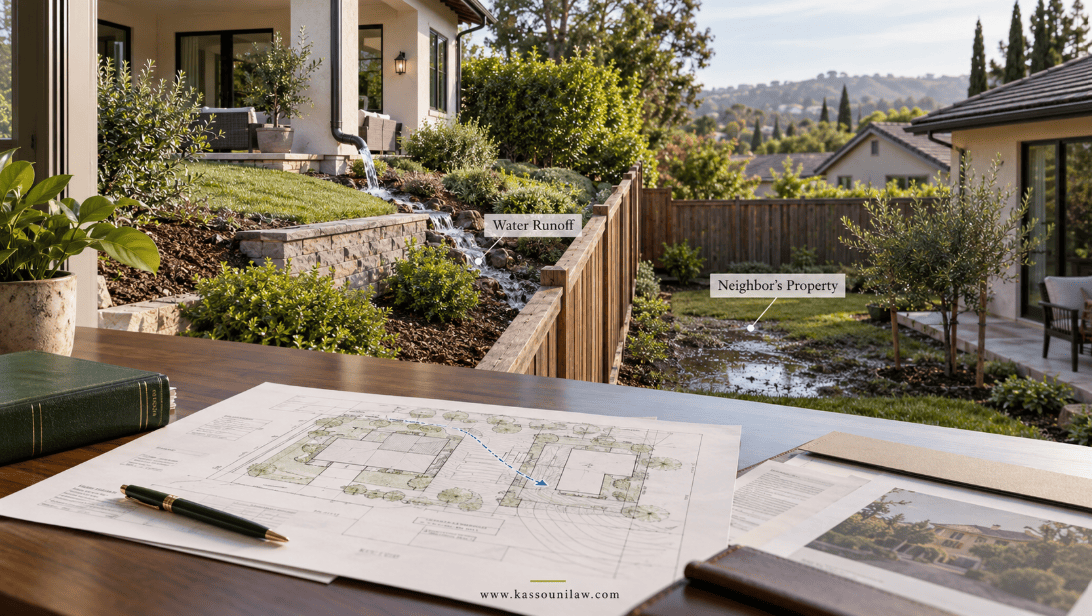
 A neighbor repaves a driveway, regrades a back slope, or points a downspout toward the property line. The next heavy rain leaves standing water, eroded soil, or a wet foundation on the adjoining lot.
California neighbor drainage laws do not treat every flow of water across a boundary as a wrong. The law recognizes the natural movement of surface water. It can impose liability when a landowner changes drainage in a way that unreasonably harms another property.
The outcome depends on the source of the water, the changes made, the damage, and the surrounding circumstances. The leading decision is Keys v. Romley (1966) 64 Cal.2d 396, which involved paving and downspouts very much like the example above.
Can a Neighbor Legally Drain Water Onto Your Property in California?
Sometimes. A neighbor’s right to use and improve land does not include unlimited freedom to redirect water and cause harm.
Keys v. Romley arose from facts that many owners will recognize. A contractor built an ice rink on an upper lot, paved the surrounding area with asphalt, and installed downspouts that sent rainwater across the pavement. The water then flowed onto the lower lot, where flooding and erosion followed. The Supreme Court described California as following a “modified civil law rule.”
Under the civil law rule, an upper owner may discharge surface water as it naturally flows. That owner may be liable for damage caused by discharging it in an unnatural manner. The Court modified the rule by adding a reasonableness requirement. Each owner must take reasonable care in using property, and a threatened owner must take reasonable precautions to avoid or reduce injury.
The analysis does not stop at whether water crossed a property line. It asks what the water did before the change, what changed, and whether each owner acted reasonably. Naturally flowing surface water is treated differently from runoff that has been concentrated or redirected through artificial changes.
What Do California Neighbor Drainage Laws Say?
Natural Drainage and Altered Water Flow
Keys states that each owner’s duty is to leave the natural flow of surface water undisturbed. A lower owner ordinarily must accept water that drains naturally from higher land.
Many ordinary improvements can change that flow. They can alter the amount of water, its direction, its concentration, or its timing. Examples include:
- Grading that changes the slope of the land
- Paving that replaces absorbent soil with hard surfaces
- Landscaping that redirects or blocks surface flow
- Retaining walls that hold back or redirect water
- Gutters, downspouts, and drainage pipes that gather water and release it at one point
A change in drainage does not by itself establish liability. The nature of the alteration and its effects on the neighboring land matter.
The Reasonableness Standard
Keys treats reasonableness as a question of fact decided case by case. The Court identified considerations that may bear on it, including the amount of harm caused, the foreseeability of that harm, and the purpose or motive behind the owner’s conduct. It also asked whether the utility of the owner’s use of the land outweighs the gravity of the harm.
These are considerations, not a formula. They do not guarantee any result.
Keys also looks at the affected owner. The Court stated that a person threatened with injury must take reasonable precautions to avoid or reduce it. Failing to take reasonable precautions can affect the analysis.
Reasonableness does not erase the underlying rule. Keys indicates that if both owners acted reasonably, the injury must be borne by the upper owner who changes a natural system of drainage. A neighbor cannot assume that careful construction ends the inquiry.
The California Supreme Court later applied the Keys reasonableness standard in Locklin v. City of Lafayette (1994) 7 Cal.4th 327. Locklin involved public entities, so it is not a private neighbor case. Its value here is how it describes the two categories of water and the standard that governs both.
Surface Water Versus a Natural Watercourse
Locklin describes surface water as water “diffused over the surface of land, or contained in depressions therein.” Rainwater running across a lawn or driveway is a common example.
A natural watercourse is “a channel with defined bed and banks made and habitually used by water.” A creek is a common example. Once surface water becomes part of a stream in a watercourse, Locklin states, it is no longer recognized as surface water.
The label still matters. It frames the dispute, points to the relevant cases, and identifies facts that need proof, such as whether a defined channel exists.
Locklin also limits how far the difference goes. The Court rejected an older natural watercourse rule that gave immunity for discharges into a watercourse regardless of reasonableness. It held that the Keys reasonableness standard governs those discharges too.
A backyard drainage dispute and a creek-erosion dispute therefore remain different kinds of cases, even though reasonableness matters in both. The first step is identifying the type of water flow. The same assumptions should not be applied to every drainage or flooding problem.
What Neighbor Actions Can Create a Drainage Dispute?
Several kinds of changes commonly prompt legal review:
- Raising or lowering land through grading
- Paving a driveway or patio and changing where runoff goes
- Directing roof water through gutters or downspouts toward neighboring land
- Installing or altering drainage pipes
- Building retaining walls that affect water flow
- Concentrating runoff in a way that causes erosion or flooding
- Blocking or diverting an established drainage route
None of these is automatically unlawful. The question for each is whether the conduct and the resulting water flow violate a legal duty or cause legally actionable harm. A small paving project that adds little runoff may raise no claim. A pipe that releases a concentrated stream onto a neighbor’s slope may raise a serious one.
What If the Water Is Causing Damage to Your Property?
The type and extent of damage shape any claim. Common examples include:
- Repeated flooding of yards or low areas
- Soil erosion
- Damage to landscaping or retaining structures
- Water entering a building
- Damage to driveways, foundations, or other improvements
Legal analysis cannot replace technical analysis. Whether damage is structural, and how water moves across a site, are questions for qualified professionals. Legal claims typically need that technical evidence to show where the water originates and how it travels.
The claim also depends on causation and the applicable legal standards. Damage that appears after a storm does not show, by itself, that a neighbor caused it.
What Evidence Can Help in a California Drainage Dispute?
Evidence matters because a court must decide what happened and who caused it. Useful materials may include:
- Photographs and videos taken before, during, and after runoff events
- Records of flooding, erosion, and repairs
- Property surveys and grading plans
- Drainage plans and permits, where relevant
- Contractor records showing changes to drainage systems
- Communications with the neighboring owner
- Opinions from qualified drainage or engineering professionals, where needed
Together, the evidence should help establish the original drainage conditions, the changes made, the source of the water, and the resulting damage.
No single item is always decisive. A photograph shows a result but not necessarily a cause. An engineering opinion can address cause but may depend on records of the original conditions.
Can You Sue a Neighbor for Redirecting Water Onto Your Property?
An owner may have legal options when a neighbor’s drainage conduct causes actionable harm. Not every drainage problem supports a lawsuit.
Keys treated surface water liability as a matter of tort principles and reasonable care. Depending on the facts, claims may be framed as negligence or private nuisance. Other property-related theories may also apply.
Nuisance has a statutory definition. Civil Code section 3479 includes anything that is an obstruction to the free use of property, so as to interfere with the comfortable enjoyment of life or property. Section 3481 provides that a nuisance not covered by the public definition is private.
Section 3479 does not make every runoff problem a nuisance. California’s civil jury instruction on private nuisance lists further elements. They include substantial interference with the use or enjoyment of the land and conduct that is intentional and unreasonable, or negligent or reckless. The interference must be of a kind that would reasonably annoy or disturb an ordinary person. The defendant’s conduct must be a substantial factor in causing the harm, and the seriousness of the harm must outweigh the public benefit of that conduct.
Trespass is a different theory about unauthorized physical entry onto land. Not every runoff dispute is a property trespass claim, and whether that theory fits depends on the facts.
Remedies depend on the claim. A court may award money damages for harm proven. In Keys, the trial court had also issued an injunction against further discharge. The Supreme Court reversed that judgment because the reasonableness of both parties’ conduct had not been decided. A court may order a neighbor to change a drainage system only where the law and the evidence justify it.
What If the Drainage Problem Involves an Easement or Shared Drainage System?
Some properties carry recorded drainage easements or other legally recognized drainage rights. Civil Code section 801 lists the right of receiving water from, or discharging it upon, land among recognized easements. Recorded documents may therefore change the analysis. A deed, a recorded easement, a subdivision map, or a drainage agreement may define what each owner may do.
An easement must be established from the relevant documents and law. A neighbor does not hold a drainage easement merely because water has flowed across the property for years. For the broader rules, see the firm’s page on California easement law.
If owners dispute whether a claimed drainage right exists, a quiet title action may be one way to resolve that question. That is a separate issue from whether a particular discharge was reasonable.
When Should You Contact a California Real Estate Attorney?
Legal review can be useful in several situations:
- Runoff repeatedly damages the property
- A neighbor has changed grading or drainage infrastructure
- The parties disagree about the source of the water
- An easement or recorded drainage agreement may apply
- A property owner receives a demand to change a drainage system
- Negotiations have failed to resolve an ongoing dispute
- The damage is significant or the problem may continue
Many drainage issues resolve without a lawsuit. A conversation, a repair, or a written agreement can settle the matter when both owners cooperate. Early review of the facts and documents helps an owner decide which path fits.
Resolving Neighbor Drainage Disputes in California
California neighbor drainage laws do not give either owner unlimited control over surface water. The analysis turns on natural drainage, the alterations made to the land, the reasonableness of each owner’s conduct, and the harm involved.
Owners facing recurring runoff or water damage can start by gathering the available evidence and obtaining advice based on their specific circumstances.
Kassouni Law’s California real estate law practice addresses California property rights disputes for private parties, including significant drainage conflicts between neighbors. The firm represents private parties and does not represent government agencies. It cannot guarantee any particular outcome.
Call (877) 770-7379 or use the firm’s contact page. Submitting a contact form does not create an attorney-client relationship.
Frequently Asked Questions
Can a neighbor direct rainwater onto my property in California?
It depends. An upper owner may let surface water drain as it naturally flows. Artificially redirected or concentrated runoff is treated differently, and each owner must act reasonably under Keys v. Romley.
Can I sue a neighbor for flooding my property?
A claim may be available when the neighbor’s conduct causes legally actionable harm. The facts, causation, and evidence determine whether a claim succeeds.
Is a neighbor responsible for water runoff from a paved driveway?
Paving can change runoff. Liability depends on how the paving altered the flow, what harm resulted, and whether the owner acted reasonably. Paving alone does not establish responsibility.
What if water has always drained from my neighbor’s land onto mine?
Natural drainage and later alterations are treated differently. A lower owner ordinarily accepts natural flow, while changes that increase or redirect it may raise separate questions. Long-standing flow does not by itself create an easement.
Can a California court order a neighbor to fix a drainage problem?
In appropriate cases, a court may grant injunctive relief. The result depends on the legal claim, the evidence, and the applicable requirements. In Keys, the Supreme Court sent the case back for findings on reasonableness before addressing relief.
The information provided here is for general informational purposes and does not constitute legal advice. Laws and individual circumstances vary. Readers should consult a qualified California attorney about their specific situation.