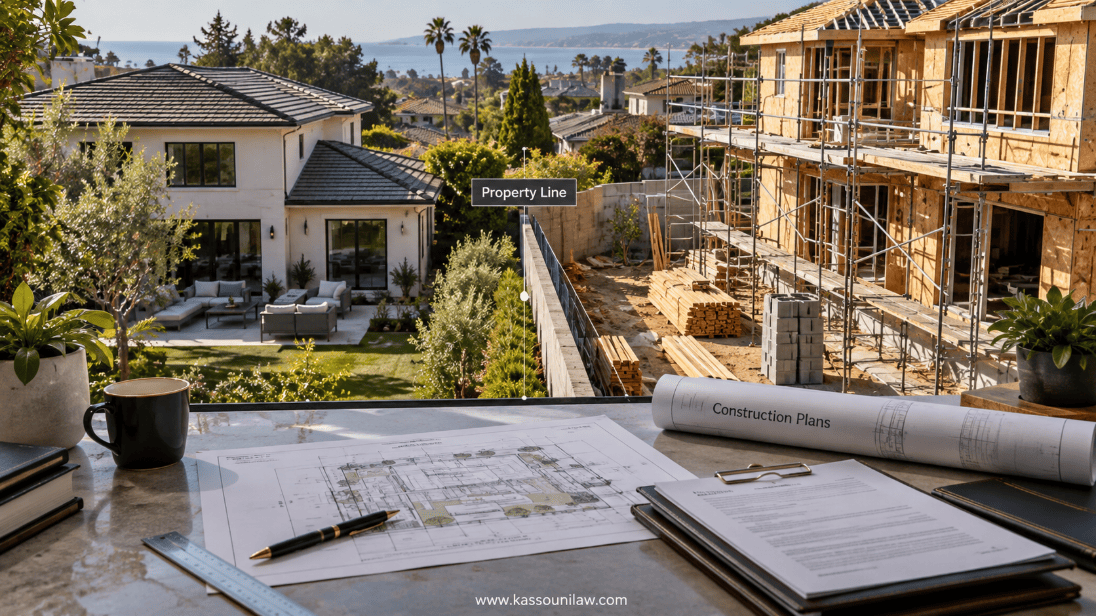
 A neighbor starts building a wall that looks too close to the line. Another begins excavating near a shared boundary, or extends a structure toward the fence. The owner next door suspects the work may affect the property but is unsure how to respond.
The question of how to stop a neighbor’s construction in California has no single answer. The right response depends on the property rights involved, the nature of the work, and whether the construction violates a law, a permit condition, an easement, or another enforceable right.
Some projects can be addressed with a conversation or a call to the city. Others may justify a court order. Many projects cannot be stopped because no enforceable right is violated.
When Can You Legally Stop a Neighbor’s Construction in California?
A property owner generally needs a legal basis. Situations that may justify action include:
- Construction that crosses the boundary or creates an encroachment, meaning a structure that extends onto another owner’s land
- Unauthorized entry onto private property
- Interference with a recorded or legally established easement
- Work that creates a legally actionable nuisance or threatens property damage
- Construction that may violate permit conditions, zoning requirements, or building codes
An objection to a project does not by itself create a right to stop it. Neither does a lost view or a general concern about noise or disruption.
Private rights and public rules are different things. A trespass or encroachment claim protects the owner’s land. A code or permit violation concerns compliance with local law. A building-code violation does not automatically give a neighbor a private right to sue. Owners who suspect a neighbor building on their property are dealing with a property-rights issue, and a city complaint will not necessarily resolve it.
Excavation raises its own issue. Civil Code section 832 gives adjoining owners a right to lateral support, but it allows proper and usual excavations. The excavating owner must give reasonable notice of the depth and start date, use ordinary care, and take reasonable precautions to protect the neighboring land.
What Should You Do First?
Confirm Your Property Boundaries
Start with the deed, title documents, and any recorded easements. A professional survey is the usual way to locate the line. Fences, hedges, and informal assumptions often do not match the legal boundary. The firm’s page on California property line disputes covers conflicting boundary evidence in more detail.
Document the Construction
Take dated photographs and videos of the property before the work changes it. Keep construction notices, plans, permits, correspondence, and records of any observed damage. Evidence of the original condition is hard to recreate later.
Review Permits and Local Requirements
The city or county building or planning department can help an owner check permit records, approved plans, setbacks, and possible code violations. Not every project needs the same permits. A permit problem does not automatically create a private right to stop the work.
Contact the Neighbor When Appropriate
A written, factual request to discuss the issue can sometimes resolve a misunderstanding. Owners should preserve all communications. They should avoid threats, trespass, property damage, and physical interference with the work.
Communication is not always appropriate or enough. Where harm is imminent, waiting for a reply can cost the owner options.
Can You Report a Neighbor’s Construction to the City or County?
Local agencies can play a role when work may violate permit conditions, zoning limits, setbacks, or building codes. An owner can:
- Check available permit and planning records
- Report a suspected violation to the appropriate department
- Request an inspection where the agency offers that process
- Keep copies of complaints, inspection results, and agency communications
The agency decides how to respond under its own authority. A complaint does not guarantee an inspection, a stop-work order, or a favorable decision.
An administrative complaint is also different from a private lawsuit. The agency enforces local rules. It does not resolve a trespass, encroachment, nuisance, or easement claim for the owner.
Can You Get a Court Order to Stop the Construction?
A court may issue an injunction in an appropriate property dispute. An injunction is a “writ or order requiring a person to refrain from a particular act” (Code Civ. Proc., § 525). The owner must first establish a legally supportable claim, such as trespass, encroachment, or easement interference. Grounds under section 526 include threatened great or irreparable injury and the inadequacy of money damages.
Types of Court Orders
- Temporary restraining order (TRO). Short-term emergency relief until a hearing.
- Preliminary injunction. An order that restricts conduct while the case proceeds.
- Permanent injunction. Relief that may follow a final judgment when the requirements are met.
California courts generally weigh two factors. One is the likelihood that the owner will prevail at trial. The other is the interim harm the owner would suffer if the order is denied, compared with the harm to the neighbor if it is granted (IT Corp. v. County of Imperial). Credible evidence, urgency, and whether money damages would fix the harm all matter.
A TRO is not automatic. A TRO without notice requires facts showing great or irreparable injury before the matter can be heard on notice (Code Civ. Proc., § 527). The court rules also generally require notice by 10:00 a.m. the court day before an ex parte hearing (Cal. Rules of Court, rule 3.1203). A TRO request proceeds by order to show cause (rule 3.1150), and a granted injunction generally requires the applicant to post a bond (section 529).
The firm’s article on injunctions in California property disputes explains the standards and process. The writs and injunctions page describes related remedies.
Why a Court May Refuse to Stop the Work
Courts can decline to halt construction. The owner may lack a legal claim, or the evidence may be thin. Damages may adequately address the harm. Courts also weigh the hardship an order would impose on the builder.
In Hirshfield v. Schwartz (2001) 91 Cal.App.4th 749, a neighbor’s improvements encroached on the plaintiffs’ land. The court weighed the parties’ conduct and hardships. It upheld a refusal to order removal and affirmed an equitable easement with payment. Such results depend on the encroacher’s innocence and on the relative hardship. They do not follow in every encroachment case.
What Evidence Can Help Support Your Case?
Each type of evidence helps establish a different point:
- Deeds and title documents: ownership and the property description.
- Surveys and boundary maps: the location of the line and any encroachment.
- Recorded easements or restrictions: the right at issue. See the firm’s page on California easement law.
- Photographs and videos: the property before and during construction.
- Plans, permit records, and inspection reports: what was approved and what is being built.
- Written communications: what the neighbor or contractor knew and said.
- Surveyor or engineer opinions: boundary or damage questions that require technical support.
- Records of timing and harm: when the work started and what harm is threatened.
No case needs every item. The issue in dispute determines which records matter.
What If the Construction Has Already Started or Caused Damage?
Ongoing work does not bar an owner from seeking relief. Delay can make some remedies harder to obtain, and completed construction complicates the practical outcome.
Preventing threatened harm differs from seeking a remedy for harm that has already occurred. Depending on the facts and the claim, the options may include an injunction, damages, or a court determination of property rights.
Prompt assessment matters when work may permanently alter the land, cross a boundary, block an easement, or cause continuing damage.
When Should You Contact a California Property Attorney?
Legal advice may be especially important when:
- Construction appears to cross a property line
- A neighbor or contractor refuses to address an alleged encroachment
- Work threatens to block an established easement or access route
- Excavation or grading may cause significant or lasting damage
- Construction is moving quickly and emergency relief may be necessary
- A permit or administrative complaint has not resolved the private dispute
An attorney can evaluate the underlying claim, the remedies, the evidence, the timing, and whether court action fits.
Choosing the Right Response to Neighbor Construction
The first step is identifying the property right or legal requirement at issue. The next steps are documenting the facts and choosing a response that fits the problem. Not every dispute requires litigation.
Owners facing a California property dispute can contact Kassouni Law. The firm represents private parties and does not represent government agencies. See the firm’s real estate law and writs and injunctions pages for more about its work. No result is guaranteed.
Call (877) 770-7379 or use the firm’s contact page. Submitting a contact form does not create an attorney-client relationship.
Frequently Asked Questions
Can I legally stop my neighbor from building on their property in California?
Only if the construction violates a legal right or requirement, such as a boundary, an easement, a permit condition, or a nuisance rule. Disliking a project is not enough. The outcome depends on the facts and the applicable law.
Can I report a neighbor’s construction to the city?
Yes. Local building and planning departments generally take reports of suspected permit, zoning, or code violations. The agency decides whether to inspect or act, and a complaint does not resolve a private property claim.
Can a California court stop construction near a property line?
A court may issue an injunction if the owner shows a legal claim and meets the injunction requirements. Courts weigh the likelihood of success and the harm to each side. Relief is not guaranteed.
What can I do if my neighbor’s construction damages my property?
Document the damage, preserve evidence, and seek advice promptly. Depending on the facts, options may include negotiation, damages, or injunctive relief to prevent further harm.
Can I get a temporary restraining order to stop a neighbor’s construction?
Possibly, in urgent cases with a supportable claim and a showing of great or irreparable injury. A TRO is short-term and requires notice or a showing why notice should be excused. The outcome depends on the facts.
The information provided here is for general informational purposes and does not constitute legal advice. Outcomes depend on the facts and the applicable law. Readers should consult a qualified California attorney about their specific situation.