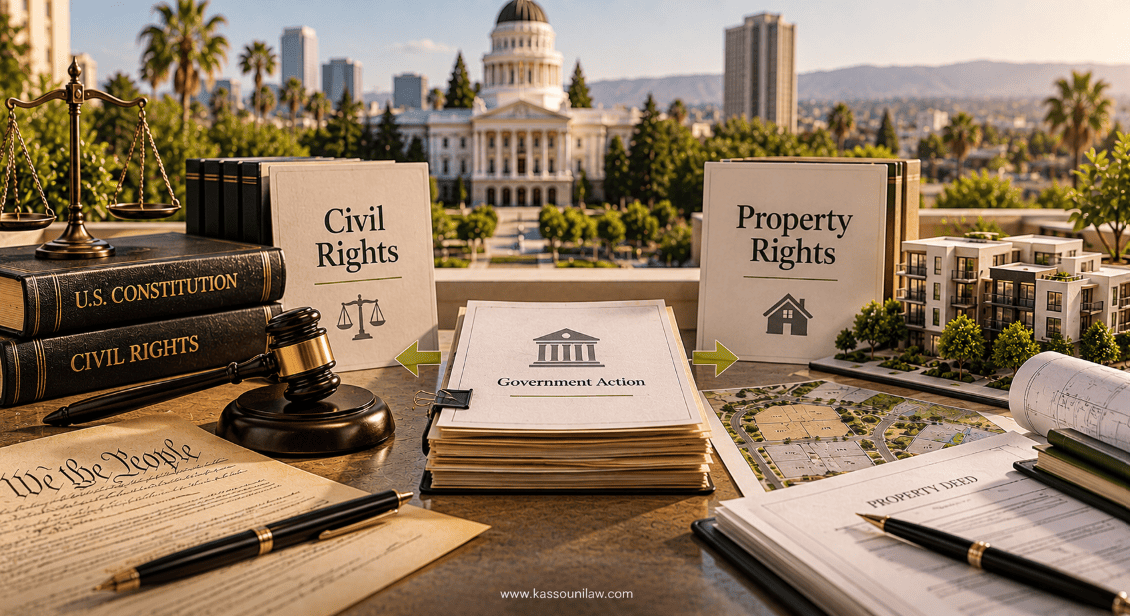
 Government action can affect individual rights and property interests at the same time. A single decision by a city, county, or state agency may raise civil rights issues, property rights issues, or both.
The right legal focus depends on three things: what the government did, which right it affected, and what legal remedy may apply. Choosing between a civil rights attorney and a property rights attorney in California starts with the nature of the claim, not with the type of person or agency involved.
The two practice areas also overlap. Some disputes involve both property rights and civil rights theories. Others involve only one. Not every government dispute is either kind of case.
What Does a Civil Rights Attorney Handle in California?
A civil rights attorney handles claims that government actors violated constitutional or statutory protections for individuals. In federal court, many of these claims proceed under 42 U.S.C. section 1983, which allows a person to sue those who deprive them of federal rights under color of state law. California also has its own constitutional protections, including Article I, Section 7, which addresses due process and equal protection.
Common civil rights issues involving government action include:
- Equal protection: claims that the government treated people differently without an adequate legal basis.
- Discrimination by government actors: claims based on protected characteristics.
- Due process: claims about unfair procedures or arbitrary deprivation of protected interests.
- Other constitutional rights: such as speech, assembly, or protection from unreasonable searches.
- Interference with protected rights: government conduct that burdens a right the Constitution protects.
Civil rights claims arise in many contexts beyond real estate or property, including policing, employment, education, and public benefits. Kassouni Law describes its work in this area on its civil rights page.
What Does a Property Rights Attorney Handle in California?
A property rights attorney handles claims that government action unlawfully interfered with private property interests. The focus is the property itself and what the government did to it. Typical subjects include:
- Regulatory takings: regulations that restrict property use so severely that the Constitution may require compensation.
- Physical takings: government acquisition or occupation of property.
- Inverse condemnation: a claim brought by a property owner when the government takes or damages property without formal eminent domain proceedings.
- Land-use and development restrictions: zoning, density limits, and similar rules.
- Interference with property use: government actions that limit what an owner may do with their land.
- Permit and entitlement disputes: disagreements over approvals, conditions, and denials.
California’s Constitution addresses takings directly. Article I, Section 19 provides that private property may be taken or damaged for public use only when just compensation has first been paid. Kassouni Law discusses these matters on its constitutional property rights page.
How Are Civil Rights and Property Rights Claims Different?
Civil rights claims concern protected individual rights. Property rights claims concern protected property interests. The table shows the general distinction.
| Aspect | Civil Rights Claim | Property Rights Claim |
|---|---|---|
| Main concern | Government interference with protected individual rights | Government interference with protected property interests |
| Common issues | Equal protection, discrimination, due process | Takings, inverse condemnation, property-use restrictions |
| Property required? | No | Usually yes |
| Government action | Often central | Often central |
| Potential remedies | Vary by claim and circumstances | May include compensation or other remedies |
Two features often distinguish these claims. A civil rights claim does not require the plaintiff to own property because the protected interest is the individual right itself. A property rights claim generally requires a legally protected property interest. That distinction can matter when determining which legal theories apply. However, one government action can implicate both civil rights and property rights.
When Can a Property Dispute Become a Civil Rights Case?
A property dispute can raise civil rights issues when government action affects an independently protected constitutional right. Examples include discriminatory treatment, equal protection, and procedural due process. Kassouni Law addresses these claims on its page about equal protection under the law.
Situations that may raise civil rights questions include:
- Discriminatory treatment: a government decision affecting property owners based on a protected classification.
- Equal protection: different treatment of similarly situated owners without a rational basis.
- Procedural due process: a government decision made without constitutionally required notice or an opportunity to be heard.
- Selective treatment: singling out one owner, where the law makes that actionable.
The U.S. Supreme Court addressed one version of this in Village of Willowbrook v. Olech (2000) 528 U.S. 562. It held that a plaintiff may bring an equal protection claim as a “class of one” by alleging intentional different treatment from others similarly situated with no rational basis. The case involved a village that demanded a larger easement from one owner than from others.
Unfair treatment does not automatically create a constitutional claim. A plaintiff must meet the legal requirements for the specific theory.
For procedural due process, courts often apply the balancing factors from Mathews v. Eldridge (1976) 424 U.S. 319. Those factors weigh the private interest, the risk of error, and the government’s interest.
When Is a Government Property Dispute More Likely a Property Rights Claim?
A dispute is more likely a property rights claim when the central issue is the government’s interference with the property itself. Common situations include:
- Physical occupation or acquisition: the government takes, occupies, or authorizes others to occupy property.
- Substantial restrictions on use: regulations that sharply limit what the owner can do.
- Delays or restrictions affecting property: government conduct that burdens the use or development of land.
- Land-use regulations: zoning and development rules that affect value and use.
- Compensation for qualifying takings: claims seeking payment when a taking occurs.
The legal framework differs depending on the type of taking. A permanent physical occupation is generally a taking requiring compensation, as the Court held in Loretto v. Teleprompter Manhattan CATV Corp. (1982) 458 U.S. 419. In Cedar Point Nursery v. Hassid (2021) 594 U.S. 139, the Court applied a similar rule to a California access regulation. Regulatory takings follow different tests, discussed in Penn Central Transportation Co. v. New York City (1978) 438 U.S. 104 and Lucas v. South Carolina Coastal Council (1992) 505 U.S. 1003. Our article on physical takings vs. regulatory takings in California covers the distinction.
A government property restriction is not automatically a taking. A reduction in property value does not by itself entitle an owner to compensation.
Can a Government Action Raise Both Civil Rights and Property Rights Issues?
Yes. The same government action can implicate more than one legal theory. A land-use decision, for example, might involve:
- Property rights
- Due process
- Equal protection
- Administrative law
- Takings principles
Identifying one possible claim does not establish another. Each theory has its own elements, and a dispute may support one, several, or none. Attorneys also do not bring every possible constitutional claim in every case. The facts and the strength of each theory guide that decision.
One example is a challenge to a permit denial. The owner might argue that the denial operates as an unlawful restriction on property use. The owner might also argue that the agency applied different standards to similarly situated applicants. Each argument rests on a separate legal basis with separate requirements.
That overlap is why the line between a civil rights attorney and a property rights attorney is not rigid. Experience in both areas can matter when a dispute raises both kinds of issues.
What Types of Government Action Can Lead to These Disputes?
It helps to organize disputes around the government’s conduct.
Land-Use Restrictions
Zoning, development restrictions, permit decisions, and other land-use actions may affect property interests. Whether they raise a constitutional claim depends on how they operate and the facts.
Property Acquisition or Physical Occupation
Government acquisition or physical occupation can raise takings or inverse condemnation questions.
Discriminatory Government Treatment
Different treatment by government actors may raise equal protection issues when the applicable constitutional requirements are met.
Procedural Decisions
Failure to provide required procedures can raise due process or administrative law questions, depending on the circumstances. Challenges to certain agency or local government decisions may proceed through a writ of administrative mandate, as described in our article on a writ of administrative mandate in California land use law. Mandate is one tool, not a remedy for every claim.
Regulatory Restrictions
Government regulations can affect property use and may raise constitutional property rights questions in some cases. Most regulations do not.
How Do You Know Which Attorney You Need?
Start by asking what right the government action allegedly affected. The following framework may help organize that question:
- Government discrimination or unequal treatment: civil rights issues may be relevant.
- Government action affecting property use or ownership: property rights issues may be relevant.
- Government acquisition or physical occupation: takings or inverse condemnation issues may be relevant.
- Government procedure or decision-making: due process or administrative law issues may be relevant.
- Multiple issues: the dispute may require analysis under more than one area of law.
No single attorney category is correct in every case. Many disputes call for experience across several areas, and an attorney can help identify which theories fit the facts.
What Should You Bring to an Attorney Consultation?
Organized documents help an attorney evaluate the dispute. Useful materials include:
- Government notices
- Permit or zoning decisions
- Property records
- Relevant correspondence
- Administrative decisions
- Photographs or records showing physical impacts
- Copies of applicable agreements or restrictions
- A timeline of important events
When Should You Talk to a California Attorney?
Legal review may be particularly useful in situations such as these:
- The government has restricted property use.
- The government has taken or occupied property.
- A development or permit decision has affected property rights.
- A property owner believes government officials treated them differently.
- The government has denied required procedures.
- A government decision may implicate multiple constitutional rights.
- A dispute involves significant property value or potential compensation.
Deadlines can apply to claims against government entities, so waiting can affect available options.
Choosing the Right Legal Focus for a Government Dispute
The appropriate legal analysis depends on the government’s conduct, the right affected, and the applicable constitutional or statutory protections. Civil rights and property rights claims can overlap, particularly when government action affects both property interests and constitutional rights.
Kassouni Law handles civil rights and property rights matters involving government action. Readers with questions can call (877) 770-7379 or use the firm’s contact page. Submitting a contact form does not create an attorney-client relationship.
Frequently Asked Questions
What is the difference between civil rights and property rights?
Civil rights protect individuals from certain forms of government interference, such as discrimination or unfair procedures. Property rights protect ownership and use of property, including against takings.
Do property disputes involve civil rights?
Sometimes. A property dispute involves civil rights only when the government action also implicates an independent right, such as equal protection or due process.
Can a government land-use decision violate civil rights?
It can, if the decision meets the requirements of a civil rights theory, such as intentional discrimination or a denial of required procedures. Most land-use decisions do not.
What does a property rights attorney handle in California?
Takings, inverse condemnation, land-use restrictions, permit disputes, and other government interference with property.
What does a civil rights attorney handle in California?
Claims that government actors violated constitutional or statutory rights, including equal protection, discrimination, and due process.
Can one government action violate both civil rights and property rights?
Potentially. One action can support more than one legal theory, but each theory must be evaluated separately on its own elements.
The information provided is for general informational purposes and does not constitute legal advice. California and federal law can change, and individual circumstances vary. Readers should consult a qualified attorney about their specific situation.