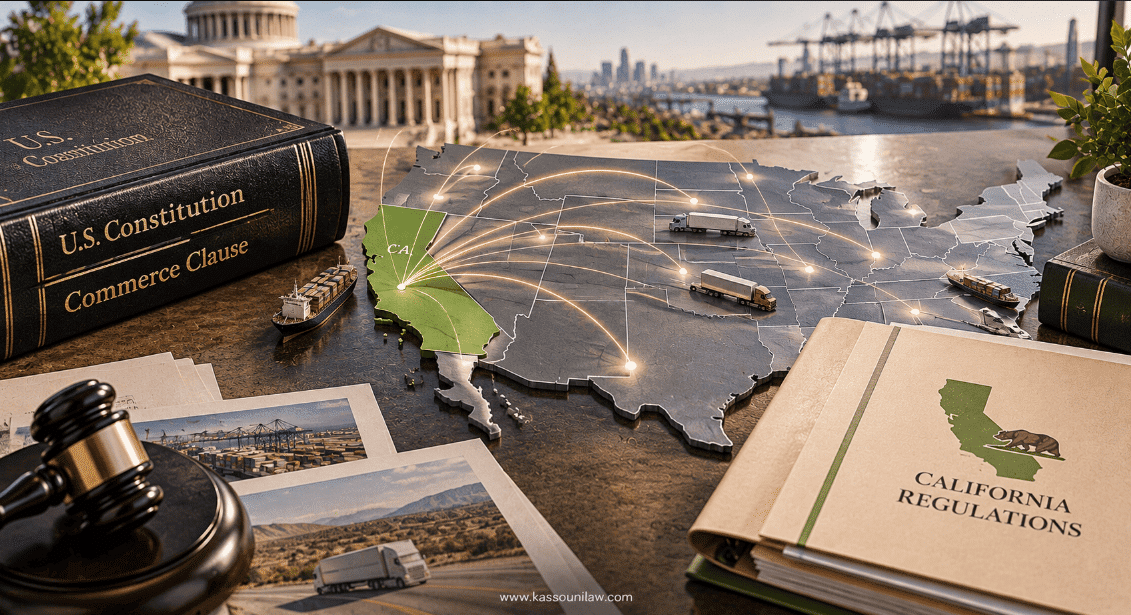
 California has broad authority to regulate businesses and activities within the state. Consumer protection, health and safety, licensing, and employment rules all fall within that authority. A company does not escape those rules because it sells across state lines.
That authority has constitutional limits, though. When a state regulation affects interstate commerce, the Commerce Clause can restrict what the state may do. Courts apply a body of law called the Dormant Commerce Clause to decide when a state regulation goes too far.
The doctrine is not a general ban on California business regulation. It addresses three concerns: discrimination against interstate commerce, excessive burdens on it, and regulation of commerce beyond the state’s borders. Commerce Clause California regulations disputes turn on the statute, how it operates, and the facts.
What Is the Commerce Clause?
Article I, Section 8, Clause 3 of the U.S. Constitution gives Congress the power “to regulate commerce with foreign nations, and among the several states, and with the Indian tribes.” The text appears in Article I of the Constitution. It is the source of Congress’s authority over interstate commerce.
The clause says nothing directly about state power. Courts have long read it to carry an implied limit on states. The reasoning is that the Constitution assigns national commerce to Congress, and states should not build economic barriers against one another.
That limit applies even when Congress has passed no conflicting law. This is why a state regulation can face a Commerce Clause challenge without any federal statute on the subject.
What Is the Dormant Commerce Clause?
The Dormant Commerce Clause is the name for this implied limit. In plain terms, it restricts state laws that interfere with interstate commerce, even though Congress has not acted.
Courts do not apply it through one mechanical test. They ask different questions depending on how the state law works. Three categories matter most:
- Discriminatory regulations: laws that favor in-state economic interests over out-of-state interests. These face the strictest review.
- Evenhanded regulations with incidental effects: laws that apply equally but still affect interstate commerce. Courts generally uphold them, unless the burden is clearly excessive compared with the local benefits.
- Extraterritorial regulations: laws that raise concerns by controlling commerce occurring outside the state. This category is narrower than many assume, as discussed below.
The categories overlap in practice. A single law can raise more than one concern, and the Supreme Court has not applied them uniformly in every case.
Can California Regulate Businesses Engaged in Interstate Commerce?
Yes. Businesses involved in interstate commerce do not become exempt from California regulation. A state may regulate activity within its borders to serve legitimate local interests. Common examples include:
- Businesses operating or selling within California
- Consumer protection and advertising rules
- Health and safety standards
- Professional licensing
- Employment-related requirements
- Property and land-use matters
- Other legitimate local interests
A constitutional question does not arise simply because a business operates across state lines. It arises from how the regulation operates and how it affects interstate commerce. The relevant inquiry looks at the law’s text, its practical effects, and the market involved.
When Can a California Regulation Violate the Commerce Clause?
Three situations can raise constitutional concerns. Each depends on specific facts, and none applies automatically.
Discrimination Against Interstate Commerce
A state law violates the Commerce Clause when it treats in-state and out-of-state economic interests differently in a way that benefits the former and burdens the latter. The Supreme Court stated that principle in Granholm v. Heald (2005) 544 U.S. 460, which involved state wine direct-shipment laws that favored in-state wineries.
Discrimination can appear in three ways:
- Facial discrimination: the law treats out-of-state interests differently on its face.
- Discriminatory purpose: the law is designed to favor local economic interests.
- Discriminatory effect: a facially neutral law burdens out-of-state interests while benefiting local ones.
In City of Philadelphia v. New Jersey (1978) 437 U.S. 617, the Court struck down a law that barred importing out-of-state waste. It described a “virtually per se rule of invalidity” for simple economic protectionism. In Hunt v. Washington State Apple Advertising Commission (1977) 432 U.S. 333, it held that a facially neutral labeling law could discriminate through its effects.
Not every difference in effect is unconstitutional. A law that affects some businesses more than others does not violate the Commerce Clause unless it discriminates against interstate commerce. A state may also justify a discriminatory law by showing a legitimate local purpose that no nondiscriminatory alternative could serve, though that showing is difficult.
Excessive Burdens on Interstate Commerce
An evenhanded law can still face scrutiny. In Pike v. Bruce Church, Inc. (1970) 397 U.S. 137, the Court held that such a law “will be upheld unless the burden imposed on such commerce is clearly excessive in relation to the putative local benefits.” The test weighs the local interest against the burden on interstate commerce.
Pike is not a rule that compliance costs invalidate a regulation. A law is not unconstitutional because it is expensive to follow. The burden must be substantial and clearly excessive compared with the benefits, and courts examine the specific regulatory context.
The Supreme Court has also divided on how Pike should work. In National Pork Producers Council v. Ross (2023), the Justices wrote separately on whether courts can weigh economic burdens against noneconomic local benefits. A majority described Pike’s core function as detecting hidden discrimination. The doctrine remains fact-specific and, in some respects, unsettled.
Extraterritorial Regulation
A state may face constitutional problems when a law effectively controls commerce occurring wholly outside its borders. In Healy v. Beer Institute (1989) 491 U.S. 324, the Court invalidated a Connecticut statute that required beer sellers to affirm their prices there were no higher than prices in neighboring states. The Court found that the statute tied Connecticut prices to out-of-state prices and could interact badly with other states’ regulatory schemes.
The Court clarified the doctrine’s reach in National Pork Producers Council v. Ross (2023) 598 U.S. 356, a challenge to California’s Proposition 12. The Court rejected an “almost per se” rule against state laws that have extraterritorial effects. It reasoned that nearly every state law produces ripple effects beyond its borders. It read Healy and similar cases as price-control or price-affirmation decisions that addressed purposeful discrimination, not as a broad ban on out-of-state effects.
Ross did not hold that California may regulate any out-of-state conduct it chooses. It held that the challengers’ extraterritoriality theory failed, and that their complaint did not plausibly allege a substantial burden on interstate commerce. The Court affirmed the Ninth Circuit’s dismissal of the complaint. Direct regulation of wholly out-of-state transactions and price-linking laws like the one in Healy remain different from laws that simply have out-of-state economic effects.
California Regulations That May Raise Commerce Clause Questions
Certain categories of regulation more often prompt Commerce Clause review. These are categories, not predictions about any specific law:
- Interstate transactions: rules that directly govern sales or shipments crossing state lines.
- Pricing and sales requirements: laws that tie prices or sales terms to transactions outside California.
- Different treatment of economic interests: laws that treat in-state and out-of-state businesses differently.
- Out-of-state conduct: requirements that force businesses to change how they operate outside California.
- Supply chains: rules that substantially affect how goods move through interstate supply chains.
Proposition 12 shows how these questions arise. Under Health and Safety Code section 25990, businesses may not knowingly sell certain pork, veal, and egg products from animals confined in a cruel manner. The law regulates sales in California, yet it affects producers elsewhere. Even so, the Supreme Court did not find a Commerce Clause violation on the allegations before it. That result does not settle how other California laws would fare, because each law is judged on its own operation.
Whether a particular regulation violates the Commerce Clause depends on the statute, its operation, the relevant market, and the facts.
Commerce Clause Claims vs. Other Constitutional Challenges
A challenge to a California regulation may involve several legal theories. Each asks a different question:
- Commerce Clause: does the state law discriminate against, unduly burden, or improperly reach interstate commerce?
- Due process: does the law violate fair notice, fair procedure, or substantive protections?
- Equal protection: does the law treat similarly situated people differently without adequate justification?
- Takings: does the regulation take private property without just compensation?
- Federal preemption: has Congress displaced the state law through federal legislation?
- First Amendment: where speech is involved, does the law restrict protected expression?
Preemption differs from the Dormant Commerce Clause in an important way. Preemption depends on what Congress has actually enacted. The Dormant Commerce Clause applies when Congress has not acted. Federal law does not override California regulation in every case, and each claim needs its own analysis.
A regulatory burden and a regulatory taking are also different constitutional questions. A takings claim asks whether a regulation has gone so far that it requires compensation. Our article on physical takings vs. regulatory takings in California covers that framework. Kassouni Law also handles broader constitutional property rights disputes involving government action.
How Can a Business Challenge a California Regulation?
Challenges vary with the law and the facts. At a high level, a business may consider:
- Identifying the exact statute or regulation at issue
- Determining whether interstate commerce is affected
- Reviewing how the law operates in practice, not just its text
- Looking for discriminatory treatment or interstate burdens
- Reviewing available administrative procedures
- Evaluating potential federal and state claims
- Seeking judicial review where appropriate
Some challenges arise from an agency decision. Judicial review of certain administrative decisions can proceed by writ of administrative mandate under Code of Civil Procedure section 1094.5, as discussed in our article on a writ of administrative mandate in California land use law. An administrative writ is not a universal remedy, however. A constitutional challenge to a statute itself may follow a different procedural path.
No challenge is certain to succeed. Cost of compliance alone does not establish a Commerce Clause violation.
California Business Regulations and Interstate Commerce
Businesses operating across state lines should consider whether California requirements:
- Apply to their activities at all
- Treat interstate transactions differently from in-state ones
- Affect operations outside California
- Conflict with federal law
- Create significant compliance burdens
The statutory language and the way the regulation operates matter most. Companies facing broader regulatory and contract issues often involve counsel on business law questions early, before a compliance deadline or an enforcement action forces the issue.
When Should a Business Talk to a Lawyer About a California Regulation?
Legal review can be useful in situations such as these:
- A new California regulation significantly affects interstate operations.
- A business believes a regulation favors California businesses over out-of-state competitors.
- A California law appears to regulate conduct occurring outside the state.
- Compliance creates substantial interstate commerce burdens.
- A business receives an enforcement action involving a disputed regulation.
- Multiple constitutional or federal-law issues may apply.
Reviewing California Regulations That Affect Interstate Commerce
California has broad regulatory authority, but that authority operates within constitutional limits. The Commerce Clause can become relevant when a state regulation discriminates against interstate commerce, imposes an excessive burden, or raises concerns about regulation beyond California’s borders.
Whether a particular regulation is constitutional depends on the statute, its practical effects, the interstate commerce involved, and the applicable legal standards.
Kassouni Law advises California businesses and property owners on constitutional questions involving government regulation. If you have questions about a California regulation affecting your business or property, call (877) 770-7379 or schedule a consultation through our contact page. Submitting a contact form does not create an attorney-client relationship.
Frequently Asked Questions
What is the Commerce Clause?
It is the provision in Article I, Section 8, Clause 3 of the U.S. Constitution that gives Congress power to regulate commerce among the states, with foreign nations, and with Indian tribes.
What is the Dormant Commerce Clause?
It is the implied limit on state laws that discriminate against or unduly burden interstate commerce, even when Congress has not acted.
Can California regulate businesses engaged in interstate commerce?
Yes. California may regulate business activity within the state for legitimate local purposes. Constitutional limits apply to laws that discriminate against interstate commerce or impose clearly excessive burdens.
When can a California law violate the Commerce Clause?
A law may violate it if it discriminates against out-of-state economic interests without adequate justification, or imposes a burden on interstate commerce that is clearly excessive compared with its local benefits. The outcome depends on the facts.
Can California regulate business activity outside the state?
California generally regulates conduct within the state and sales into it. Laws that directly control wholly out-of-state commerce can raise constitutional problems. But the Supreme Court has rejected a rule that any law with out-of-state effects is invalid.
Does the Commerce Clause prevent California from regulating businesses?
No. It limits how California regulates, not whether it may regulate. Most California business regulation operates within these limits.
The information provided here is for general informational purposes only and does not constitute legal advice. Laws and individual circumstances vary, so readers should consult a qualified attorney about their specific situation.