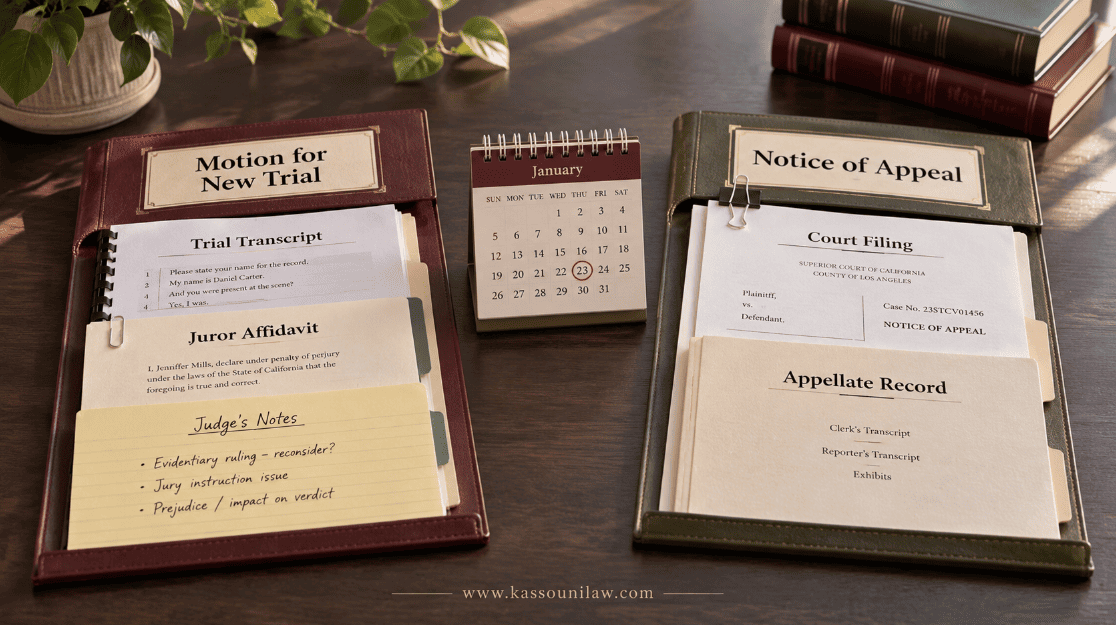
 A jury returns a verdict against a contractor after a two-week trial. The contractor believes the damages are excessive. A juror’s later comment also suggests the jury ignored the judge’s instructions. Her lawyer identifies two options: ask the trial judge for a new trial or file an appeal. She wants to know which procedure comes first.
Both procedures can challenge an unfavorable result. However, they involve different courts, legal standards, and deadlines. Neither procedure automatically requires the other.
What Is a Motion for New Trial in California?
Under Code of Civil Procedure section 656, a new trial reexamines an issue of fact in the same court. It follows a trial and decision by a jury, court, or referee. The motion asks the trial judge to reconsider the result.
Section 657 lists the grounds for a new trial. The moving party must show that the problem materially affected its substantial rights. The recognized grounds include:
- Irregularity. Misconduct or irregularity by the court, jury, or opposing party. This also includes an order or abuse of discretion that prevented a fair trial.
- Jury misconduct. This may include reaching a verdict by chance. The statute allows a party to prove misconduct through one juror’s affidavit.
- Accident or surprise. Ordinary prudence must not have been enough to prevent the event.
- Newly discovered evidence. The evidence must be material. Reasonable diligence must not have uncovered and produced it at trial.
- Excessive or inadequate damages. The jury’s award is too high or too low.
- Insufficient evidence. The evidence does not support the verdict, or the decision conflicts with the law.
- Error in law. The party must have objected to the error during trial.
Disagreement with the verdict alone does not justify a new trial. The party must establish a statutory ground. For insufficient evidence or damages, the judge must weigh the evidence. The judge may grant relief only when convinced the jury clearly should have reached a different verdict.
The notice of intention
The notice of intention to move for a new trial starts the process. Under section 659, the party must file the notice with the clerk and serve each opposing party. The notice must state the grounds and identify its supporting materials. Those materials may include affidavits, the court minutes, or both. Section 659(b) treats the notice as a motion on every ground it identifies.
The party must file the notice after the decision but before judgment entry. Alternatively, the party may file within 15 days after the clerk or another party serves notice of entry of judgment. A 180-day limit after judgment entry also applies. The earliest applicable deadline controls. Section 659(b) does not allow a court order or stipulation to extend these deadlines.
The party files the supporting brief and affidavits separately. Under section 659a, the moving party generally has 10 days after filing the notice to serve them. The opposing party then has 10 days to respond. The moving party has another five days to reply. For good cause, the judge may extend these periods by up to 10 days.
Section 660 sets the deadline for the judge’s ruling. The judge generally has 75 days after the clerk mails or a party serves notice of entry of judgment. The earlier date controls. If neither occurs, the period runs from the first notice of intention. The court denies a motion by operation of law if the judge does not decide it within that period.
The California Supreme Court has treated this deadline as jurisdictional. In Sanchez-Corea v. Bank of America (1985) 38 Cal.3d 892, 899, 903-904, the court held that a late ruling was ineffective. The statute then provided a shorter period.
How Is a Motion for New Trial Different From an Appeal?
The two procedures involve different decision makers and serve different purposes.
Motion for new trial
- Where it is filed. In the trial court that heard the case.
- What it asks. The judge to reconsider the result based on a statutory ground under section 657.
- What the judge may review. Trial proceedings, evidence, and jury conduct. The judge may also consider affidavits.
- Possible results. A new trial on all or some issues, or other relief authorized by law.
Appeal
- How it starts. The party files a notice of appeal in the superior court under rule 8.100.
- What it asks. An appellate court to review the case for reversible legal error.
- What the court reviews. Generally, the trial court record. The appellate record explains what that record includes.
- Possible results. Affirmance, reversal, or other appellate relief.
An appeal does not ordinarily provide a new trial or allow new evidence. A new trial motion goes to the judge who heard the case. An appeal goes to appellate judges who review the trial court record. The timeline of a California civil appeal generally extends beyond the ruling period under section 660.
A motion for new trial also differs from a motion for reconsideration. Reconsideration falls under a separate statute. The article on reconsideration versus appeal explains that distinction.
Should You File a Motion for New Trial Before Appealing?
Generally, no. California law does not require a party to seek a new trial before appealing. However, an order denying a new trial motion is not separately appealable. In Walker v. Los Angeles County Metropolitan Transportation Authority (2005) 35 Cal.4th 15, 18, the Supreme Court explained that a party may challenge the denial when appealing the underlying judgment.
Reasons to consider a new trial motion
- The error falls under a statutory ground. Section 657 covers issues such as jury misconduct and excessive damages.
- The trial judge can address the problem directly. The judge may order a new trial or grant other relief.
- The ruling may change the judgment. This could narrow or resolve the dispute.
- The motion may establish a record. For example, juror affidavits can present evidence of misconduct to the court.
Reasons to appeal directly
The complaint may involve a legal ruling that the trial judge already made. For example, a pretrial ruling may have ended part of the case. The appellate record may already show the error. A new trial motion may serve little purpose in that situation.
Either way, check both sets of deadlines before choosing a procedure. Filing one does not automatically protect the deadline for the other.
Does a Motion for New Trial Extend the Appeal Deadline?
It can, but only if the party meets the requirements in rule 8.108(b). The ordinary deadline comes from rule 8.104. A party must file a notice of appeal by the earliest of these dates:
- 60 days after the clerk serves notice of entry of judgment.
- 60 days after a party serves notice of entry of judgment.
- 180 days after entry of judgment.
What triggers the extension?
The key filing is a valid notice of intention to move for a new trial. Rule 8.108(b) requires the party to serve and file that notice. The later brief or affidavits do not trigger the extension.
The notice must meet the procedural requirements. It does not need to succeed on the merits.
How the extended deadline works
If the court denies the motion, the extension applies to all parties. The new appeal deadline is the earliest of these dates:
- 30 days after service of the order. This period starts when the clerk or a party serves the order denying the motion or notice of its entry.
- 30 days after denial by operation of law. This applies when the court does not rule within the statutory period.
- 180 days after entry of judgment. This remains the outer limit.
The extension does not shorten a longer deadline under rule 8.104. The following example uses illustrative dates. Actual deadlines require a review of the case record and applicable rules.
A court enters judgment on January 4, 2027. A party serves notice of entry on January 11. The ordinary 60-day deadline falls on March 12.
The losing party files and serves a valid notice of intention on January 19. This falls within 15 days after service. The court denies the motion by written order. A party serves the order on February 22.
Thirty days later falls on March 24. The 180-day limit falls in early July, so it does not control. The new appeal deadline is March 24, rather than March 12.
Several limits apply. An untimely or improperly filed notice of intention may not extend the appeal deadline. Section 659 deadlines cannot be extended by court order or stipulation. Other postjudgment filings may not extend the appeal deadline either. If a party questions the notice’s validity, the party should protect the ordinary appeal deadline.
What Happens If the Court Grants or Denies the Motion?
If the court grants the motion
The court may order a new trial on all or some issues. Section 657 requires the judge to state the grounds and reasons. The case then returns to the trial court for further proceedings.
Section 904.1(a)(4) makes an order granting a new trial appealable. Rule 8.104(e) sets the deadline for appealing that order. Conditional orders based on damages involve separate timing rules under rule 8.108(b)(2). Review the order before calculating the deadline.
The appellate court applies special review standards to these orders. When the judge relies on insufficient evidence or excessive or inadequate damages, the stated reasons generally control. A reviewing court reverses only when the record provides no substantial basis for those reasons.
If the court denies the motion
The judgment generally remains in place. The party may still appeal if the deadline remains open. Rule 8.108(b) may extend that deadline, as explained above. Under Walker, the party challenges the denial through an appeal from the judgment.
If the court modifies the judgment
Section 662 gives judges additional options in cases tried without a jury. Instead of ordering a new trial, the judge may:
- Change or add to the statement of decision.
- Modify or vacate the judgment.
- Reopen the case to receive additional evidence.
A new judgment remains subject to sections 657 and 659.
A modified judgment may change the issues on appeal and the applicable deadlines. Review the entered order or judgment before calculating the appeal deadline.
How Should You Choose Between the Two Options?
The type of error often points to the appropriate procedure. A new trial motion may fit complaints involving statutory grounds tied to the trial. Examples include jury misconduct, newly discovered evidence, and excessive damages.
An appeal may fit a challenge to a legal ruling or an error shown in the appellate record.
Some cases may justify considering both procedures. The facts, deadlines, and possible consequences affect that decision. Neither option is always better, and filing both may not serve the party’s interests.
The guide to filing an appeal explains how the process begins. A lawyer can assess the available options and applicable deadlines. Prompt review matters because sections 659 and 660 and rule 8.104 set separate time limits.
Different Procedures for Different Errors
A motion for new trial and an appeal address different types of problems. The appropriate choice depends on the alleged error and the applicable deadlines.
Kassouni Law represents private parties in appellate matters. The firm can review your circumstances if you are considering a new trial motion or an appeal. Its attorneys can discuss the legal options that may apply.
Call Kassouni Law at (877) 770-7379 or contact the firm to discuss your situation. Submitting a contact form does not create an attorney-client relationship.
Frequently Asked Questions
Do I have to file a motion for a new trial before appealing in California?
Generally no. An appeal from the judgment does not require a new trial motion. The motion may help in some cases, such as when affidavits are needed to show juror misconduct.
Does a motion for a new trial extend the deadline to appeal?
It can. Under rule 8.108(b), a valid notice of intention to move for a new trial extends the time to the earliest of three dates. An invalid or late notice may not extend anything.
How long do I have to file a motion for a new trial in California?
The notice of intention is generally due within 15 days after service of notice of entry of judgment, or within 180 days after entry, whichever is earliest. Courts cannot extend those periods. A notice may also be filed after the decision and before entry of judgment.
Can I appeal after the court denies my motion for a new trial?
Often yes. The denial is reviewed through an appeal from the judgment. The appeal must still be timely under rule 8.104 or an extension under rule 8.108(b).
Can I file both a motion for a new trial and an appeal?
Sometimes. The timing and consequences depend on the case. A lawyer should review the deadlines and how each filing affects the other before filing both.
The information provided here is for general informational purposes only and is not legal advice. Post-trial deadlines and available relief depend on the type of case, the dates involved, and the law in effect. Consult a qualified attorney about your circumstances.