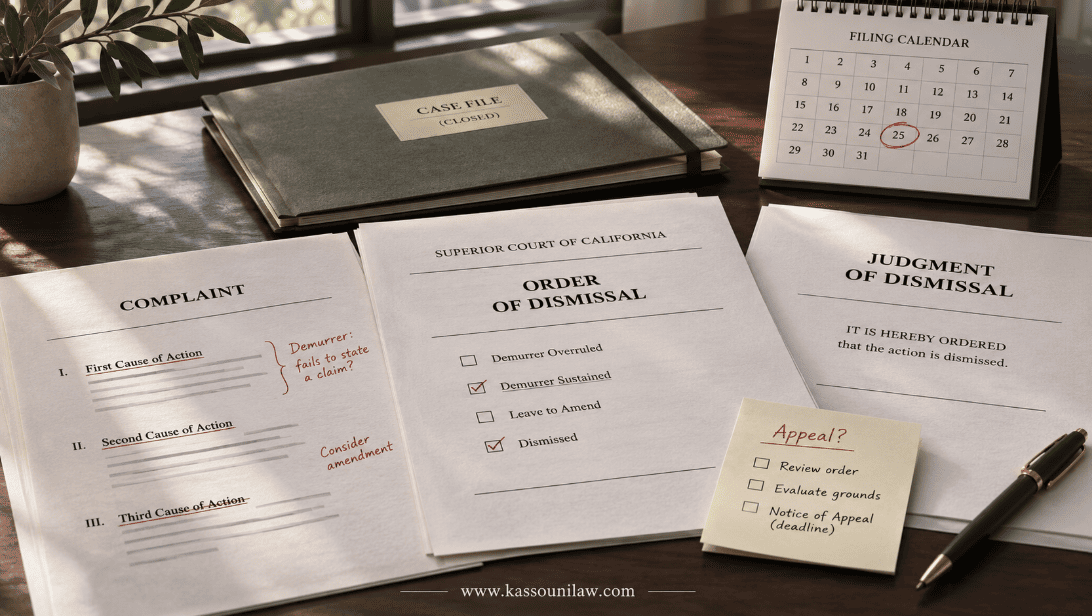
 A judge sustains a demurrer without leave to amend. The complaint is out. The plaintiff wants to appeal.
The first question is not whether the ruling was wrong. It is whether the plaintiff can appeal yet. In California, that usually depends on what the trial court does next.
An unfavorable demurrer ruling does not always allow an immediate appeal. The sections below explain which rulings can be appealed, when deadlines begin, and what appellate courts review.
What Happens When a Court Sustains a Demurrer Without Leave to Amend?
A demurrer is a formal objection to a complaint. It challenges the legal sufficiency of the pleading. Section 430.10 lists the grounds. One key ground is that the pleading “does not state facts sufficient to constitute a cause of action.”
The court reviews the complaint and any matters subject to judicial notice. Section 430.30 defines that scope. Judicial notice allows courts to accept certain facts, such as court records, without formal proof.
A demurrer does not resolve disputed facts. No trial takes place. The court assumes the pleaded facts are true and asks whether the law recognizes a claim.
A court that sustains a demurrer has two options:
- With leave to amend. The plaintiff may file an amended complaint. Section 472a allows the court to permit amendments on just terms and set a filing deadline.
- Without leave to amend. The court decides that another amendment would not fix the problem. The plaintiff cannot file another complaint.
The case does not end automatically when the court sustains the demurrer. The defendant usually moves for dismissal. Section 581(f)(1) allows dismissal in that situation when either party requests it.
The resulting judgment of dismissal ordinarily allows the plaintiff to appeal.
Can You Appeal an Order Sustaining a Demurrer?
Generally, no. The order itself is not independently appealable. The California Supreme Court explained this rule in Berri v. Superior Court (1955) 43 Cal.2d 856. It stated that there is “no appeal from a ruling on a demurrer but only from the ensuing judgment.”
Sisemore v. Master Financial, Inc. (2007) 151 Cal.App.4th 1386 repeats this rule. An order sustaining a demurrer without leave to amend is not appealable. The plaintiff must wait until the court enters a dismissal.
The demurrer order records the court’s ruling. The judgment of dismissal formally ends the case. Section 904.1(a)(1) allows appeals from judgments, not this type of ruling.
The plaintiff who files the appeal becomes the appellant. Appellant vs. Appellee in California explains the roles.
When a Court May Treat the Order as a Judgment
In some cases, an appellate court may treat the demurrer order as a judgment. In Hamilton v. Green (Dec. 28, 2023, No. B323621), the trial court sustained a demurrer to every cause of action. The Court of Appeal found that only the formal entry of dismissal remained. It treated the order as incorporating a judgment of dismissal and reviewed the appeal.
This treatment depends on the circumstances. In Hamilton, the order disposed of every cause of action. Parties should not assume an appellate court will excuse a missing judgment.
When Only Some Claims Are Dismissed
A court may sustain a demurrer against some claims while others remain pending. The one final judgment rule generally requires parties to wait until the case ends.
Morehart v. County of Santa Barbara (1994) 7 Cal.4th 725 illustrates this rule. The Court held that a judgment leaving causes of action undecided between the parties is not appealable.
Multiple defendants can affect the result. A dismissal may be final as to one defendant even when claims against others remain. Heshejin v. Rostami (2020) 54 Cal.App.5th 984 held that a judgment is final and appealable when no issues remain against one party. The claims and parties involved matter.
Statutory exceptions allow some appeals before final judgment. The guide to interlocutory appeals explains those exceptions.
When Does the Appeal Deadline Begin?
The appeal deadline does not start when the judge announces the demurrer ruling. It runs from entry of the judgment of dismissal or qualifying service of notice. Plaintiffs must identify the actual judgment before calculating the deadline.
Rule 8.104 sets the deadline. The notice of appeal is due by the earliest of these three dates:
- 60 days after the court clerk serves a notice of entry of judgment or a file-endorsed copy.
- 60 days after a party serves either document with proof of service.
- 180 days after entry of judgment.
The 180-day period is the outside limit. Qualifying service can shorten that period. The earliest date controls.
Assume the court sustains a demurrer without leave to amend on March 1, 2027. It enters a judgment of dismissal on March 24. The defendant serves a notice of entry with proof of service on March 29.
Sixty days after March 29 is May 28, 2027. The 180-day deadline is September 20, 2027. The May deadline controls. Calculating from March 1 would produce the wrong date.
The court cannot extend the appeal deadline. A late notice of appeal requires dismissal. Certain postjudgment motions may affect the deadline. The applicable rules depend on the motion and its timing.
How Does the Appellate Court Review the Demurrer Ruling?
Appellate courts review demurrer rulings de novo. They decide the legal question independently, without deferring to the trial judge. T.H. v. Novartis Pharmaceuticals Corp. (2017) 4 Cal.5th 145 describes this standard.
The court asks whether the complaint states a cause of action under any legal theory. It independently examines the complaint’s legal sufficiency.
Blank v. Kirwan (1985) 39 Cal.3d 311 explains which allegations the court accepts as true. A demurrer admits all material facts properly pleaded.
The court does not accept “contentions, deductions or conclusions of fact or law.” It reads the complaint as a whole and considers its context. The court also considers matters subject to judicial notice.
De novo review does not involve a retrial. The appellate court does not weigh evidence or resolve factual disputes. It reviews the complaint.
The court may also affirm on a different ground. Carman v. Alvord (1982) 31 Cal.3d 318 holds that a ruling stands if any ground stated in the demurrer supports it. The trial court need not have relied on that ground.
Can You Challenge the Denial of Leave to Amend?
Yes, but the appellate court applies a different standard. It reviews the demurrer ruling de novo. It reviews the denial of leave to amend for abuse of discretion.
Loeffler v. Target Corp. (2014) 58 Cal.4th 1081 states the test. The court asks whether a reasonable possibility exists that an amendment could cure the defect. If so, denying leave to amend was an abuse of discretion.
City of Dinuba v. County of Tulare (2007) 41 Cal.4th 859 applies the same test. Blank places the burden of proving that possibility “squarely on the plaintiff.”
The plaintiff must explain how an amendment would fix the complaint. A general claim that amendment is possible rarely satisfies this burden. The plaintiff should identify the specific facts or allegations that would cure the defect.
A plaintiff may propose an amendment for the first time on appeal. Section 472c allows this, even if the plaintiff never requested leave below. Sierra Palms Homeowners Assn. v. Metro Gold Line Foothill Extension Construction Authority (2018) 19 Cal.App.5th 1127 allowed such a showing. The plaintiff relied on a proposed pleading and arguments presented on appeal.
The appellate court does not have to grant leave simply because the plaintiff requests it. The plaintiff must show how an amendment could cure the defect.
What Arguments Can You Raise on Appeal?
Arguments for reversal may include:
- The complaint stated a legally sufficient claim.
- The trial court applied the wrong legal standard.
- The court considered matters outside the permissible scope of demurrer review.
- The allegations support a recognized legal theory, even if the complaint named another theory.
- The court abused its discretion by denying leave to amend despite a reasonable possibility of curing the defect.
These arguments depend on the complaint and applicable legal standards. Each argument must address the actual allegations and the trial court’s ruling.
The appellate record also matters. The court reviews the pleadings and materials subject to judicial notice. The appellate record guide explains which materials the record includes.
What Happens If You File a Notice of Appeal Too Early?
Three events can look similar but have different legal effects. A judge may announce a ruling. The court may issue a minute order. The clerk may enter a judgment. An entered judgment of dismissal ordinarily supports an appeal.
Rule 8.104(d) addresses certain premature notices. Under subdivision (d)(1), a notice filed after the court announces its intended ruling but before judgment is premature. A reviewing court may treat it as filed immediately after judgment entry.
Under subdivision (d)(2), a notice filed after judgment is rendered but before entry remains valid. The court treats it as filed immediately after entry.
Heshejin illustrates this rule. The trial court sustained a demurrer in December 2018. The plaintiffs later filed a notice of appeal targeting the nonappealable minute order. The Court of Appeal warned that it would dismiss unless the plaintiffs obtained a signed dismissal order.
The plaintiffs obtained that order, and the court entered the dismissal on July 22, 2019. The Court of Appeal treated the earlier notice as filed immediately after entry under rule 8.104(d)(2). It then reviewed the merits.
This result does not save every premature appeal. The trial court later entered a signed dismissal that resolved all issues against the affected defendants. Without that judgment, the appeal faces dismissal. Rule 8.100(a)(2) requires courts to construe notices of appeal liberally. It does not make a nonappealable ruling appealable.
Check whether the trial court has entered an appealable judgment before filing. The guide to filing an appeal explains the filing process.
What Happens After the Appellate Court Reverses the Judgment?
Reversal sets aside the judgment of dismissal. The case generally returns to the trial court for further proceedings.
The appellate opinion determines what happens next. If the court finds that the complaint states a claim, the case can proceed. If it finds that denying leave to amend was an abuse of discretion, the plaintiff may amend the complaint.
Reversal does not establish liability. It allows the complaint to proceed. The defendant may still answer, dispute the facts, and defend the case.
After the decision becomes final, the Court of Appeal issues a remittitur. This document returns the case to the trial court. Rule 8.272 governs its issuance. The trial court must then follow the appellate opinion.
Appeals can take months or longer. How long a civil appeal takes explains the typical timeline.
The Judgment Decides Whether You Can Appeal
The right to appeal after a demurrer depends on the judgment, the case’s procedural status, and the filing deadline. Challenging the ruling also requires reviewing the complaint and trial court record.
Kassouni Law represents private parties in appellate matters. Individuals and businesses facing dismissal after a demurrer can contact the firm about their cases and possible legal options.
Call Kassouni Law at (877) 770-7379 or contact the firm to discuss your situation. Submitting a contact form does not create an attorney-client relationship.
Frequently Asked Questions
Can you appeal a demurrer sustained without leave to amend in California?
Generally, the appeal follows entry of the resulting judgment of dismissal. The demurrer order itself is not independently appealable. In limited cases, a court may treat the order as incorporating a dismissal.
How long do you have to appeal a judgment after a demurrer is sustained?
Rule 8.104 generally allows 60 days after qualifying service of a notice of entry. The outside limit is 180 days after entry. The earliest applicable date controls. Other circumstances may affect it.
Can an appellate court reverse a demurrer ruling?
Yes. Review is de novo. If the complaint states a legally sufficient claim, the court may reverse. Reversal is not guaranteed.
Can you challenge a court’s refusal to allow an amended complaint?
Yes. The court reviews the denial for abuse of discretion. The plaintiff must show a reasonable possibility of curing the defect, and should identify specific facts.
What happens if a demurrer is sustained against only some claims?
Unresolved claims may prevent an immediate appeal under the one final judgment rule. A dismissal that ends all claims against one party may be treated differently. The specific facts decide.
The information provided here is for general informational purposes only and is not legal advice. Appealability and deadlines depend on the type of case, the dates involved, and the law in effect. Consult a qualified attorney about your circumstances.