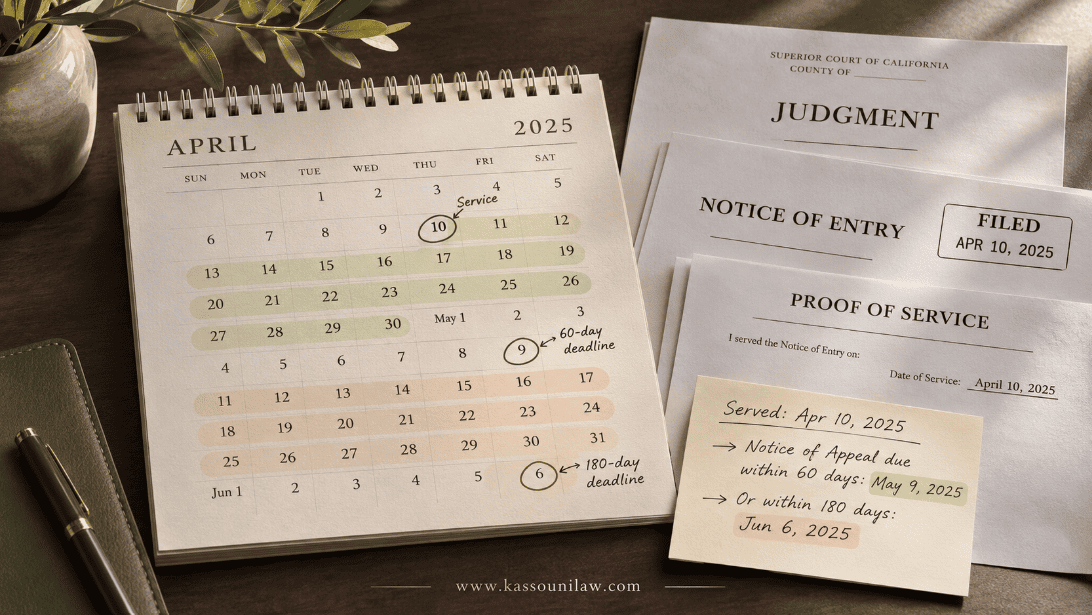
 An unfavorable judgment does not leave unlimited time to appeal. California law sets a strict deadline for filing a notice of appeal. Courts enforce that deadline.
Rule 8.104 of the California Rules of Court sets two deadlines: 60 days and 180 days. Each runs from a different event. The judgment entry date and the date someone serves a Notice of Entry can affect the deadline.
What Is the Deadline to File a Notice of Appeal in California?
A notice of appeal is the document that starts an appeal. Under rule 8.104(a)(1), it must be filed by the earliest of these dates:
- 60 days after the clerk serves the appealing party with a Notice of Entry or filed-endorsed judgment showing the service date.
- 60 days after a party serves or is served with either document, accompanied by proof of service.
- 180 days after entry of judgment.
The earliest applicable date controls. These periods do not run one after another. The 180-day period does not begin when the 60 days expire.
The rule applies unless a statute or another listed rule provides a different deadline. This article focuses on ordinary appeals in unlimited civil cases. Criminal and limited civil appeals follow different rules.
Limited civil appeals to the appellate division follow rule 8.822. That rule generally allows 30 days after qualifying service or 90 days after entry of judgment. The 60-day and 180-day periods discussed here do not apply to those appeals.
Rule 8.104 also covers appeals from certain orders. Under rule 8.104(e), “judgment” includes an appealable order when the appeal is from that order. However, not every court ruling can be appealed immediately. Code of Civil Procedure section 904.1 identifies many appealable judgments and orders.
When Does the 60-Day Appeal Deadline Start?
The 60-day period does not begin when the judge announces a ruling. It starts when someone serves a document that meets the rule’s requirements. Two types of service qualify.
When the Court Clerk Serves a Notice of Entry
A Notice of Entry of judgment informs the parties that the court has entered judgment. The document must carry that title. Alternatively, the clerk may serve a filed-endorsed copy of the judgment. This copy bears the clerk’s stamp showing the filing date.
Either document must show its service date. That date starts the 60-day period. A document without a service date does not meet the rule’s requirements.
The document must also satisfy the requirements on its own. In Alan v. American Honda Motor Co., Inc. (2007) 40 Cal.4th 894, the clerk mailed a statement of decision and a minute order. Neither document independently met all the requirements. The Supreme Court held that the 60-day period had not started.
Alan involved an earlier version of the rule. Its single-document reasoning still explains why the document’s title, filing endorsement, and service date matter.
When a Party Serves the Judgment or Notice of Entry
A party can also trigger the 60-day period. Under rule 8.104(a)(1)(B), the period runs from service of a Notice of Entry or filed-endorsed judgment. The document must include proof of service.
The appealing party may serve the document or receive it from another party. Proof of service is a signed statement identifying when and how service occurred. The date shown determines when the 60-day period begins.
Rule 8.104(a)(2) permits service by any method allowed under the Code of Civil Procedure. This includes electronic service when section 1010.6 and rules 2.250 through 2.261 permit it.
Not every copy of a judgment starts the 60-day period. The document must be a Notice of Entry or filed-endorsed judgment. When a party serves it, proof of service must accompany it.
When Does the 180-Day Appeal Deadline Apply?
Rule 8.104(a)(1)(C) sets an outside deadline of 180 days after entry of judgment. The count starts on the entry date, not the date the judge announces the ruling.
This deadline becomes relevant when no one serves a qualifying document. Without qualifying service, the 60-day period does not begin. The 180-day deadline may then be the only applicable deadline.
Parties sometimes waive notice of the order being appealed through a stipulation under Code of Civil Procedure section 1019.5. In that situation, the 180-day period applies unless the court or a party later serves a qualifying notice. Rule 8.104(a)(3) addresses this circumstance.
The 180-day deadline does not replace an earlier 60-day deadline. If someone serves a qualifying document, the 60-day deadline may fall first.
Which Deadline Controls: 60 Days or 180 Days?
Calculate each deadline that applies. The earliest date is the filing deadline. A qualifying Notice of Entry can therefore give a party less time than the 180-day limit.
| Triggering event | Applicable period |
|---|---|
| Clerk serves a qualifying Notice of Entry or filed-endorsed judgment | 60 days |
| A party serves a qualifying Notice of Entry or filed-endorsed judgment with proof of service | 60 days |
| Entry of judgment | 180 days |
Example One: The 60-Day Period Controls
Assume the court enters judgment on Wednesday, April 7, 2027. The clerk serves a qualifying Notice of Entry on Monday, April 12.
The 60-day deadline is Friday, June 11. The 180-day deadline is Monday, October 4.
The June 11 deadline comes first. The party must file the notice of appeal by that date.
Example Two: The 180-Day Period May Control
Now assume the court enters judgment on Wednesday, August 4, 2027. Neither the clerk nor a party serves a qualifying Notice of Entry or filed-endorsed copy.
Because no qualifying service occurs, the 60-day period does not begin. The 180-day deadline falls on Monday, January 31, 2028.
The 180-day deadline may therefore control. However, later service of a qualifying document could start a 60-day period and change the applicable deadline.
What Counts as Entry of Judgment?
The 180-day period runs from entry of judgment. It does not run from the date the judge announces or signs the judgment, or the date someone serves it. Rule 8.104(c) defines when entry occurs:
- A judgment. The entry date is the filing date under section 668.5, or the date entered in the judgment book. If the clerk records judgments in the court’s register or electronic system, the filing date counts as the entry date.
- An order entered in the minutes. The entry date is when the order appears in the permanent minutes.
- A minute order directing a written order. The entry date is when the signed written order is filed. A written order prepared under rule 3.1312 or a local rule does not qualify unless the minute order directed it.
- An order not entered in the minutes. The entry date is when the signed order is filed. An electronically signed order has the same effect as a paper-signed order.
A judge’s oral announcement does not necessarily establish entry. A notice of appeal filed after the court renders judgment but before entry remains valid. Under rule 8.104(d)(1), the court treats it as filed immediately after entry.
Do Weekends and Court Holidays Affect the Appeal Deadline?
Yes, but only when the final day falls on a weekend or holiday. Saturdays, Sundays, and holidays within the 60-day or 180-day period still count.
Rule 1.10 explains how to calculate court deadlines. Exclude the first day and include the last. If the last day falls on a Saturday, Sunday, or legal holiday, move the deadline to the next nonholiday.
Code of Civil Procedure section 12a follows the same approach for acts required by law. It includes Saturdays and judicial holidays under section 135. It also covers days treated as holidays under section 12b. Section 135 covers most holidays listed in Government Code section 6700. These include Sundays and the day after Thanksgiving.
Section 12b may also treat a full-day closure of a public office as a holiday for that office’s business. Check the applicable closure before relying on an adjusted deadline.
For example, assume judgment is entered on Tuesday, June 1, 2027. The 180th day falls on Sunday, November 28. The deadline moves to Monday, November 29, because Sunday is a noncourt day.
Filing before the deadline avoids last-day complications.
Can a Postjudgment Motion Change the Notice of Appeal Deadline?
Yes, in certain circumstances. Rule 8.104(a)(1) is subject to rule 8.108. That rule extends the appeal deadline for specific qualifying motions:
- A motion for new trial.
- A motion to vacate a judgment.
- A motion for judgment notwithstanding the verdict.
- A motion to reconsider an appealable order.
Each motion has its own filing and timing requirements. Other postjudgment filings do not automatically extend the appeal deadline. Filing a motion also does not automatically pause or restart the appeal period.
A separate article on rule 8.108 explains each subdivision and its deadlines.
Reconsideration raises separate procedural questions. The comparison of a motion for reconsideration and an appeal explains how the two procedures differ.
What Happens If You Miss the Notice of Appeal Deadline?
Rule 8.104(b) leaves little room for late filings. Except as provided in rule 8.66, no court may extend the time to file a notice of appeal. A reviewing court must dismiss an appeal filed after the deadline.
The deadline is jurisdictional. In Hollister Convalescent Hosp., Inc. v. Rico (1975) 15 Cal.3d 660, defense counsel’s staff allegedly received an incorrect entry date from the clerk. The notice of appeal arrived on the 31st day, one day late under the rule then in effect.
The Supreme Court dismissed the appeal. It held that estoppel, waiver, reasonable reliance, and good faith could not extend the deadline.
Hardship or an honest mistake does not ordinarily excuse a late notice of appeal. Parties should not rely on an opposing party’s conduct or an informal agreement to preserve their appeal rights. Narrow exceptions exist, but parties should never assume a late filing can be corrected.
Filing on time only begins the appellate process. The guide to filing an appeal in California explains the filing steps. How long a California civil appeal takes covers the timeline after filing.
Identify the Event That Starts the Deadline
The appeal deadline depends on when the applicable triggering event occurs. The earliest qualifying deadline controls. Check the judgment, any Notice of Entry, and all proofs of service before calculating the filing date.
Kassouni Law represents private parties in appellate matters. If you have received an unfavorable judgment or appealable order, the firm can assess your situation and explain your legal options.
Call Kassouni Law at (877) 770-7379 or contact the firm to discuss your case. Submitting a contact form does not create an attorney-client relationship.
Frequently Asked Questions
Is the California notice of appeal deadline 60 days or 180 days?
Both periods can apply. The earliest applicable date controls. The 60 days run from qualifying service. The 180 days run from entry of judgment.
Does the 60-day appeal period start when the judge signs the judgment?
Not by signing alone. The 60-day period starts after qualifying service of a Notice of Entry or filed-endorsed copy. The 180-day limit runs from entry, which is defined in rule 8.104(c).
What happens if the court never serves a Notice of Entry?
No 60-day period may start from the clerk. A party may still serve a qualifying document. If no one does, the 180-day period from entry may apply.
Does receiving a copy of the judgment by email start the 60-day deadline?
Not automatically. The document must be a Notice of Entry or filed-endorsed copy. Clerk service must show the service date. Party service needs proof of service. Electronic service must also be permitted by law.
Can the California notice of appeal deadline fall on a weekend or holiday?
Yes. If the final day is a Saturday, Sunday, or court holiday, the deadline generally moves to the next court day. Weekends inside the period still count.
The information provided here is for general informational purposes only and is not legal advice. Appeal deadlines depend on the type of case, the dates involved, and the law in effect. Consult a qualified attorney about your circumstances.