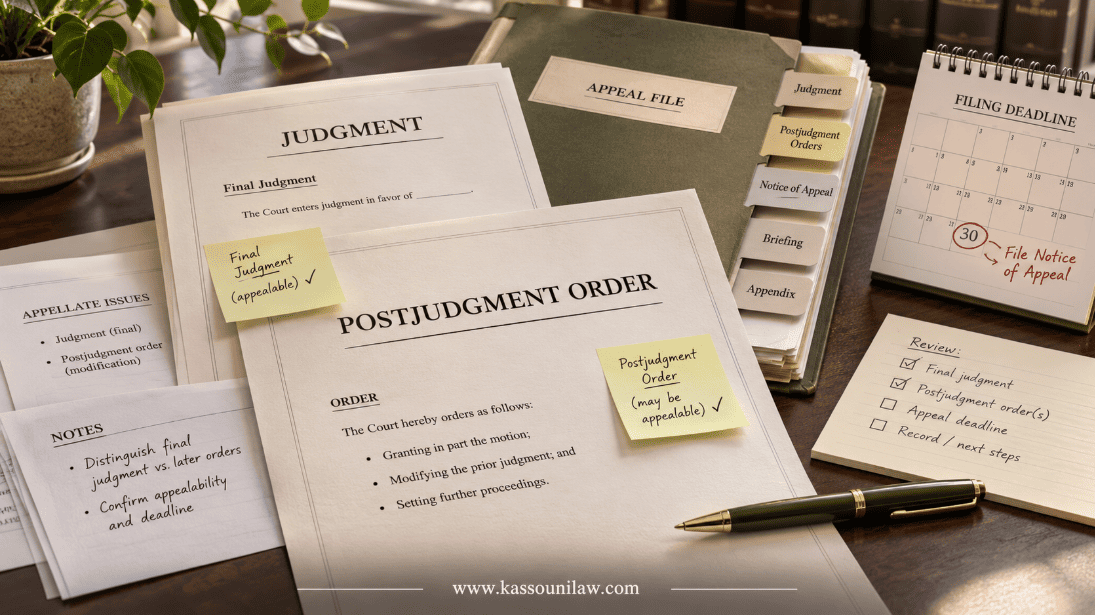
 A court enters final judgment. The trial seems over. Then another dispute arises over attorney fees, costs, enforcement, or a motion to undo the judgment.
Some postjudgment orders carry their own appeal rights. Others do not. Misjudging the deadline or appealability can cost a party the right to challenge a ruling.
The main statute is Code of Civil Procedure section 904.1(a)(2). Court decisions define its limits.
What Is a Postjudgment Order in California?
Section 577 defines a judgment as the final determination of the parties’ rights. A postjudgment order is a separate ruling the court makes after judgment.
Disputes often continue after judgment. Common examples include:
- Attorney fees claimed by the prevailing party.
- Litigation costs and disputes over allowable expenses.
- Efforts to enforce or stay a judgment.
- Motions seeking to vacate a judgment or obtain relief from it.
The timing alone does not establish appealability. A court may issue an order after judgment without creating a separate right to appeal.
Section 904.1(a)(2) permits an appeal “from an order made after a judgment made appealable by paragraph (1).”
Orders issued before final judgment follow different rules. The guide to interlocutory appeals discusses those appeals.
Which Postjudgment Orders Are Appealable?
Section 904.1(a)(2) covers certain postjudgment orders, not every ruling made afterward. The California Supreme Court explained its limits in Lakin v. Watkins Associated Industries (1993) 6 Cal.4th 644. The Court applied the provision’s predecessor.
Lakin identifies three considerations:
- Different issues. The issues raised by the postjudgment order appeal must differ from those raised in an appeal from the judgment. Otherwise, the judgment appeal can address them.
- Connection to the judgment. The order must “either affect the judgment or relate to it by enforcing it or staying its execution.”
- Finality. Orders “preliminary to a later judgment” or “preparatory to later proceedings” generally lack finality. Parties can review them later.
The Court also rejected treating the phrase “neither adds nor subtracts” as the sole test. An order can affect a judgment without changing its wording.
The question is what the order actually decides. Does it determine rights arising from the judgment? Or does it merely prepare for another ruling or carry out an existing decision?
Orders Awarding Attorney Fees
Lakin involved a postjudgment order denying attorney fees. The Court held that the order was appealable because it finally determined the parties’ rights concerning those fees.
The procedural posture matters:
- Fees included in the judgment. A party challenges the fee award through an appeal from the judgment.
- A separate postjudgment order. A party generally must file a separate, timely appeal from that order.
- Routine steps involving an existing award. Calculating or collecting fees already awarded does not automatically create another appeal right.
Silver v. Pacific American Fish Co. (2010) 190 Cal.App.4th 688 illustrates the risk. A party appealed before the court ruled on fees. The party never appealed the later fee order. The court dismissed that portion of the appeal. General language about costs in the judgment did not cover the later fee award.
Not every fee ruling qualifies. The order must satisfy the requirements discussed in Lakin.
Orders Determining Costs
Section 1033.5 lists recoverable litigation costs and expenses that parties cannot recover. It also treats attorney fees as costs when a contract, statute, or other law authorizes them.
Silver cited earlier authority holding that postjudgment orders awarding or denying costs or attorney fees are separately appealable. A ruling deciding whether a particular cost is recoverable may qualify.
Routine administrative steps differ. For example, entering an amount the court previously decided may not create a new appeal right. Courts examine what the order actually resolves.
Orders Denying Relief From Judgment
The appealability of an order denying relief from judgment depends on the motion and governing statute. Courts treat motions under different provisions differently.
An order denying relief under section 473 is generally appealable. Section 663 presents a different situation. The motion’s legal basis and timing matter. The following sections explain these distinctions.
Certain Orders Concerning Judgment Enforcement
Lakin recognized that an order may qualify because it relates to enforcing a judgment or staying its execution. The Court cited an earlier decision involving an order denying a motion for judgment on an appeal bond. That ruling directly concerned judgment enforcement.
However, an enforcement label does not establish appealability. Courts examine whether the order determines rights or merely carries out the judgment. Routine implementation steps may not qualify.
Which Postjudgment Orders Are Not Appealable?
Section 904.1(a)(2) does not cover every postjudgment order. Courts examine the order’s substance and legal effect, not its timing. These orders often fall outside the statute:
- Routine procedural directions. Lakin discussed orders concerning preparation of the appellate record. These orders lacked finality because they prepared for later proceedings.
- Orders awaiting a later ruling. In In re Marriage of Ellis (2002) 101 Cal.App.4th 400, the family court found a community interest in a retiree health subsidy. However, it left valuation and division for later. The Court of Appeal held that the order was interlocutory and not appealable.
- Orders repeating issues from the judgment. The first Lakin requirement is not met when the appeal raises the same issues as an appeal from the judgment.
- Orders failing other requirements. The order must also affect the judgment or relate to its enforcement or execution.
The label “postjudgment” does not establish appealability. Courts examine what the order actually decides.
Can You Appeal an Order Denying a Motion to Vacate?
Sometimes. The answer depends on the statute supporting the motion.
- Section 663. Section 663 allows a party to seek a different judgment. The grounds include an incorrect legal basis for the decision or inconsistency with a special verdict. In City of Los Angeles v. Glair (2007) 153 Cal.App.4th 813, the court held that denying a section 663 motion “is not separately appealable.”
- Section 473(b). Section 473(b) allows relief from a judgment, dismissal, or order. Grounds include mistake, inadvertence, surprise, and excusable neglect. The motion must be filed within a reasonable time, no later than six months. Leader v. Health Industries of America (2001) 89 Cal.App.4th 603 held that an order denying relief under section 473 is appealable.
- Other requests. A request asking the court to reconsider its ruling follows different rules. The article on motions for reconsideration versus appeals explains the distinction.
The Lakin requirements still govern postjudgment appeals. An appeal from an order denying relief challenges that denial. It does not automatically challenge the underlying judgment.
Glair illustrates this distinction. The notice of appeal identified only a postjudgment order. The party filed it about 11 months after the underlying injunction. That exceeded the 180-day deadline. The court therefore lacked jurisdiction to review the injunction itself.
A later motion does not restore an expired appeal right. Filing a motion to vacate does not automatically extend the appeal deadline. Rule 8.108 applies only when a party satisfies its requirements. One requirement involves filing a qualifying motion or notice of intention within the rule 8.104 appeal period.
What Is the Deadline to Appeal a Postjudgment Order?
Rule 8.104 sets the deadline. It treats an appealable postjudgment order like a judgment. The notice of appeal must meet the earliest of these three deadlines:
- 60 days after the clerk serves a notice of entry or filed-endorsed copy of the order.
- 60 days after a party serves a notice of entry or filed-endorsed copy with proof of service.
- 180 days after entry of the order.
The 180-day period sets the outside limit. Qualifying service can shorten that period. The earliest applicable deadline controls. Courts cannot extend the deadline, and they must dismiss late appeals.
Consider a fictional example. A court enters an order denying a fee motion on February 4, 2027. The opposing party serves a notice of entry with proof of service on March 4, 2027.
Sixty days after March 4 falls on May 3, 2027. The 180-day deadline falls on August 3, 2027. The earlier date controls. The party must file the notice of appeal by May 3.
If no one serves a qualifying notice of entry or filed-endorsed copy, the 180-day deadline applies.
Rule 8.108 may change the deadline when a qualifying motion satisfies its requirements. Not every postjudgment motion extends the appeal period.
What Can the Appellate Court Review?
An appeal from a postjudgment order generally concerns that order alone. The appellate court reviews the legal and factual issues the order presents. In a fee appeal, those issues may involve entitlement or the amount awarded. In an appeal from a denial of relief, they concern whether the motion satisfied the legal grounds.
The appeal does not reopen the original judgment. Lakin requires the order to raise issues distinct from those in the judgment appeal. In Glair, the court refused to consider a late challenge to the underlying injunction.
A party seeking review of both decisions generally must appeal each one within its own deadline. The notice of appeal should identify the specific order being challenged.
The appellate record also matters. The appellate record guide explains which documents and materials the court may review.
What Happens If the Order Is Not Appealable?
An appeal from a nonappealable order generally faces dismissal for lack of jurisdiction. Glair dismissed an appeal on that basis. Ellis also involved an appeal from an interlocutory order.
A party may sometimes seek writ review instead. A writ petition asks an appellate court to direct a lower court to take or refrain from taking an action. The court decides whether to consider the petition. It may deny the petition without reaching the merits.
Ellis illustrates this possibility. The court treated the appeal as a writ petition and decided the merits. It exercised its discretion because both parties wanted a resolution. Parties should not expect the same treatment in every case.
Identify the proper review procedure before filing. The guide to filing an appeal explains the process once an appealable order exists.
Not Every Postjudgment Order Can Be Appealed
An order entered after judgment does not automatically create a separate appeal right. Appealability depends on the order’s legal effect, statutory basis, and procedural history.
Kassouni Law represents private parties in appellate matters. If you are considering an appeal from a postjudgment order, the firm can review your circumstances and discuss your legal options.
Call Kassouni Law at (877) 770-7379 or contact the firm to discuss your situation. Submitting a contact form does not create an attorney-client relationship.
Frequently Asked Questions
Can you appeal an order entered after final judgment in California?
Sometimes. Section 904.1(a)(2) allows appeals from certain orders made after an appealable judgment. The order must meet the Lakin requirements. Many postjudgment orders do not qualify.
Are postjudgment attorney fee orders appealable?
Often, depending on the posture. A separate postjudgment order awarding or denying fees can be appealed. Fees decided in the judgment are reviewed with the judgment. Routine steps on an existing award may not qualify.
Can you appeal an order denying a motion to vacate a judgment?
It depends on the motion. An order denying section 473 relief is appealable under Leader. Glair held that denying a section 663 motion is not separately appealable.
How long do you have to appeal a postjudgment order in California?
Under rule 8.104, the deadline is the earliest of 60 days after qualifying service or 180 days after entry. Rule 8.108 may extend it only if a qualifying motion meets the rule’s requirements.
Can you challenge the original judgment when appealing a later postjudgment order?
Generally, no. The appeal addresses the postjudgment order. A party who missed the deadline to appeal the judgment cannot revive it through a later order.
The information provided here is for general informational purposes only and is not legal advice. Appealability and deadlines depend on the type of case, the dates involved, and the law in effect. Consult a qualified attorney about your circumstances.